


Littermates Don't Replace a Mother Cat. The Study Is Blunt About It.
Researchers tested 62 kittens at nine weeks. The orphans struggled sooner when handled and panicked faster when confined, and here's the part that should change how rescues foster: having siblings around didn't help at all.
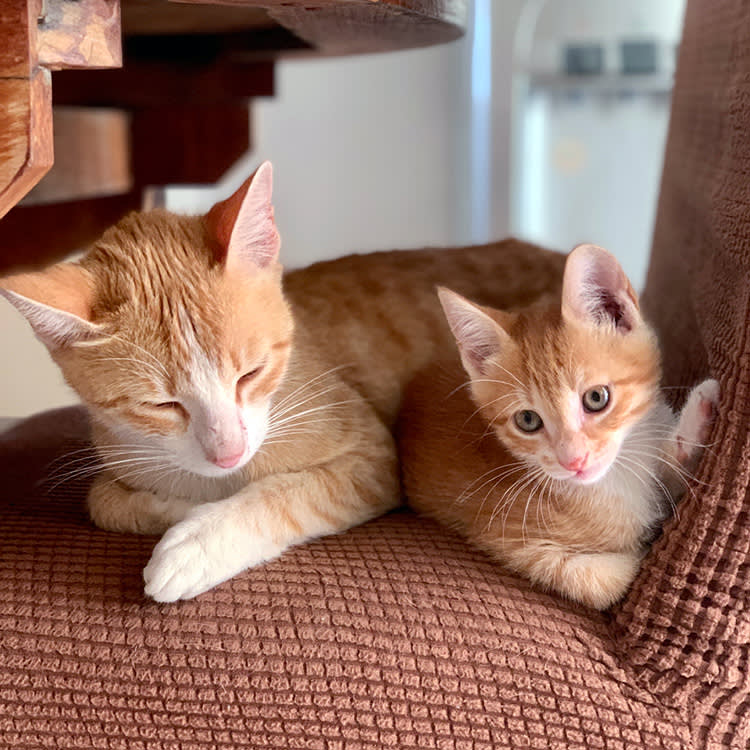
If you have ever fostered a bottle-baby, you have almost certainly told yourself the comforting thing: at least she has her brother. At least they have each other.
A study of 62 kittens says that comfort is misplaced. Not that siblings are bad, they are not, but that on the specific thing you were hoping they would fix, coping with stress, they appear to do nothing at all.
That finding has a direct, practical consequence for anyone who fosters, adopts, or rehomes kittens, and it is not the one most people take away from a headline about kittens needing their moms.
The study
Researchers compared three groups of kittens: those raised by their mothers, those hand-raised by humans alongside littermates, and those hand-raised alone as singletons.
An important note first, because people worry about it: no kitten was deliberately orphaned for this research. The orphaned kittens in the study were orphaned by bad luck, not by design, and all of them were adopted into homes afterwards.
All 62 kittens were given three behavioral tests at nine weeks of age. In every one of them, the orphans behaved differently from the mother-reared kittens.
The handling test
A person stroked the kitten three times, then picked her up and held her, either until she started to struggle or for 30 seconds, whichever came first. The measure was how long it took her to start struggling.
Orphaned kittens started struggling sooner.
The test was deliberately run in the kitten’s own living space, so that the stress of an unfamiliar room and extra handling did not contaminate the result. The difference showed up anyway.
The separation and confinement test
Each kitten was put into a carrier, alone, in a room by herself, for five minutes, and filmed.
Orphaned kittens could not settle. They vocalized more, and they started vocalizing sooner. They were more active throughout. They spent more time pawing at the walls of the carrier.
This is the test that most closely resembles a real thing that is about to happen to that kitten: the carrier ride to the vet, the carrier ride to a new home, the night alone in an unfamiliar room.
The food defense test
Each kitten was given a bite-sized piece of meat, and then a researcher tried to take it back with tongs.
Here the picture is more nuanced, and it is worth being precise. Orphaned kittens who had been raised with littermates started eating the meat sooner than the other kittens. But they were not more defensive or more aggressive about the theft. Across all groups, there was no difference in hissing, growling, stomping, or swiping.
So the “orphan kittens become food-aggressive” folk belief did not appear. What appeared was a kitten who ate faster.
The finding people skip
Now put the three tests together, because the pattern is the point.
Orphaned kittens showed a heightened stress response. And having siblings did not protect against it. The kittens hand-raised with littermates were not meaningfully better off, on these measures, than the kittens hand-raised alone.
That is the sentence worth sitting with, because it quietly demolishes the reassurance every foster tells themselves.
Being orphaned is a form of social isolation, and it is a specific one. What the mother provides in those weeks is apparently not simply company. It is something else, something regulatory, and a sibling of the same age with the same total lack of experience cannot supply it.
Foster carers apologise to me for the kitten being ‘a bit dramatic’ in the carrier, and half the time that kitten was hand-raised. She isn’t dramatic. Nobody ever taught her nervous system how to come back down, because the animal whose job that was wasn’t there.
To be fair to siblings, the researchers are careful here. Littermates may well help in ways this study did not measure: learning play skills, learning bite inhibition, learning the social vocabulary of being a cat. Nobody is saying to separate them. The claim is narrower and more useful. On the ability to handle stress, siblings are not a substitute for a mother.
What we still don’t know
This was a snapshot at nine weeks. It tells you nothing about what these kittens are like at two, or five.
Do orphaned kittens remain more reactive for life? Do they compensate? Does a well-run foster environment close the gap by adulthood? Nobody knows yet, and the researchers say plainly that more work is needed on the long-term effects.
That uncertainty cuts both ways, and it is worth saying out loud if you have just adopted a bottle-baby and are now anxious. This is not a diagnosis. It is a nine-week-old kitten with a measurably shorter fuse in a carrier. It is not a prophecy about the cat she will be.
What to actually do about it
The value of this research is that it converts fairly directly into practice.
Do not take kittens from their mothers early. This is the headline instruction and it is aimed squarely at anyone rehoming a litter. Every week with mom is doing something you cannot replicate with a bottle and a blanket. Rushing adoption because homes are waiting is a false economy paid for by the kitten.
Where possible, use a surrogate. The single best intervention for a genuinely orphaned litter is to place them with an unrelated nursing queen. Rescues that maintain a network of nursing foster mothers are doing something better than kindness. They are doing the thing the study says actually works.
If you are hand-raising, mimic a mother, not a bottle. Feed on a schedule rather than on demand-chaos. Handle them the way a queen would: frequent, brief, physical, matter-of-fact contact, not long anxious cuddles. Groom them. Move them.
Limit isolation aggressively. Isolation is the mechanism. Time alone is the thing to minimize, and that includes the hours in a quiet room while you are at work.
Assume the carrier is worse for this kitten. If you have an orphan, start carrier work early and slowly: the carrier lives out in the room, it has a blanket, she eats in it, and nothing bad ever happens in it. She is starting from a worse baseline than a mother-reared kitten, so she needs more of the work, not less.
Tell the adopter. If you are rehoming an orphan, say so, and say what it means. An adopter who knows their kitten has a shorter fuse under stress will read her behavior correctly and be patient with it. An adopter who does not will conclude the cat is difficult.
What this fits into
The broader body of work on early feline development keeps landing in the same place. The window that shapes a cat’s temperament is short, it runs roughly from two to seven weeks, and it is largely closed before most kittens ever meet their owner. Kittens handled by several different people in that period grow into adults who are markedly friendlier to strangers. Kittens who miss the window show consistent fear of new things by three months.
This study adds the maternal dimension to that picture, and it is the piece that has been missing. It is not only exposure to humans that matters in those weeks. It is the presence of the mother, and whatever she is doing, minute to minute, that teaches a nervous system how to settle.
Rescue does extraordinary work with orphaned kittens under impossible conditions, and this is not a criticism of it. It is a specific instruction to it: if you can find that litter a nursing queen instead of a bottle, find her.
References
- Ahola, M.K., Vapalahti, K., Lohi, H. “Early weaning increases aggression and stereotypic behaviour in cats.” Scientific Reports, vol. 7, 2017, 10412.
- Casey, R.A., Bradshaw, J.W.S. “The effects of additional socialisation for kittens in a rescue centre on their behaviour and suitability as a pet.” Applied Animal Behaviour Science, vol. 114, no. 1–2, 2008, pp. 196–205.
- Chon, E., et al. “Behavioural differences between orphaned and mother-reared kittens at nine weeks of age.” Applied Animal Behaviour Science, 2024.
- American Association of Feline Practitioners. “AAFP Feline Behavior Guidelines.” AAFP, 2022.
- Quimby, J., Gowland, S., Carney, H.C., et al. “2021 AAHA/AAFP Feline Life Stage Guidelines.” Journal of Feline Medicine and Surgery, vol. 23, no. 3, 2021, pp. 211–233.
Dr. Solis is a board-certified veterinary dermatologist with over twelve years of clinical experience. She advises on skin conditions, allergies, and grooming practices that affect coat and skin health. All dermatology and allergy content at The Pet Times is reviewed by her team before publication.
Meet our experts ↗Keep reading
 Training'My Cat Doesn't Like to Play' Is Almost Always a You ProblemDr. Lena Park · 8 min
 TrainingKitten Biting Has a Closing Window. This Is What You Do in It.Dr. Amara Solis · 6 min
 First DaysYour Older Cat Doesn't Hate the Kitten. It Hates the Energy.Dr. Priya Nair · 7 min
 TrainingYour Kitten Isn't Kissing You. It's Filing You Under 'Family.'Dr. Amara Solis · 7 min
 First DaysYour New Cat Isn't Aloof. They're Running a Background Check.Dr. Nina Kohl · 8 min
 First DaysTake a Kitten Home Too Early and You'll Pay for It for 15 YearsDr. Lena Park · 10 min