


'My Cat Doesn't Like to Play' Is Almost Always a You Problem
The cat isn't broken and the toy isn't wrong. Most cats who 'won't play' are being handed a solo toy and left to entertain themselves. Here's how to run play the way a cat's hunting brain actually wants it, so play stops being optional and starts being enrichment.

Affiliate disclosure. This article contains affiliate links. We may earn a small commission if you buy through a link, at no extra cost to you. How we handle recommendations.
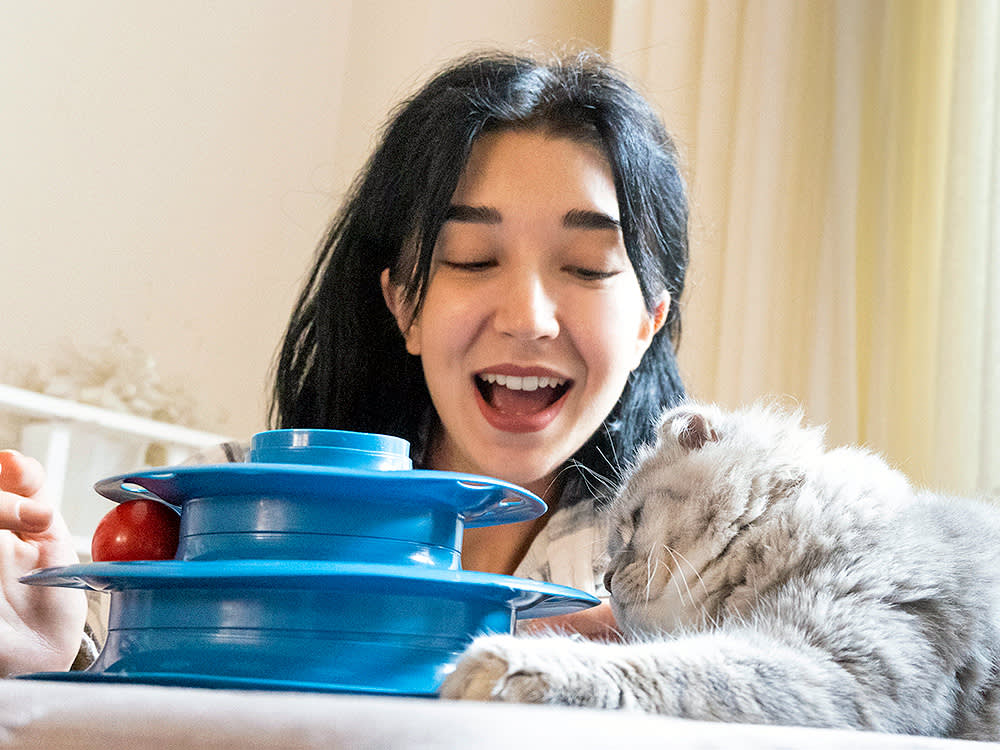
Somewhere out there is a cat owner insisting their cat just isn’t playful. They bought the little mouse, they tossed it across the floor, the cat watched it slide to a stop and walked away. Case closed: this cat doesn’t play.
The cat plays fine. What’s missing is the other half of the game. Behavior consultants who work with new cat owners hear the same line constantly, “oh, he doesn’t like to play,” and it almost always turns out that the person either didn’t recognize their cat’s play, or didn’t know how to start it. Play is not a personality trait some cats lack. It’s a skill the human usually hasn’t learned yet. Here’s how to learn it.
Play is a need, not a bonus
Start by reframing what play is for. It’s easy to treat it as optional entertainment, scoop the litter, put down food, and figure the cat is fine. But play sits right alongside the other instinctive needs: it ranks with a surface to scratch, a full food bowl, and a clean box to use. It delivers exercise, mental stimulation, and the social interaction cats genuinely thrive on, and skimping on it is a common hidden driver of behavior problems.
Cats do four kinds of play: locomotive play (running, leaping, climbing), predatory play (the stalk-chase-pounce sequence), object play (batting things around), and social play (roughhousing with other cats). A well-played-with cat gets outlets for all four. A bored one turns your curtains, your ankles, and your 3 a.m. into the outlet instead.
The one fix that changes everything: be the prey
Here is the single biggest misunderstanding about cat play. People buy solo-play toys, the little mice, balls, and spring coils, and assume the cat will hunt them. But a solo toy just sits there. To a hunting cat, that’s not prey; prey moves, and moves unpredictably, trying not to die.
Real hunting is the cat reacting to something alive and evasive. When you pick up a wand or teaser toy and animate it yourself, you become the puppet master, and you can give the toy exactly the darting, freezing, hiding behavior that a mouse or bird would have. That unpredictability is the whole point, and it’s what a self-propelled toy or a rolling ball can never replicate. Solo toys still have a place, they’re fun, and they’re useful for kittens burning energy, but they are not the type of play cats most benefit from. Interactive play that mimics the hunt is.
The mechanics are simple once you know them: move the toy away from your cat, not at them. Prey flees; it doesn’t charge. Let it skitter under a chair, pause, twitch, and bolt. Your cat’s eyes will lock on, their body will drop, and the animal you were told doesn’t play will be mid-stalk within seconds. A basic wand toy is all the equipment you need.
Let them win
There’s one more piece people miss: let your cat actually catch the toy. A hunt that never ends in a capture is just frustration on a loop. Build the chase, then let your cat pounce and pin the toy several times across a session, and finish on a successful catch. That completed hunt sequence is what leaves a cat satisfied rather than wound up, and it’s often the difference between a cat who settles afterward and one who redirects that pent-up drive onto your hands.
Kittens are a different, wilder animal
If you have a kitten, everything above goes double, because kittens are bananas. They have far more energy than adults and a much stronger drive to chase anything that moves, because they’re at the life stage where they’re perfecting their hunting skills. Nine times out of ten, a new kitten owner’s complaint is that the cat is “too wild,” scaling the curtains, ambushing hands and feet. That’s developmentally normal, not naughty.
But it’s also the window where bad habits form, so it matters how you channel it. You do not want a kitten learning that hands, feet, and eyelashes are legitimate prey. When a kitten winds up and lunges at you, don’t offer petting into that energy; instead let the cat come to you for affection when they’re calmer, and when they’re clearly in a wild mood, redirect it onto an interactive toy or a kicker toy they can bite and bunny-kick to their heart’s content. The message is “not my hand, this instead.”
Kittens also need more social play than a single household can always provide, which is a real argument for adopting two. Social play is the earliest form of play kittens show, kicking off the moment their eyes open and they begin tumbling with littermates, and it peaks around four months of age. Since most shelters place kittens at eight to twelve weeks, a solo kitten lands in a new home right in that peak social-play window without a playmate, and you become the stand-in.
Keep it safe
More play does not mean more gadgets. The toys least likely to hurt a cat are the plainest ones. Cheap and simple wins here: cut-up toilet paper rolls, ping-pong balls, and wine corks are reliably safe, roughly the right size, and have no dangling parts to swallow. Watch out for anything with ribbons, strings, or glued-on “eyes” a cat can chew off and choke on.
Anything with a string, wire, or long handle, which is to say most wand toys, should only be out while you’re actively playing and holding it. The moment play is over, put it completely away, out of reach. An unsupervised string toy is a swallowing hazard, and swallowed string is a genuine emergency. Play hard, then pack it up.
What newer research adds
The case for daily interactive play got a striking boost from research on cats and wildlife. In a study of pet cats that roamed outdoors, owners who added just five to ten minutes of daily object play, the wand-and-pounce kind, saw their cats bring home markedly fewer hunted animals, on the order of a 25 percent reduction, apparently because the play satisfied the same predatory drive. Whether or not your cat goes outside, the finding underlines the point: play isn’t burning off surplus energy, it’s meeting a real hunting need, and a met need is a calmer cat.
It’s also worth knowing that in controlled tests, many cats actually prefer social interaction with people over food or toys when given the choice, which quietly demolishes the “cats are aloof and self-sufficient” story. The cat who “doesn’t play” is frequently a cat waiting for their person to pick up the other end of the toy. For a deeper playbook, the behaviorist Mikel Delgado’s book Play With Your Cat! is an accessible, science-based guide built around exactly this interactive-play approach.
When a client tells me their cat won’t play, I don’t hand them a new toy, I hand them the toy they already own and show them how to move it. The cat was never the problem. Once people stop rolling a ball and start making a wand behave like a terrified mouse, letting the cat catch it now and then, I watch ‘unplayful’ cats turn into hunters in about ten seconds. Play is a conversation, and the human has to speak first.
Your cat wants to play. They’re just waiting for you to become the prey.
References
- Cecchetti, M., Crowley, S. L., Goodwin, C. E. D., & McDonald, R. A. (2021). Provision of food and object play reduces predation of wild animals by domestic cats. Current Biology, 31(5), 1107–1111.
- Vitale Shreve, K. R., Mehrkam, L. R., & Udell, M. A. R. (2017). Social interaction, food, scent or toys? A formal assessment of domestic pet and shelter cat preferences. Behavioural Processes, 141, 322–328.
- Delgado, M. (2023). Play With Your Cat!: The Essential Guide to Interactive Play for a Happier Feline. TarcherPerigee.
Common questions
My cat ignores toys. Does that mean they don't like to play?
Usually not. It means the toy is being left to move itself. Cats are wired to chase prey that behaves like prey, moving unpredictably, darting, and hiding. Pick up a wand toy and animate it like a scared mouse or bird, and most 'uninterested' cats switch on fast.
How much play does a cat need?
Aim for a couple of interactive sessions a day of roughly 10 to 15 minutes each, more for kittens, who have enormous energy and are perfecting their hunting skills. Play is a genuine need, on the level of scratching, food, and a clean litter box, not a nice-to-have.
What are the safest cat toys?
The safest toys have the fewest bells and whistles. Ping-pong balls, wine corks, and cut-up toilet paper rolls are cheap and reliable. Anything with strings, wires, or glued-on parts should only come out under supervision and be put completely away afterward.
Should I get one kitten or two?
If you can, two. Social play is the earliest form of play kittens do and it peaks around four months of age. A solo kitten going into a home during that window loses their built-in playmate, and the human has to fill that role much more actively.
Dr. Park is a board-certified emergency and critical care specialist. She reviews our health and safety content for clinical accuracy and contributes guides on recognising urgent conditions. Her focus is helping owners act quickly and correctly when it matters most.
Meet our experts ↗Keep reading
 TrainingThe Cat Your Kitten Becomes Is Mostly Decided by Week SevenDr. Nina Kohl · 7 min
 TrainingKitten Biting Has a Closing Window. This Is What You Do in It.Dr. Amara Solis · 6 min
 TrainingLittermates Don't Replace a Mother Cat. The Study Is Blunt About It.Dr. Amara Solis · 6 min
 TrainingYour Kitten Isn't Kissing You. It's Filing You Under 'Family.'Dr. Amara Solis · 7 min
 First DaysYour Older Cat Doesn't Hate the Kitten. It Hates the Energy.Dr. Priya Nair · 7 min
 First DaysBy the Time Your Cats Are Hissing, You Blew the Introduction Three Steps AgoDr. Mara Chen · 9 min