


Your New Kitten Will Bond With You. It's the Other Pets You Have to Win Over
The hard part of a new kitten isn't getting the kitten to love you, it's the resident cat hissing through the door. A behaviorist and a vet on the socialization clock and a room-by-room introduction plan.

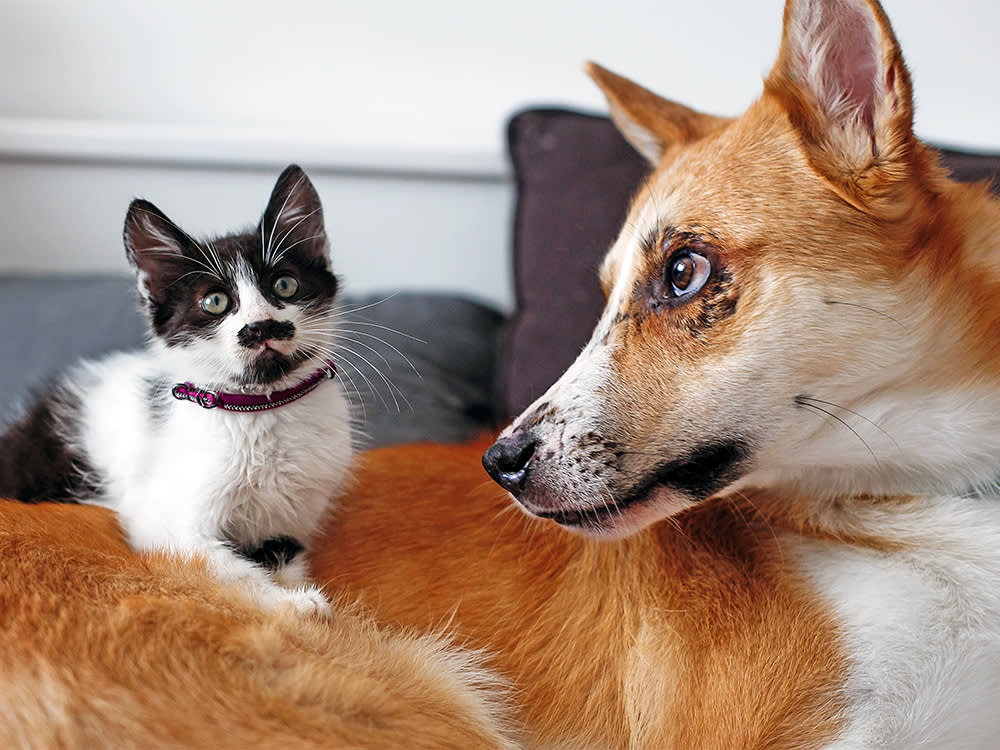
Almost everyone bringing home their first kitten worries about the same thing: will this tiny creature love me? It is the wrong thing to worry about. A kitten whose food, warmth, and play come from you will attach to you fast, often within days. The genuinely hard part of a new kitten, the part that makes people call a behaviorist weeks later, is the animal already living in your house, the one planted on the far side of a closed door with their tail puffed to twice its size, vibrating with indignation.
So this is not really a guide to making a kitten like you. That mostly takes care of itself. It is a guide to two things that do not: managing the resident pets who did not ask for a roommate, and reading the developmental clock that decides how much social runway your particular kitten has left. Get those right and the bonding you were anxious about happens almost on its own.
First, the clock nobody tells you about
Kittens are not blank slates you can socialize on any schedule you like. There is a biological window, and it is startlingly early. The most sensitive period for socialization runs from roughly two to seven weeks of age, with a softer secondary window extending to about 14 to 16 weeks. Whatever a kitten meets calmly during that stretch, people, dogs, vacuum cleaners, car rides, gets filed away as normal and safe for life. Whatever they miss can read as threatening later.
That single fact reframes the kitten in front of you. If you adopted a confident eight-week-old who came from a foster home full of handling, the hard socialization work is largely done, and your job is mostly not to undo it. If you took in a feral-born kitten who never met a friendly human hand during those weeks, you are working uphill, and the clock matters.
“Watch a litter in a shelter kennel. If they’re tumbling over each other happily but freeze the instant a person leans in, back off, or start hissing, that’s an under-socialized kitten, because they were perfectly confident until a human entered the picture,” says feline behavior specialist Sara Lim. A shy kitten who still plays happily with littermates is usually just nervous and will warm up. A kitten who shuts down specifically when a person appears is telling you the window was missed, and that you need to start building trust today, not next week.
Socialization gets harder with every week that passes. Once a kitten crosses roughly eight weeks without friendly human contact, you are no longer filling a blank page, you are gently rewriting one.
That is the line every new kitten parent should internalize. It does not mean an older or under-socialized kitten is a lost cause. It means time is a real ingredient, and the food-based trust work below is not optional for them.
The resident pets are the real project
Here is the part the cute videos skip. “Cat-to-cat introductions gone wrong are the single most common reason people call a behaviorist,” Lim says. Your kitten is not the obstacle. Your established cat, who has owned this territory for years and did not consent to a newcomer, is.
Resist every instinct to “let them work it out.” Cats are both predator and prey, and a frightened first meeting can sour a relationship permanently. Dr. Amara Solis, a feline-focused veterinarian, frames the goal in one sentence. “You are not trying to get them to like each other on day one,” she says. “You are trying to make sure nothing scary happens on day one, because cats remember scary far longer than they remember pleasant.” Build the introduction so that the first time the animals truly meet, both are already bored of each other’s smell.
That is what the room-by-room plan below is for. It is slower than most people expect, and that slowness is the whole point.
A week-by-week introduction plan
This is the structure the source advice points at but rarely lays out. Adjust the pace to the animals, faster for an easygoing household, slower if there is hissing.
-
Days 1 to 3, the safe room. Set your kitten up in one small room, a spare bedroom or even a bathroom, with food, water, a litter box, a bed, toys, and a scratching surface. “Keep the new kitten in a closed room of their own for the first several days, so feeding and any meetings stay controlled and the animals get used to each other’s smell before they ever lock eyes,” says veterinarian Dr. Amara Solis. The resident pets get the run of the rest of the house. Nobody sees anybody. This is not cruelty, it is scent and sound acclimation, the foundation everything else sits on.
-
Days 3 to 7, scent swapping. Rub a soft cloth on the kitten’s cheeks and leave it where your resident cat eats, and do the reverse. Feed both animals on opposite sides of the closed door so each starts pairing the other’s smell with the best part of their day. You want the new smell to mean dinner, not danger.
-
Week 2, see-but-can’t-touch. Crack the door behind a baby gate, or swap the animals’ rooms so each explores the other’s space without a face-to-face. Watch body language closely. “Let the animals’ reactions set the pace, not the calendar,” Dr. Solis says. “Territory runs deep in cats — a comfortable coexistence is sometimes a weeks-long project, not a weekend one.” Relaxed tails and curious sniffing mean go on. Puffed tails, flattened ears, or a low growl mean back up a step.
-
Week 3 and beyond, supervised together time. Short, calm, treat-rewarded sessions in a shared space, ending while everyone is still relaxed rather than waiting for it to go wrong. Lengthen them only as the animals stay loose. Most households land somewhere here, but some take longer, and longer is fine.
For a kitten meeting a dog, the logic is identical with one addition: the dog stays leashed and under a solid recall until they have proven, repeatedly and over time, that they treat the kitten as family and not as something to chase. “The burden of proof sits with the dog, and it takes many calm encounters over many days to meet it,” Lim says. The myth that cats and dogs are natural enemies is just that, a myth, but a kitten’s safety is not the place to take the myth’s word for it.
Drawing out the kitten who is hiding from everyone
If your kitten is hiding even after a proper separation period, do not chase reassurance, build it. The first move is containment, not coaxing. “A kitten frightened enough to hide belongs in a small, fully stocked room, a bathroom works, so they can’t vanish into the house and turn one problem into ten,” Lim says. A kitten lost behind your dryer cannot be socialized; a kitten in a stocked bathroom can.
Then make the small space a confidence gym. Lim recommends wand toys to draw out the hunter in a timid kitten, plus cozy enclosed beds to hide in and a cat tree or perch so they can feel brave from a height, alongside high-value treats. Height and hiding spots are not indulgences, they are the tools a cat uses to feel safe enough to get brave.
And for the genuinely fearful kitten, food does the heavy lifting that petting cannot. “For a kitten so under-socialized they flinch from any touch, food is the way in,” Lim says. Start at whatever distance the kitten tolerates, even feeding from a long-handled spoon, and close the gap by inches across days. If they will not eat, take the food away and try again in an hour or two. The endgame is a kitten eating off your finger. “Every lick means they’re touching the thing they’re afraid of and getting an instant reward for it, and from there you can work up to petting while they eat,” Lim says. You are not bribing the kitten. You are teaching their nervous system that your hand predicts good things.
One thing to skip entirely: swaddling a frightened kitten to “calm” them. “Wrapping up a scared kitten isn’t calming, it’s flooding, and it usually just makes them shut down,” Lim says. A still kitten is not always a calm kitten.
What bonding with you actually requires
With the hard parts handled, the bond you were worried about is almost embarrassingly simple. “A kitten bonds with the mother cat because she’s the source of food, warmth, play, and safety,” Lim says. “So become the mother cat. Be the one who reliably delivers all of it.” In practice that is three things, reliably delivered.
-
Food, and more of it than you expect. Kittens are tiny and growing fast, so ask your vet what and how much, and be ready for the answer to involve a lot. The animal you feed every day is the animal you bond with.
-
Warm places to crash. Being a kitten is exhausting. Plenty of soft, cozy spots for marathon naps tells a kitten this is a safe place to be off-guard, which is its own kind of trust.
-
Play, with you in it. Kittens do not want to play alone, they want you on the other end of the wand. The daily play session is where the relationship is actually built, not the cuddle you are hoping for at the end of it.
When to call in help
If you have worked the plan and your kitten still will not eat, stays hidden, seems frightened of everyone, or shows anything that genuinely worries you, stop troubleshooting alone. “Bring up any introduction worries at your kitten’s wellness visits, that’s exactly what those appointments are for,” Dr. Solis says. A behaviorist or your vet can spot a medical problem masquerading as fear, or fine-tune an introduction that has stalled. The families who get the happiest endings are usually the ones who asked for help one step sooner than they thought they needed to.
References
- Companion Animal Psychology. “The Sensitive Period for Socialization in Puppies and Kittens.” https://www.companionanimalpsychology.com/2017/07/the-sensitive-period-for-socialization.html. Accessed June 2026.
- VCA Animal Hospitals. “Socialization and Fear Prevention in Kittens.” https://vcahospitals.com/know-your-pet/socialization-and-fear-prevention-in-kittens. Accessed June 2026.
- Oklahoma City Animal Welfare. “Solving Aggression Between Family Cats.” https://www.okc.gov/home/showpublisheddocument/2096/635908685526700000. Accessed June 2026.
- Mikkola, Salla, et al. “Fearfulness Associates with Problematic Behaviors and Poor Socialization in Cats.” iScience, vol. 25, no. 10, 21 Oct. 2022. https://www.sciencedirect.com/science/article/pii/S2589004222015371. Accessed June 2026.
Common questions
How long does it take to bond with a new kitten?
Bonding with you is usually quick, a day or two to a couple of weeks, because kittens attach to whoever provides food, warmth, and play. Getting your kitten and your resident pets to accept each other is the slower part and can take several weeks of gradual, scent-first introductions.
Is there an age when it's too late to socialize a kitten?
The most sensitive window for socialization runs from about two to seven weeks of age, with a softer secondary window up to roughly 14 to 16 weeks. After that, socialization still works but goes slower and less predictably, which is why an under-socialized older kitten needs patient, food-based trust-building right away.
Why is my new kitten hiding from my other pets?
Hiding is a normal early fear response, not a failure. Confine the kitten to one small, fully stocked room so they can't vanish into the house, then reintroduce the other animals slowly using scent swapping, a closed door, then a baby gate or cracked door, rewarding calm behavior on both sides.
Dr. Park is a board-certified emergency and critical care specialist. She reviews our health and safety content for clinical accuracy and contributes guides on recognising urgent conditions. Her focus is helping owners act quickly and correctly when it matters most.
Meet our experts ↗Keep reading
 First DaysOne Kitten Is Harder Than Two. Here's Why.Dr. Mara Chen · 6 min
 Health & WellnessIf Your Kitten Hasn't Pooped in 48 Hours, Treat It as an EmergencyDr. Lena Park · 6 min
 First DaysYour Kitten's First Year Is a Series of Doors That CloseDr. Lena Park · 8 min
 TrainingYour Kitten Isn't Kissing You. It's Filing You Under 'Family.'Dr. Amara Solis · 7 min
 Health & WellnessYour Vet Injects Your Kitten in the Leg for a Reason. It Isn't Convenience.Dr. Priya Nair · 9 min
 First DaysGive Your New Cat Less House. They'll Settle Faster.Jordan Ellis · 7 min