


Your Cat's Shedding Is Telling You Something. Learn to Read It
Most cat-hair advice is about cleanup. The more useful skill is learning your cat's normal shedding baseline, so you can spot the moment shedding stops being cosmetic and becomes a health signal. A groomer and a vet on both.

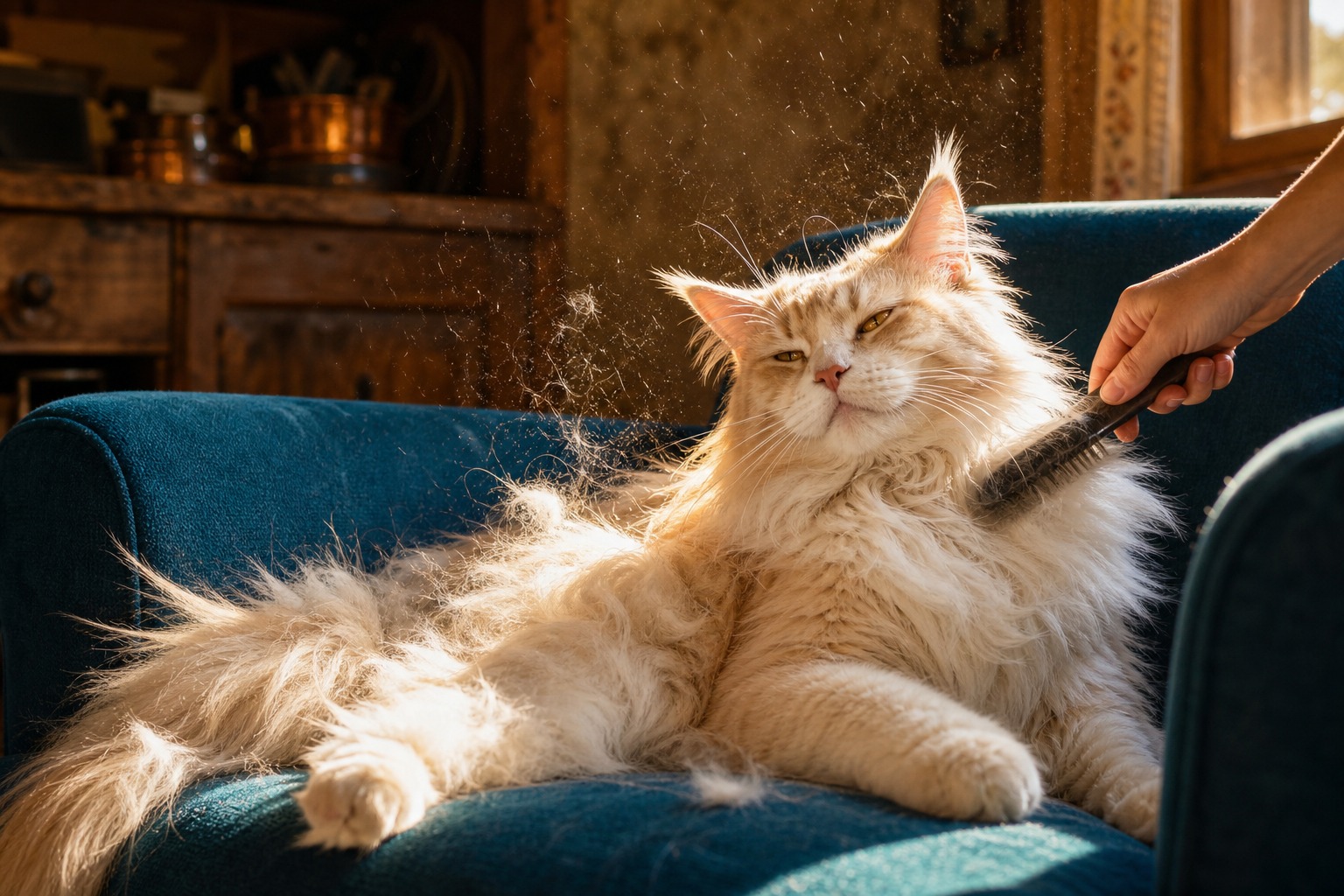
There are roughly a thousand articles about getting cat hair off your couch, and this is partly one of them. But cleanup is the least interesting thing about shedding. The more useful skill, the one almost nobody teaches, is learning to read your own cat’s shedding as a signal. A cat’s coat is a slow-moving readout of their health, their stress, and even the season, and once you know your cat’s normal, the moments when shedding breaks from that normal become one of the earliest warnings you get that something is off. So we are going to do two things here: help you manage the fur, and, more importantly, help you tell ordinary shedding apart from the kind you should act on.
First, what “normal” actually is
Cats shed to clear out dead hair and make room for new growth, the same basic process people go through. How much depends on the climate, the cat’s breed, their health and diet, and, crucially, their light exposure.
That last one surprises people. Shedding is driven by photoperiod, the amount of daylight a cat is exposed to. Outdoor cats read the lengthening and shortening days and shed hardest during the spring and fall transitions, bulking up a winter coat and dropping it again for summer. Indoor cats live under artificial light and climate control that never really changes, so their bodies lose the seasonal signal and many of them shed at a low, steady rate all year instead of in big seasonal pushes. If your indoor cat seems to shed constantly rather than in bursts, that is not a malfunction. It is your lighting flattening a cycle that would otherwise have peaks and valleys.
Knowing your cat’s baseline is the whole game. A moderate, even, year-round shed with healthy skin underneath is normal. What matters is noticing when that pattern changes.
The line between shedding and a red flag
Here is where reading the signal pays off. Ordinary shedding drops loose hair fairly evenly across the body and leaves smooth, healthy skin behind. Trouble looks different, and it is usually one of two things.
The first is patchy or symmetrical hair loss. Bald spots, thinning patches, or hair loss that shows up in a mirror-image pattern, often on the belly, the inner legs, or the base of the tail, is not shedding. Symmetrical loss on easy-to-reach areas is a classic sign of overgrooming, sometimes stress-driven (a condition called psychogenic alopecia), and sometimes the result of an allergy that makes the skin itch. Flea and environmental allergies are among the most common reasons a cat licks and chews itself thin.
The second is heavy shedding that comes with anything else wrong: itching, scabs, redness, scaling, dandruff, a bad smell, or changes in weight, appetite, or behavior.
A few fine hairs coming loose is completely normal. What is not normal is constant scratching, digging at the skin, clumps coming out, or bald patches. Heavy shedding paired with skin changes can point to allergies, parasites, or an internal problem like kidney, liver, or thyroid disease. When the pattern breaks, that is your cue to call the vet, not the vacuum.
So the rule is simple: even shedding with good skin is a housekeeping issue, but changed shedding, patchy loss, or shedding plus any skin or whole-body symptom is a medical question.
The hairball is part of the same story
Shedding and hairballs are directly linked, because a cat swallows loose fur every time they groom, and more loose fur means more of it collecting in the stomach. That connection also gives you another readout. An occasional hairball, once or twice a month at most, is normal. A cat producing hairballs weekly, or multiple times a week, is either shedding more than their grooming can keep up with or grooming excessively, and either way it is worth attention. And retching or gagging that produces no hairball at all, especially alongside a poor appetite or lethargy, is a reason to see a vet promptly rather than write it off as a routine hairball.
Now the management part
Once you are confident the shedding is the ordinary kind, here is how to keep it under control.
Regular brushing is the single most effective move, and it does double duty: it removes loose hair before your cat swallows it, which cuts down on both hairballs and the fur you scrape off the carpet. Some cats love it; if yours turns brushing into a wrestling match, try mellowing them out first with a little catnip, and keep sessions short and positive.
Bathing helps in specific cases rather than as a routine. An older cat who can no longer keep up with grooming, or a cat with a skin condition or allergy, may benefit from the occasional bath to loosen trapped hair and prevent matting, often on a vet’s recommendation. A healthy self-grooming cat does not need regular baths.
Professional grooming is genuinely worthwhile, especially for longhaired cats and overweight cats who cannot physically reach parts of their body.
“Keeping up a grooming routine heads off matting, dander, and dried-out skin, along with the irritation and infection those can bring on,” says Pet Times veterinarian Dr. Lena Park. “It is especially valuable for longhaired breeds, overweight cats who cannot reach certain spots, and outdoor cats who track in debris or pick up parasites. A groomer will also flag skin problems you might miss under all that coat.”
And the fur that is already everywhere
For the hair that has already colonized your home: vacuum often, ideally with a machine built for pet hair, and cut down on floor clutter, since nooks and corners are prime fur traps. Static makes hair cling, so an anti-static spray, a squeegee, and a rubber carpet broom all earn their place. And a genuinely useful trick, dry air makes cat hair stick stubbornly to surfaces, so run a humidifier or lightly mist a fur-covered spot with a spray bottle before wiping; the slightly damp hair lifts away far more easily.
The gear keeps getting better, self-emptying pet vacuums and undercoat de-shedding brushes are now standard recommendations, but the core skill has not changed. Know your cat’s normal, brush to stay ahead of it, and treat any break in the pattern as information worth acting on.
References
- “Feline Behavior Problems: Destructive Behavior and Grooming.” Cornell University College of Veterinary Medicine, Cornell Feline Health Center. https://www.vet.cornell.edu/departments-centers-and-institutes/cornell-feline-health-center
- “Alopecia (Hair Loss) in Cats.” VCA Animal Hospitals. https://vcahospitals.com/know-your-pet/hair-loss-alopecia-in-cats
- “Hairballs in Cats.” Cornell Feline Health Center, Cornell University College of Veterinary Medicine. https://www.vet.cornell.edu/departments-centers-and-institutes/cornell-feline-health-center/health-information/feline-health-topics/hairballs
Not a substitute for your vet. Our guidance is educational. For urgent symptoms, contact a vet or emergency clinic right away. Editorial standards
Claire Sutton writes about life with pets, from the first days home to the small daily routines that make a household work. Her reporting spans people-and-pet relationships, training basics, and the practical side of bringing a new animal into the family.
Meet our experts ↗Keep reading
 Health & WellnessA Cat's Tongue Cannot Do This: When Grooming Stops Being OptionalLeila Torres · 6 min
 Health & WellnessYour Cat Grooms for Hours, and Cleaning Is the Smallest Reason WhyDr. Priya Nair · 7 min
 Health & WellnessThe Secret to Bathing Your Cat: Almost Never Do ItLeila Torres · 7 min
 Health & WellnessYour Cat's Itch Isn't the Problem. Not Knowing Why IsDr. Nina Kohl · 9 min
 Health & WellnessWhy the Cat Pee Smell Keeps Coming Back (and How to Actually Kill It)Sara Lim · 17 min
 Health & WellnessThat Mat in Your Cat's Fur Is Hurting Them. Don't Reach for Water.Dr. Priya Nair · 7 min