


Your Cat Grooms for Hours, and Cleaning Is the Smallest Reason Why
That endless licking looks like fussy tidiness. It's actually a cooling system, a scent network, a self-soothing ritual, and sometimes the only sign your cat is in pain. Here's how to read it.

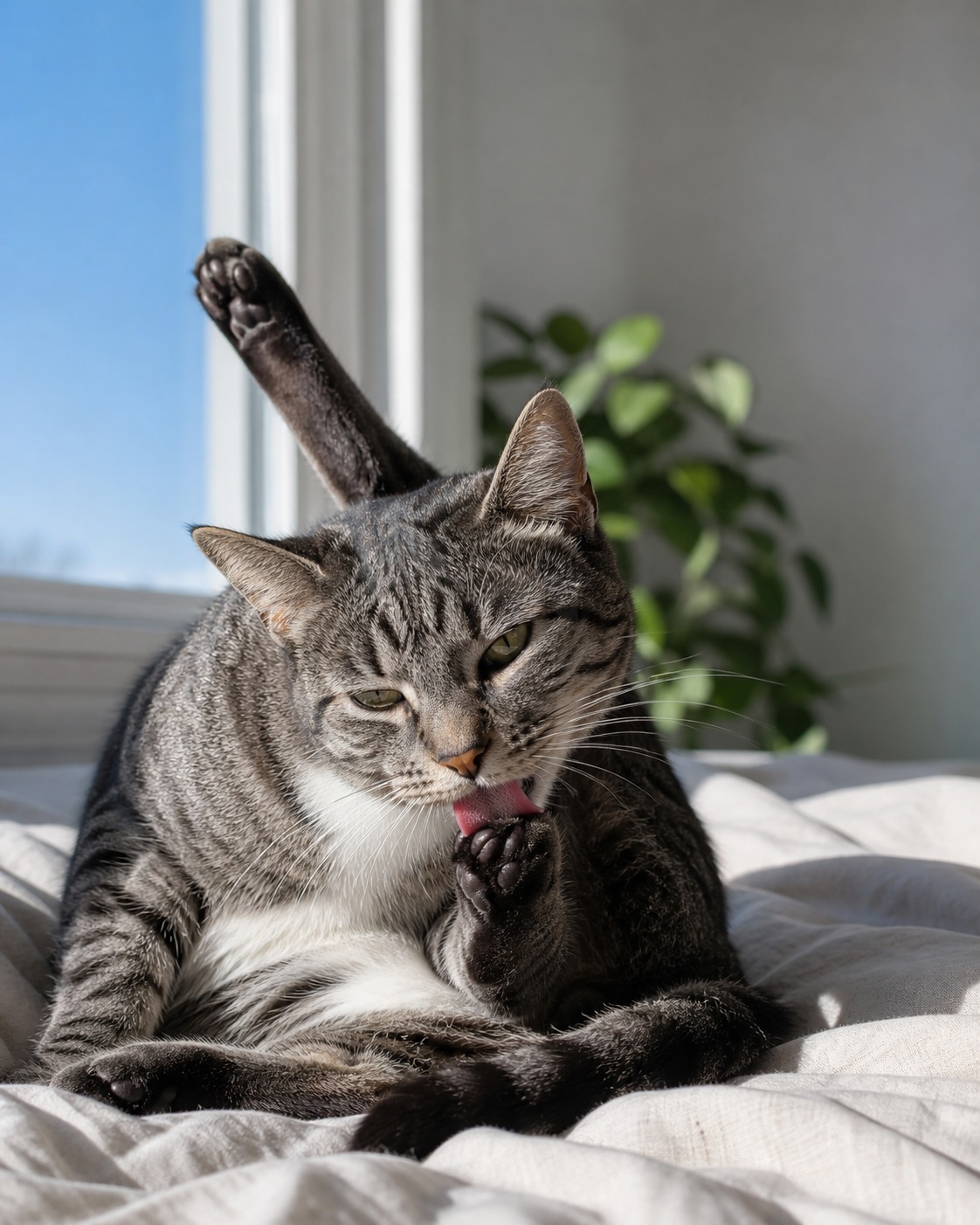
Picture your cat mid-groom: one back leg hoisted skyward, tongue working over a toe, the whole performance so routine you barely notice it anymore. It reads as vanity, or maybe mild neat-freak energy. The reality is stranger and more useful. Staying clean is on the list of reasons cats groom, but it’s near the bottom. What’s really happening is closer to a cat running several body systems at once, using the most specialized tool it owns.
Understanding that changes how you read the behavior, because the same licking that’s totally healthy on Monday can be the loudest thing your cat says about pain on Friday. The trick is knowing which is which.
The tongue is doing more than you think
Start with the equipment, because it explains a lot. A cat’s tongue isn’t a soft mop. It’s carpeted with hundreds of tiny, backward-facing spines called filiform papillae, each made of keratin, the same material as your fingernails. For years these were assumed to be simple scrapers. Then a 2018 study published in PNAS looked closer and found something more elegant: each spine has a scoop-shaped hollow at its tip that wicks saliva out of the mouth and carries it deep into the fur, right down to the skin.
That single design detail unlocks why grooming does so much. Every lick deposits saliva that isn’t just cleaning; it’s spreading moisture where it’s needed. And grooming isn’t only tongue work. Cats also use their teeth to nibble at spots the tongue can’t manage well, chewing at a claw to shed the dry outer sheath or working between the toes to pull out trapped debris. It’s a full toolkit, not a one-note habit.
The jobs grooming quietly handles
Once you see grooming as maintenance rather than fussiness, the range of what it accomplishes comes into focus.
It runs the cooling system. Cats can’t sweat their way to a comfortable temperature the way we do. Instead, they lay down saliva across their fur, and as it evaporates it pulls heat away, especially with a little air moving over the coat. That PNAS work found the effect is real and substantial, with each lick delivering a meaningful chunk of the cooling a cat needs. On a hot day, a grooming cat is partly a cat air-conditioning itself.
It maintains the coat and skin. Loose fur, if it isn’t removed, mats and builds up. Cats shed skin cells constantly, just like we do, but their skin is buried under fur, so the dead cells can’t simply flake away. Grooming lifts out that loose fur and skin, and it drags natural oils along the length of each hair, which keeps the coat conditioned, wards off painful mats, and moisturizes the skin underneath.
It soothes. In the same way a stressed person might rub their hands together or hug themselves, a cat may groom to calm down. It’s a self-comforting loop that traces all the way back to kittenhood, when a mother’s licking was the cat’s first experience of feeling safe. That’s part of why a cat in pain or fear often reaches for the same behavior.
It’s a social currency. Cats don’t only groom themselves. They groom other cats, other pets, and their people, and sometimes even blankets. This kind of licking is usually not about dirt at all. It’s about scent. When cats groom each other, a behavior called allogrooming, they blend their smells into a shared group scent that marks who belongs, who’s safe. Occasionally there’s a status note in it too, the way an older sibling might pin down a younger one and groom them whether they like it or not.
It cleans wounds, for better and worse. Cats instinctively lick injuries, and there’s some logic to it: their saliva carries mild antibacterial properties and the licking clears away blood and debris. But it’s a wash at best and often a net negative. A cat’s mouth is full of bacteria, and that sandpaper tongue keeps a wound wet and irritated exactly when it would heal faster dry and scabbed over. If your cat has a wound, licking is usually working against it.
Where healthy grooming crosses a line
Here’s the part worth committing to memory, because it’s where grooming stops being charming and starts being a message.
The single most important thing to know is that intense, focused licking is one of the few ways a cat signals pain. Cats are stoic to a fault, and a cat who hurts will often lick the spot that hurts, whether it’s a sore joint, a broken bone, an impacted anal gland, an itchy patch of allergic skin, or anything else that feels wrong. Sometimes that licking is the only outward clue you get.
Beyond pain, grooming can tip into a genuine compulsion, usually called overgrooming, where it stops serving any purpose and becomes an outlet for overwhelming stress or anxiety. This is different from the ordinary self-soothing lick. It has an obsessive, can’t-stop quality to it.
Two tests separate normal grooming from the kind that needs attention:
- Is it causing damage? Watch for hair loss in the groomed area, and in more serious cases raw or open sores from constant licking. A healthy grooming session doesn’t leave a mark.
- Can you interrupt it? If it’s easy to catch your cat’s attention and pull them into something else, that’s normal. If they won’t be distracted, or you interrupt them and they immediately return to the same patch, that’s a compulsive pattern.
A cat crossing either line is telling you they’re in significant pain or distress, and they need help sooner rather than later.
Cats are experts at hiding when something’s wrong, so I’ve learned to treat sudden overgrooming as a symptom until proven otherwise. Before we ever call it a stress habit, I want to rule out the physical stuff, because a cat that’s suddenly obsessed with one patch of skin is very often telling you that exact spot hurts.
What to do when grooming looks obsessive
The first move is a vet visit, not a behavior plan. Overgrooming so often traces back to a medical cause that skipping this step means potentially leaving your cat in pain. Take a video of the behavior before you go, so your vet can see the precise area and your cat’s body language while it happens. Note anything else that’s shifted lately, less play, more or less appetite, poor sleep, withdrawal, since those details help point toward a diagnosis. Cats hide illness well enough that it sometimes takes more than one visit, and a bit of advocacy on your part, to get to the bottom of it.
Only once medical causes are ruled out does anxiety become the leading suspect. If you can identify a specific trigger, remove it, or help your cat build a calmer association with it over time. A certified feline behavior consultant can be genuinely useful here, tracing triggers and building a plan to lower your cat’s stress overall. And the everyday tools matter: hunting-style play sessions, mental enrichment, and more bonding time all take the pressure down.
The short version
Your cat isn’t obsessed with being clean. The licking cools them, conditions their coat, calms their nerves, and stitches them into the social fabric of your home, all through a tongue that’s a small marvel of engineering. Cleaning is almost a side effect. Keep that in mind, and the day the grooming turns frantic or lands on one spot and won’t move, you’ll recognize it for what it is: not tidiness, but your cat asking for help.
References
- Noel, A. C., and Hu, D. L. “Cats Use Hollow Papillae to Wick Saliva into Fur.” Proceedings of the National Academy of Sciences, 2018. https://www.pnas.org/doi/10.1073/pnas.1809544115
- Cornell Feline Health Center. “Feline Behavior Problems: Destructive and Compulsive Behavior.” Cornell University College of Veterinary Medicine. https://www.vet.cornell.edu/departments-centers-and-institutes/cornell-feline-health-center
- International Cat Care. “Grooming and Hairballs in Cats.” https://icatcare.org/advice/
Common questions
Is it bad if my cat licks a wound?
Usually, yes. Cat saliva has mild antibacterial properties, but a cat's mouth is also full of bacteria, and the rough tongue keeps a wound wet and irritated when it needs to dry and scab. Licking a wound tends to do more harm than good.
How do I know if my cat is overgrooming?
Two signs stand out: the grooming is causing visible harm, like thinning fur or bald patches and sometimes open sores, and you can't easily distract your cat out of it. Healthy grooming stops when something more interesting comes along. Compulsive grooming doesn't.
Should I take my cat to the vet for overgrooming?
Yes, start there. Overgrooming is very often a pain signal, and pain is something only a vet can rule out. Bring a video of the behavior so they can see exactly where and how your cat is licking.
Not a substitute for your vet. Our guidance is educational. For urgent symptoms, contact a vet or emergency clinic right away. Editorial standards
Dr. Nair is a veterinarian focused on diet and feeding. She covers everyday nutrition, treats, and the many "can they eat this?" questions owners ask, grounding each answer in what is actually safe and sensible for dogs and cats.
Meet our experts ↗Keep reading
 Health & WellnessYour Cat's Itch Isn't the Problem. Not Knowing Why IsDr. Nina Kohl · 9 min
 Health & WellnessYour Cat's Shedding Is Telling You Something. Learn to Read ItClaire Sutton · 5 min
 Health & WellnessA Cat's Tongue Cannot Do This: When Grooming Stops Being OptionalLeila Torres · 6 min
 Health & WellnessWhy the Cat Pee Smell Keeps Coming Back (and How to Actually Kill It)Sara Lim · 17 min
 LivingLong Hair Is the Least Important Thing About a Long-Haired CatDr. Amara Solis · 10 min
 Health & WellnessThat Mat in Your Cat's Fur Is Hurting Them. Don't Reach for Water.Dr. Priya Nair · 7 min