


A Cat's Tongue Cannot Do This: When Grooming Stops Being Optional
Self-cleaning is a myth with limits. Here is what a professional bath removes that a tongue never can, which cats actually need one, and how to vet a groomer so the appointment stays safe.

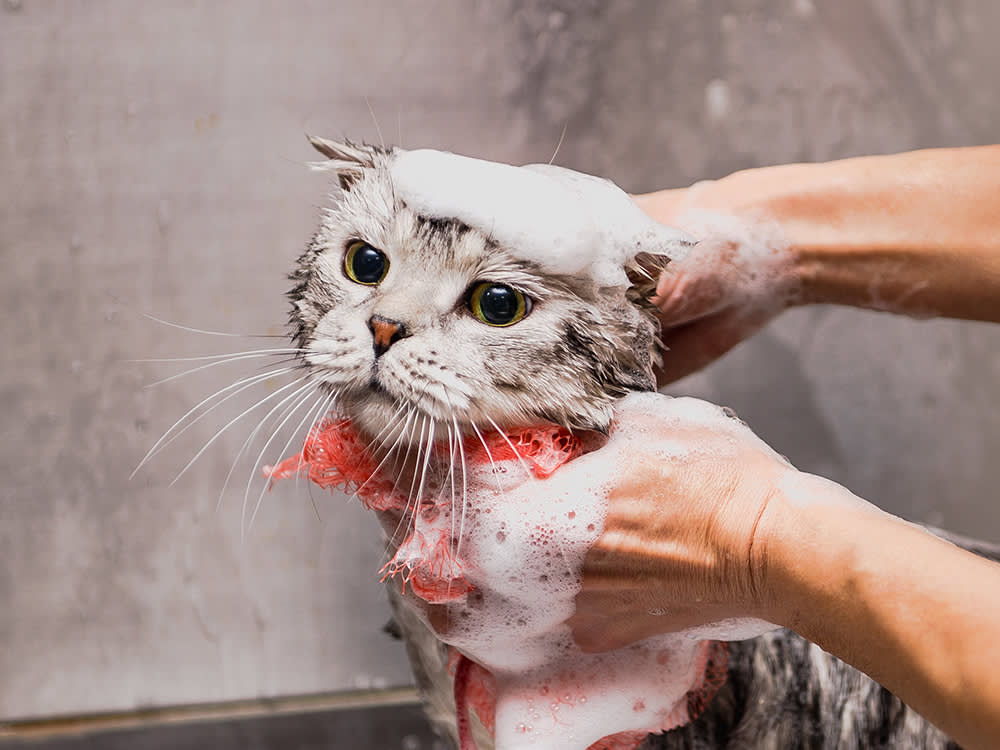
Here is the thing nobody tells you about the self-cleaning cat: a tongue is a comb, not a washcloth. It lifts loose hair and spreads saliva, and for a healthy shorthair with a normal weight and no medical baggage, that is genuinely enough. But the moment a cat’s coat, body, or age changes the math, the grooming a cat does for itself and the grooming a professional does are two different jobs. The useful question is not whether your cat can groom itself. It is whether the cat in front of you still can, and whether the coat it has can be maintained by a tongue alone.
For a lot of cats the answer is yes, and you can stop reading. This article is about the cats for whom the answer is no, often without their owners realizing it until a mat has already tightened against the skin.
What a bath does that licking never will
A cat licks. A groomer washes, and those are not the same verb. Saliva evaporates. It does not carry away grease, litter dust, dried skin oils, or the trace of urine and feces that settles into the coat of a cat who can no longer reach its own back end. We get the cat wet, work a degreasing shampoo through to the skin, rinse it out, force-dry the coat, and comb it flat. A tongue cannot rinse. That is the whole difference.
That difference matters most in three places a tongue physically cannot reach or resolve:
Mats. A mat is not a cosmetic problem. As it tightens it pulls the skin into a knot, traps moisture and dander against the surface, and blocks air from circulating, which impairs the way a cat sheds heat. Veterinary dermatology sources are blunt about what hides underneath: a dense mat can conceal a hot spot, a healing wound, fleas, or a skin infection that no one sees until the mat comes off. Cats also have thin, mobile skin that tents up into the base of a mat, which is exactly why shaving one out is a job for someone with feline-specific clipper training and not a pair of kitchen scissors.
Eye and ear debris. Flat-faced breeds like Persians and Himalayans weep into the corners of their eyes and cannot clear it. Left alone it crusts and irritates.
The allergy load in your own house. The proteins most cat-allergic people react to, chiefly Fel d 1, ride on dander and dried saliva in the coat. Washing physically removes that layer. Torres lives with three cats and an allergic partner, and a regular bath is what keeps the household breathing.
The real decision: match the schedule to the coat, not the calendar
There is no universal grooming interval, and any groomer who quotes you one without asking about the coat is guessing. Use the cat you have:
Longhairs (Persian, Maine Coon, Ragdoll, and their mixes) carry a double coat that mats faster than a tongue can keep up, especially over the hindquarters and behind the elbows. Plan on a professional groom every four to six weeks. This is the group most likely to need a groomer rather than merely benefit from one.
Medium and shorthairs usually stay ahead of it themselves and do fine with a professional bath every two to three months, or less if they are light shedders. Home brushing covers most of the gap.
Any cat, regardless of coat, moves up the schedule when a specific thing changes: an allergic person in the home (monthly is reasonable), obesity or arthritis that stops the cat from twisting to reach its back, dental pain that makes self-grooming hurt, or old age. A cat that suddenly stops grooming is not being lazy. It is usually the first visible sign that something hurts, and it is worth a vet call before it is worth a groomer call.
The part owners underestimate: a groom can be dangerous
This is the section most “does your cat need a groomer” articles bury, and it is the one that should change how you choose. A bath is not just wet and unpleasant for a cat. For a cat with an undiagnosed heart condition, the stress of restraint and handling can genuinely trigger a cardiac event on the table.
“The cat that scratches you is not the one I worry about,” Torres says. “It is the quiet one whose stress you cannot read. Hypertrophic cardiomyopathy is common in cats and often silent until a stressor exposes it. A trained groomer watches for the signs, knows when to stop and let the cat breathe, and is prepared to give first aid or CPR if it comes to that. Handling a cat safely is the actual skill. The bath is the easy part.”
That is why training is not a nicety. A Certified Feline Master Groomer through the National Cat Groomers Institute has passed nine exams, four written and five hands-on, at 85 percent or better, covering cat handling, anatomy, health, and breed-specific coats, and renews that credential annually. It is a cat-specific qualification, not dog grooming with a cat swapped in.
Five questions to ask before you book
Demand for cat grooming has outrun the supply of people trained specifically to do it, so plenty of salons take cats with zero feline education. Screen for it directly:
- What cat-specific training or certification do you hold?
- Are you trained in pet first aid and feline CPR?
- Walk me through your step-by-step process for a cat.
- Do you groom cats in the same room as dogs?
- Do you offer dog-free hours or days?
That last one carries more weight than owners expect. The best feline groomers block cat-only time so there are no barking dogs and no wall of dryers running while a nervous cat is on the table. Here is a simple gut check: if the salon’s noise overwhelms you at the front desk, it is far worse for the cat, whose hearing is built for the rustle of a mouse. Trust that and keep looking. You can find certified groomers through the National Cat Groomers Institute’s own directory.
Start young, but it is never too late
A kitten’s core socialization window closes around seven or eight weeks, which is often the exact age it comes home with you. Introduce baths, dryers, nail trims, and handling before that door shuts and grooming becomes a normal, boring part of life. Miss it and cats grow more easily spooked, which is why an adult’s first-ever groom takes a patient professional.
But do not let an unsocialized past stop you. Torres has taken cats in for their first bath well into their teens, and older cats, the ones whose own grooming is starting to fail, are frequently the ones who need the help most. The coat comes back softer and cleaner than a tongue ever left it, and for a stiff, aging cat, someone else doing the reaching is a small mercy.
References
- National Cat Groomers Institute. “Cat Groomer Certification Process.” https://nationalcatgroomers.com/pages/certification-process
- Countryside Veterinary Clinic. “Matting in Cats.” https://www.countrysideveterinaryclinic.org/services/cats/blog/matting-cats
- Cornell Feline Health Center. “Hypertrophic Cardiomyopathy.” https://www.vet.cornell.edu/departments-centers-and-institutes/cornell-feline-health-center/health-information/feline-health-topics/hypertrophic-cardiomyopathy
- Chan, C.C., et al. “The cat allergen Fel d 1.” Journal of Allergy and Clinical Immunology. https://www.jacionline.org/article/S0091-6749(18)30058-9/fulltext
Not a substitute for your vet. Our guidance is educational. For urgent symptoms, contact a vet or emergency clinic right away. Editorial standards
Leila Torres leads our Living coverage, from home life and travel to the products and rescue stories that come with sharing a life with animals. She edits and writes across the section, with a soft spot for pieces about the bond between people and their pets.
Meet our experts ↗Keep reading
 Health & WellnessThat Mat in Your Cat's Fur Is Hurting Them. Don't Reach for Water.Dr. Priya Nair · 7 min
 Health & WellnessYour Cat Grooms for Hours, and Cleaning Is the Smallest Reason WhyDr. Priya Nair · 7 min
 Health & WellnessThe Secret to Bathing Your Cat: Almost Never Do ItLeila Torres · 7 min
 LivingLong Hair Is the Least Important Thing About a Long-Haired CatDr. Amara Solis · 10 min
 Health & WellnessYour Cat's Itch Isn't the Problem. Not Knowing Why IsDr. Nina Kohl · 9 min
 Health & WellnessWhy the Cat Pee Smell Keeps Coming Back (and How to Actually Kill It)Sara Lim · 17 min