


Her Rescue Was Allergic to Everything. So She Built a One-Ingredient Treat.
Houndstone & Co.'s freeze-dried treats are exactly one thing, wild boar, antelope, or bison liver, and nothing else. The story of how a hypoallergenic dog became a whole brand, why single-ingredient organ treats are having a moment, and the one feeding caveat nobody mentions.

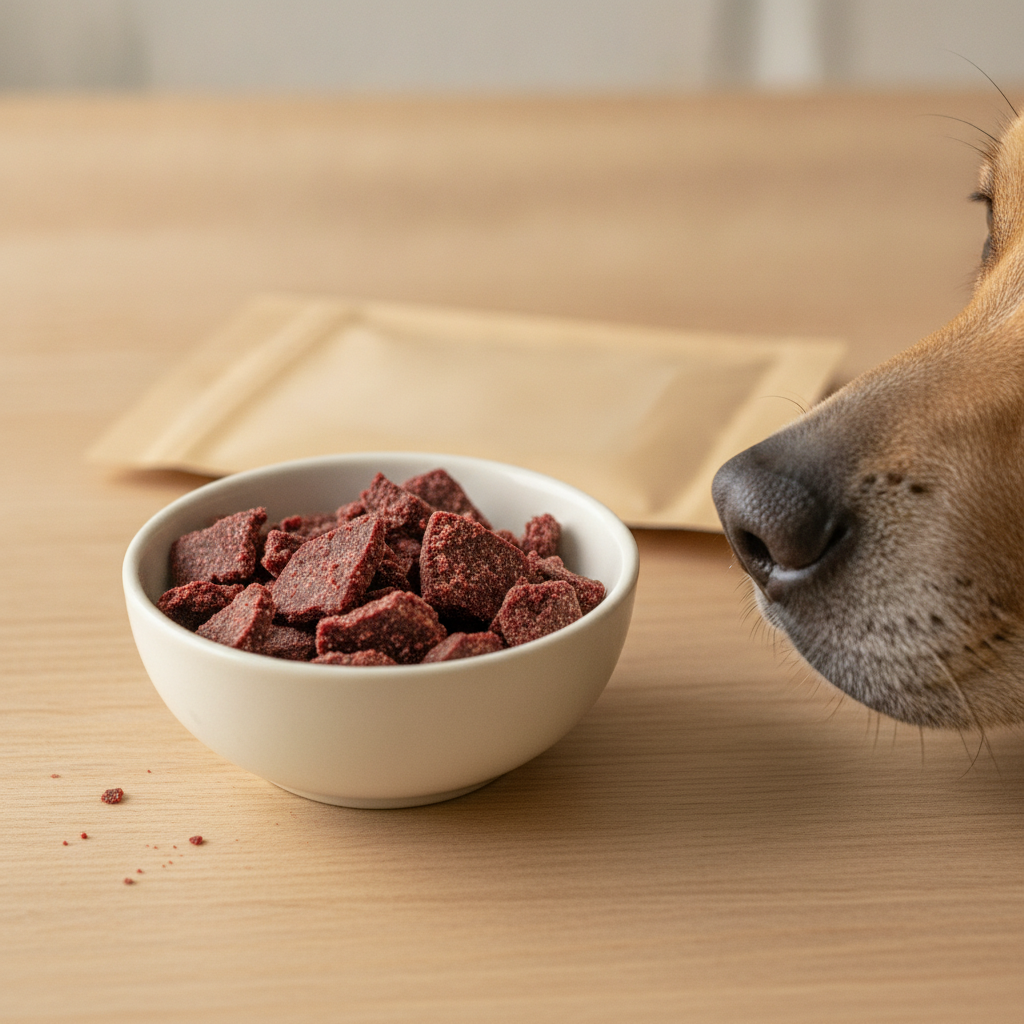
We have reached the point where a new pet brand that does nothing for animal welfare feels like the odd one out. Houndstone & Co. is firmly on the right side of that shift, and not as an afterthought. Advocacy is the reason the company exists at all. But what will actually catch your eye in the treat aisle is the ingredient list, because there barely is one.
A dog who couldn’t eat anything ordinary
Founder Neda Torabi had wanted to make pet products for years without knowing where to begin, driven by a lifelong hatred of seeing animals suffer or get abandoned. The push came from one of her own rescues, a pup named Arepa who is allergic to more or less everything. Struggling to find anything Arepa could tolerate, Torabi formulated a hypoallergenic dog shampoo, which became Houndstone’s very first product. From there the company grew to cover just about every category, from beds and collars to leashes and, naturally, treats.
The treats trace back to Arepa, too. After learning Arepa’s stomach rebelled against everyday proteins such as chicken and beef, a vet steered Torabi toward novel proteins, the less common meats a sensitive dog’s immune system hasn’t been overexposed to. Wild boar, antelope, and bison became the answer, and Arepa devoured them.
One ingredient, on purpose
Here is the part that stands out. Houndstone’s freeze-dried treats come in three versions, and each is 100 percent of a single organ: wild boar liver, antelope liver, or bison liver. That is the entire recipe. Every liver is human-grade, hypoallergenic, and ethically sourced, and the freeze-drying was a deliberate call, it lets a one-ingredient treat hold a long shelf life with no preservatives at all.
There is real nutrition behind the organ-meat focus, too. Liver is one of the most nutrient-dense foods you can feed, packed with iron, B vitamins, protein, alpha-lipoic acid, magnesium, selenium, zinc, and vitamins A, D, and E. For a dog with the kind of sensitivities Arepa has, a clean, single-protein, additive-free treat solves a genuinely hard problem.
The one caveat worth knowing
Nutrient-dense is a selling point and, with organ meat, also a reason for a little restraint. Liver is so rich in vitamin A that it is meant to be a small part of a dog’s intake, not a free-for-all. That fits the standard guidance for any treat: keep treats to no more than about 10 percent of your dog’s daily calories, and let a complete, balanced diet do the heavy lifting.
“Liver is close to a natural multivitamin, which is exactly why you don’t want it to be the whole meal,” says Dr. Ravi Mehta. “As an occasional single-ingredient treat, organ meat like this is fantastic. Just keep it to a small slice of the day’s calories, because too much vitamin A over time isn’t something you want to build up.”
The mission behind the bag
Torabi never lost sight of why she started. Houndstone began as a way to raise money for rescue animals, and the company channels 10 percent of all profits into animal causes. She also founded The Houndstone Foundation, a nonprofit devoted to rehoming abandoned dogs, which has worked with shelters as far apart as Los Angeles and Iran. Buying a bag of liver treats is, in a small and direct way, funding that work.
References
- Nutritional value of liver for dogs — VCA Animal Hospitals
- Vitamin A in canine diets — Merck Veterinary Manual
- Houndstone & Co. and The Houndstone Foundation — brand and nonprofit
This article discusses treats and feeding; ask your veterinarian about the right treat allowance for your individual dog.
Not a substitute for your vet. Our guidance is educational. For urgent symptoms, contact a vet or emergency clinic right away. Editorial standards
Nina Vasquez writes about life at home with pets and the relationships at the heart of it. Her work covers day-to-day living, people-and-pet stories, and the products that fit into a real household, with a warm, grounded take on everyday pet ownership.
Meet our experts ↗Keep reading
 FoodShrimp for Dogs: The Cooking Rule Protects You BothDr. Lena Park · 7 min
 FoodThe Most Dangerous Thing in Homemade Dog Treats Is Hiding on the Peanut Butter LabelDr. Priya Nair · 6 min
 Food10 Human Superfoods for Dogs: The Prep Matters More Than the ProduceDr. Ravi Mehta · 8 min
 FoodThat Lemon Face Your Dog Makes Is a 40,000-Year-Old Survival TrickDr. Lena Park · 6 min
 FoodCelery Is Basically Crunchy Water. That's Exactly Why It's a Good Dog Treat.Dr. Ravi Mehta · 5 min
 FoodOne Slim Jim Has as Much Saturated Fat as a Whole Serving of FriesDr. Priya Nair · 6 min