


8 Disgusting Things Your Dog Does. Only 3 Are Worth Worrying About.
Rolling in dead things, eating grass, dragging their butt across your rug. Most of it is normal and you should relax. But three of these habits have a version that is a symptom, and here is exactly where the line sits.

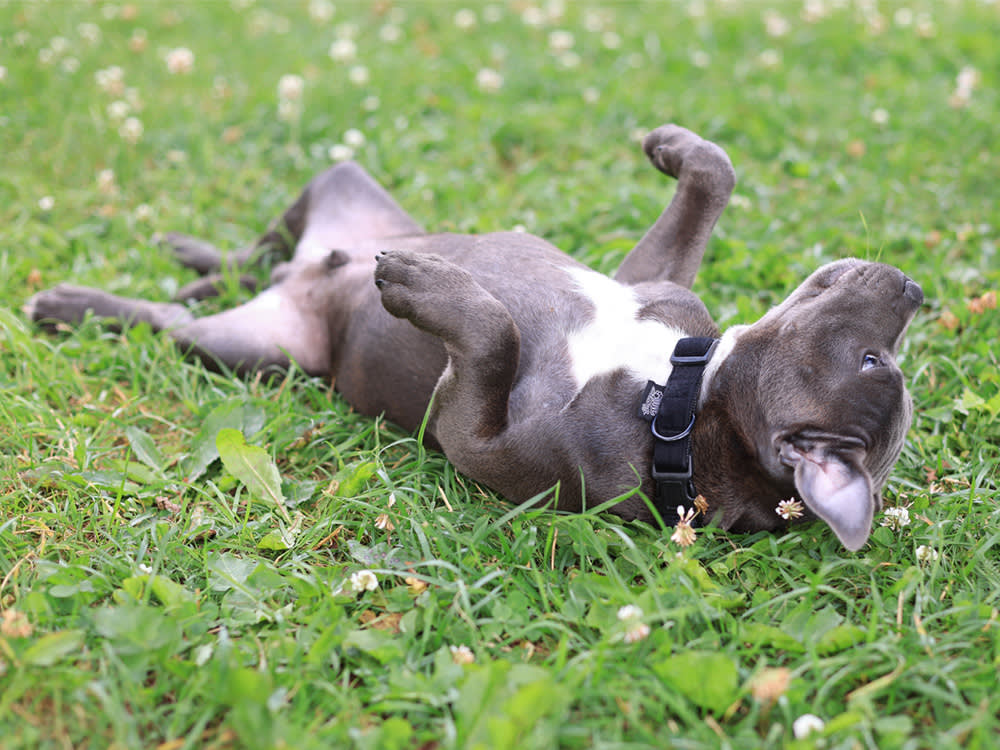
Almost every list of weird dog behaviors makes the same mistake. It explains each habit, tells you it is normal, and sends you on your way feeling charmed.
That is fine right up until the moment it is not, because a few of these behaviors have a second version of themselves. The same act, done a little more often or a little more intensely, stops being a quirk and starts being a symptom. And the dog does not signal the switch. The scooting looks the same. The tail-chasing looks the same. What changes is the frequency, and frequency is exactly the thing people are worst at noticing.
So this is the same list of gross things, sorted by whether you should actually care. Five of them are just dogs being dogs. Three have a line, and the line is the useful information.
First, the five you can stop worrying about
1. Rolling in something dead
You spot the carcass or the garbage pile and steer wide. Your dog’s entire being is oriented toward getting in it, shoulder first, with obvious joy. The worse the smell, the more irresistible it is.
The leading explanation is scent-masking: covering their own odor with something powerfully foul, which would make it easier to close on prey undetected. Whether or not that is the full story, this is deeply hardwired, and you are not going to train it out.
What to do: win the race. Spot the smelly thing before your dog does and redirect. That is the entire strategy, and there is no shame in it.
Worry threshold: none, behaviorally. The only real risk is what they rolled in, so check for anything that could be toxic or barbed, and be aware that a dead animal is a plausible route to parasites or, in some regions, worse.
2. Humping
Watching your dog get amorous with a couch cushion in front of guests is a specific kind of misery. It is also completely normal.
Many dogs simply discover it feels good. It can also be a release valve for stress, or an outlet for excitement that has nowhere else to go. Both males and females do it, though males do it more.
What to do: if it bothers you, interrupt calmly and redirect to something else. Do not punish it. And do read the context, because humping that shows up specifically when a dog is overwhelmed is telling you the dog is overwhelmed.
Worry threshold: sudden, frequent humping in a dog who never did it, especially with licking at the genitals, is worth a vet visit. It can point to a urinary tract infection or a skin irritation.
3. Sniffing your guests’ crotches
You are horrified. Your dog is doing paperwork.
The reason two dogs meeting will go straight for one another’s rear ends is that this is where the file is kept: the anal glands carry a detailed chemical dossier. When your dog does this to a person, they are running the same protocol. This is not rudeness. This is the canine equivalent of asking someone what they do for a living, except more accurate.
What to do: if you want it stopped for the sake of your guests, teach an alternative greeting, like a hand-target or a sit, and reward it heavily at the door. Do not scold. You are not correcting bad manners; you are asking for a translation.
Worry threshold: none.
4. Eating poop
The one everyone finds hardest to accept, and it is normal.
Dogs almost certainly retained this from early domestication, when cleaning up feces around the den served a hygienic function. Their digestive system is efficient enough that they can genuinely extract some nutrients from it, though there are, to put it gently, better sources.
What to do: manage the environment. Pick it up fast, especially the litter box, which is the single most popular buffet in most mixed households. Baby-gate it or get a top-entry box. Punishment is famously useless here and often makes dogs eat the evidence faster.
Worry threshold: a dog who suddenly starts eating stool after never doing it, especially alongside weight loss or a ravenous appetite, is worth a workup. Malabsorption and parasites can drive it.
5. Licking their paws
The Frito feet phenomenon. Ordinary grooming, mostly.
What to do: nothing, at low levels.
Worry threshold: this one edges toward the second list. Persistent licking of one specific spot, to the point of staining the fur rust-red or breaking the skin, is not grooming. It is usually allergy, and sometimes pain in the joint underneath. That belongs in front of a vet.
Now the three with a line
6. Tail-chasing
Normal: a puppy spinning after their own tail is doing what a baby does grabbing at its toes. It is body-discovery, it is play, and it is fine.
The line: whether you can interrupt it.
This is the cleanest diagnostic question on the whole page, so use it. If you offer your dog something they love (a walk, dinner, a favorite toy) and they would rather keep chasing their tail, that is not play anymore. That is the hallmark of a compulsive behavior, and canine compulsive disorder is a real, recognized, and treatable condition. It deserves a veterinary assessment rather than a video.
The same test applies to shadow-chasing and light-chasing, which sit in the same family.
Worry threshold: cannot be distracted from it, or it is escalating in time spent. Call the vet.
7. Scooting
Normal: an occasional drag across the ground after a bowel movement, particularly if the stool was loose. Basically a wipe.
The line: frequency.
If your dog is scooting repeatedly through the day, that is not hygiene. The most common cause is impacted anal glands, which is genuinely painful and which can progress to an abscess or a rupture if left alone. That is not a wait-and-see condition.
Other causes worth ruling out include tapeworms and skin irritation around the rear.
Worry threshold: repeated scooting in a single day, a strong fishy odor, licking at the rear, or any visible swelling. Vet.
8. Eating grass
Here is the one where the folk wisdom is not just wrong; it is backwards.
Everyone “knows” that a dog eats grass because their stomach is upset and they are trying to make themselves vomit. The research does not support this at all.
In a survey of 1,571 dog owners led by researchers at UC Davis, 79 percent of dogs with access to plants ate them regularly, with grass by far the most common. But only 9 percent were reported to seem ill beforehand, and only 22 percent vomited afterward.
Read those numbers again, because they demolish the myth. If grass-eating were self-medication for nausea, dogs would look sick before doing it and would throw up after. Overwhelmingly, they do neither. Grass-eating is just something dogs do. Dogs are omnivores. Sometimes they would like a salad.
The line: sudden, frantic, binge grass-eating.
That is a different behavior from ambling around chewing a few blades on a walk, and it is worth attention. Frantic grass consumption can signal genuine gastrointestinal distress, and it can precede bloat in deep-chested breeds, which is an emergency.
Worry threshold: frantic or compulsive grazing, retching, a distended or tight abdomen, unproductive attempts to vomit. That last cluster is an emergency, not a phone call.
The one rule that covers all of it
You will notice the pattern. Almost none of these behaviors is inherently alarming. What is alarming is change.
A dog who has always sniffed crotches, always eaten grass, and occasionally scooted is a dog. A dog who is suddenly doing something they never did, or is doing an old thing far more, is a dog telling you something. That is true even for the behaviors on the harmless list.
So do not memorize a list of scary symptoms. Just know your own dog’s baseline, and take deviations from it seriously.
Owners come in apologizing for wasting my time about something gross, and half the time it turns out to be the most useful thing they could have brought me. I do not need you to know what it means. I need you to notice that it is new.
What newer research adds
Two things have sharpened since this advice was first written.
Grass-eating has been fairly conclusively separated from illness. The Hart survey work described above, and the follow-up analyses, keep landing in the same place: plant-eating is common, is not typically preceded by signs of illness, and rarely produces vomiting. The leading explanation now is an inherited behavior, plausibly rooted in purging intestinal parasites in wild ancestors, that persists in domestic dogs regardless of whether they need it. It is a vestigial habit, not a symptom.
Coprophagy got a better explanation too. The same UC Davis group examined why dogs eat stool and found a telling pattern: dogs strongly prefer stool that is fresh, within about two days old. That fits an ancestral den-hygiene hypothesis, because intestinal parasite eggs generally are not infectious in the first day or two. Removing fresh feces from the den would have been protective, and the dogs doing it would not have gotten sick. The same work also found something practically useful and slightly deflating: none of the commercial products or training approaches marketed to stop the behavior worked with any meaningful success rate.
Which means the answer to the grossest habit on this list is the least satisfying one available: pick it up faster.
References
- Hart, B. L., Hart, L. A., Thigpen, A. P., Tran, A., & Bain, M. J. “The paradox of canine conspecific coprophagy.” Veterinary Medicine and Science, 2018. https://pmc.ncbi.nlm.nih.gov/articles/PMC5980124/
- Sueda, K. L. C., Hart, B. L., & Cliff, K. D. “Characterisation of plant eating in dogs.” Applied Animal Behaviour Science, 2008. https://www.sciencedirect.com/science/article/abs/pii/S0168159108000749
- American College of Veterinary Behaviorists. “Compulsive Disorders in Dogs.” https://www.dacvb.org/
- Cornell University College of Veterinary Medicine. “Anal Sac Disease in Dogs.” https://www.vet.cornell.edu/departments-centers-and-institutes/riney-canine-health-center
- American Veterinary Medical Association. “Gastric dilatation-volvulus (bloat).” https://www.avma.org/resources/pet-owners/petcare
Dr. Mehta is a board-certified veterinary nutritionist who evaluates pet food formulations, ingredient quality, and the science behind dietary trends. He writes and reviews all nutrition content at The Pet Times, including our food rankings and feeding guides.
Meet our experts ↗Keep reading
 Health & WellnessYour Dog Sleeps 14 Hours a Day. That's Not Lazy, It's Wiring.Dr. Lena Park · 8 min
 First DaysStop Counting Your Puppy's Sleep Hours. Watch for the Change.Dr. Amara Solis · 8 min
 TrainingLetting Your Dog Sleep in Your Bed Isn't Spoiling Them. The Science Sides With You.Dr. Lena Park · 7 min
 Health & WellnessYour Dog's Tongue Is a Dashboard. Most Owners Never Learn to Read ItDr. Amara Solis · 6 min
 TrainingYour Dog's Sleeping Position Is Mostly a Thermostat. One Pattern Isn't.Dr. Nina Kohl · 6 min
 TrainingYour Dog Isn't Standing Guard. They're Just Not All the Way Asleep.Dr. Nina Kohl · 7 min