


Your Dog Isn't Standing Guard. They're Just Not All the Way Asleep.
The dog by the door looks like a sentry. What you're actually watching is a dog stuck in the shallow end of a sleep cycle, and there's a much better question than which way the nose is pointing.

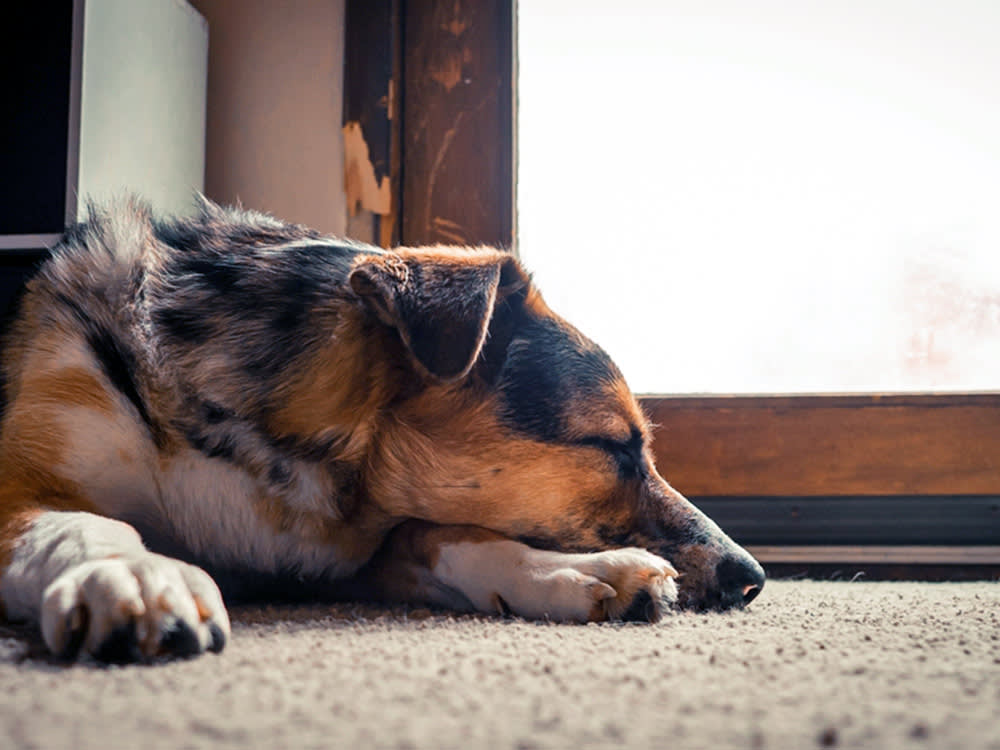
Here is the fact that reframes the whole thing: a dog runs through a complete sleep cycle in roughly twenty minutes. Not ninety, like you. Twenty. Sleep researchers who have wired up family dogs for overnight recordings describe an ultradian cycle of about twelve minutes of drowsiness and light non-REM sleep followed by around six minutes of REM.
Do the arithmetic on a long afternoon nap and you get a startling picture. Your dog surfaces, again and again, dozens of times, into a semi-alert state where the ears still work and the nose is still running. In that shallow phase, a dog will orient toward whatever is most informative.
In your house, the most informative object is the door.
So when you find your dog stretched out with their nose pointed at the hallway, you are not looking at a guard on duty. You are looking at a dog spending a lot of its rest in the shallow end, and arranging itself accordingly. Which raises a much more useful question than “why the door?” The question is: how much of the time is my dog actually getting to the deep part?
The door is a sensor, not a post
Dogs did descend from animals that could not afford to sleep stupidly. Awareness of the approach, of who is coming and from where, was the difference between a nap and a bad ending. That inheritance did not evaporate when we started buying orthopedic beds.
But the modern version is quieter than the myth. A dog lying with its head toward an opening is not braced for intruders. It has simply chosen the position that costs the least: the one where the incoming stream of sound and scent arrives without the dog having to move to collect it.
People read the doorway as a job the dog has given itself, and it usually isn’t. It’s a low-effort listening post. The dog is trying to stay lazily informed while it sleeps, not defend a perimeter.
Two other explanations get almost no airtime and account for a surprising number of cases.
Airflow. A doorway is where moving air lives. Dogs shed heat inefficiently, and a threshold with a draft crossing it is often simply the coolest square meter in the room. Plenty of “sentry” dogs are just warm dogs.
Scent traffic. Open doorways are where the house’s smells funnel. A dog with its nose at the gap is reading the building the way you’d skim a group chat.
Once you know that, the doorway stops being mystical. It’s a good seat.
Anticipation looks exactly like vigilance
The other big driver is much more emotional and much easier to misread.
A dog that lies facing the door because someone in the family is out is not scanning for threats. It is waiting. The posture of hope and the posture of watchfulness are, from the outside, identical: head up or head down toward the opening, ears live, eyes closing and opening.
The way to tell them apart is not the position. It’s the recovery. When the person walks in, does the dog settle deeply, sprawl out, roll a hip, and go quiet? Then that was waiting, and it resolved. Does the dog remain up on its sternum, resetting every time a car passes? Then something else is going on.
Wiring nudges it, but it does not decide it
Breeds built to notice things do notice more things. Guardian and protection lines, livestock guardians, and the herding breeds that were selected to track movement all tend to hold onto more alertness at rest. A herding dog treats a household the way it would treat stock: everyone is accounted for, everyone is in a known location, and any change to that list is worth a look.
But do not read temperament out of a sleeping position. A confident, wildly under-worried dog can face the door for nine years because that is where the breeze is. An anxious dog can sleep facing a wall. The position is a weak signal on its own. It only becomes meaningful in combination with everything below.
The signal that actually matters: does the deep part happen?
Here is what a genuinely secure dog looks like when it sleeps, and none of it is about direction.
- They change position freely. Curled, then flat on the side, then upside down, then a leg draped over nothing. Rotation is a confidence tell.
- They change rooms. A dog that sleeps in three or four different places across a week has decided the whole house is safe, not just one defensible corner.
- They go floppy. Slow breathing, muscles gone soft, the occasional twitch or paddle or muffled woof. Those twitches are the REM stage doing its job, and they are a good sign, not a bad one.
- They are hard to wake. A dog you have to say the name of twice is a dog that got somewhere.
And here is the flip side, the pattern worth taking seriously:
- Startling awake repeatedly at ordinary household noise.
- Refusing to settle anywhere except with an eye on the entrance.
- Pacing at times when the rest of the house has powered down.
- Never rolling onto a side or a back. Always up on the chest, always ready to stand.
That combination is not a personality quirk. It is a dog that is not getting deep sleep, and chronic under-sleeping makes everything else, reactivity, impulse control, learning, appetite, measurably worse. It is also, sometimes, pain: a dog that cannot lie flat because lying flat hurts will look exactly like a dog that will not lie flat because it is scared. A vet visit sorts that out faster than a trainer can.
Build a room a dog can actually fall asleep in
If you want the deep phase, you do not move the bed away from the door. You lower the cost of relaxing.
- Make the day predictable. Feeding, walks, and lights-out at roughly the same times. Predictability is not a comfort cliché; it is what allows a nervous system to stop budgeting for surprise.
- Put the bed where the traffic isn’t. Not the hallway, not the path from kitchen to bathroom, not directly under the stairs. Being stepped over is a wake-up.
- Give the bed a second exit. Counterintuitive, but a dog will relax faster in a spot with two ways out than in a cul-de-sac corner, even though the corner feels safer to us.
- Load it with familiar smells. A worn blanket, an unwashed t-shirt, a bed that has not just been laundered into odorlessness.
- Reward the settle, not just the sit. Most dogs get paid for doing things. Very few get paid for lying down and going quiet. Drop a treat next to a dog that has settled itself, without a word, and walk away.
- Rule out pain before you rule out anxiety. Especially in a dog over seven, or any dog whose sleeping style changed.
What newer research adds
The most interesting recent work on dog sleep does not care where the dog is pointed. It cares who else is in the room.
Researchers using non-invasive sleep recordings on family dogs found that dogs sleep worse when their owner is not there. Not “seem restless.” Measurably worse sleep structure: less of the deep, restorative stage, more time spent surfacing. The same group has also found that what happens in the hour before bed matters, dogs who had a negative interaction with a person beforehand had different, poorer sleep afterwards than dogs who had a pleasant one.
Put those two findings next to your dog by the door and the picture snaps into focus. The direction of the nose is not the lever. You are. A dog that has you in the room, and had a calm evening, is a dog that can afford to go all the way under. A dog that is alone, or wound up, will hover in that light, listening, doorway-facing state no matter what you do to the bed.
So the answer to “why does my dog sleep facing the door” is often, in the end, unbearably simple. Because the door is where you come from.
Frequently asked questions
Is a dog facing the door being protective of me?
Usually not in the deliberate way people mean. Most of the time it is a low-cost listening position during light sleep, or a spot with better airflow, or the direction from which their favorite person appears.
Should I move my dog’s bed so they can’t see the door?
No. Blocking the sightline does not remove the vigilance; it just removes the information. If your dog is genuinely struggling to settle, work on the routine, the pain check, and the surrounding stress rather than the geometry of the room.
My dog twitches, paddles, and yips in their sleep. Is that bad?
That is REM, and it is a sign your dog reached the deep part. It is a good sign. Do not wake them.
When is sleeping position actually a red flag?
When your dog will only ever lie in one spot, always facing out, never rolls onto a side, startles constantly, and paces instead of resting. That combination is worth a conversation with your vet or a certified behavior professional, and pain should be ruled out first.
References
- Bunford, N., et al. “Sleep in the Dog: Comparative, Behavioral and Translational Relevance.” Current Opinion in Behavioral Sciences, vol. 33, 2020, pp. 25–33. https://www.sciencedirect.com/science/article/pii/S2352154619301378
- Kis, A., et al. “Family Dogs’ Sleep Macrostructure Reflects Worsened Sleep Quality When Sleeping in the Absence of Their Owners: A Non-Invasive Polysomnography Study.” Animals, 2025. https://www.ncbi.nlm.nih.gov/pmc/articles/PMC12608857/
- Kis, A., et al. “The Interrelated Effect of Sleep and Learning in Dogs (Canis familiaris); an EEG and Behavioural Study.” Scientific Reports, vol. 7, 2017. https://www.nature.com/articles/srep41873
- Bódizs, R., et al. “Interhemispheric Asymmetry During NREM Sleep in the Dog.” Scientific Reports, vol. 11, 2021. https://www.nature.com/articles/s41598-021-98178-3
- Kis, A., et al. “REM Versus Non-REM Sleep Disturbance Specifically Affects Inter-specific Emotion Processing in Family Dogs (Canis familiaris).” Scientific Reports, vol. 10, 2020. https://www.ncbi.nlm.nih.gov/pmc/articles/PMC7319983/
Dr. Kohl is a board-certified veterinary dentist with a particular interest in preventive oral care. She reviews all dental health content at The Pet Times and contributes practical guides on home dental routines, professional cleaning, and oral disease prevention.
Meet our experts ↗Keep reading
 TrainingYour Dog Puts Up With Being Picked Up. That's Not the Same as Loving ItDr. Lena Park · 7 min
 Training8 Disgusting Things Your Dog Does. Only 3 Are Worth Worrying About.Dr. Ravi Mehta · 9 min
 Health & WellnessYour Old Dog Staring at the Wall Is Veterinary Medicine's Most Missed DiagnosisDr. Nina Kohl · 8 min
 Health & WellnessYour Dog Becomes an Adult Three Separate TimesDr. Ravi Mehta · 9 min
 TrainingLetting Your Dog Sleep in Your Bed Isn't Spoiling Them. The Science Sides With You.Dr. Lena Park · 7 min
 Health & WellnessYour Dog Doesn't See the World. They Smell It.Dr. Ravi Mehta · 10 min