


Your Dog Puts Up With Being Picked Up. That's Not the Same as Loving It
Scooping your dog into your arms feels natural to you. To a lot of dogs, it's a loss of control they only tolerate. Here's how to read whether yours is actually okay with it, and how to make lifting something they trust.

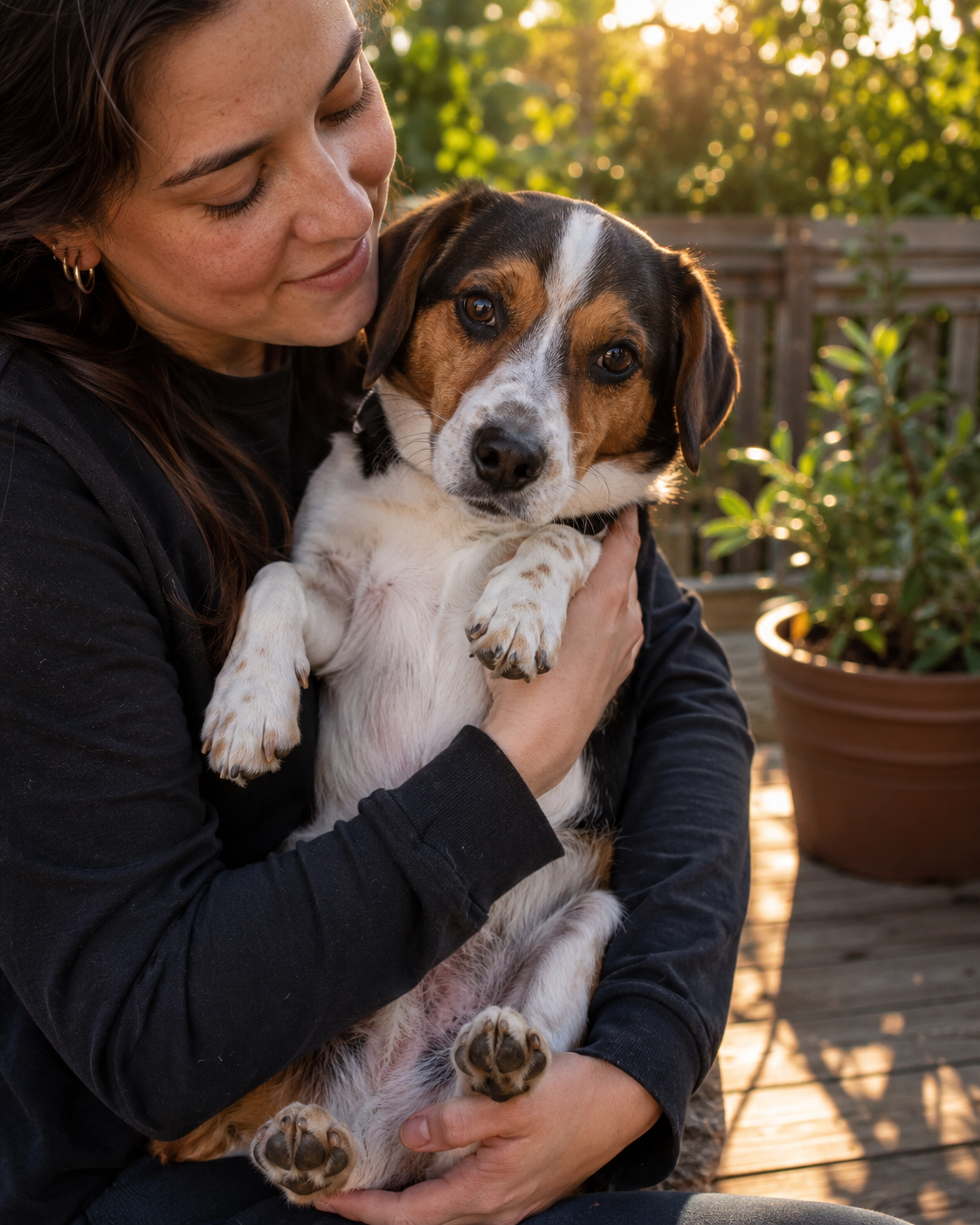
Picking your dog up feels like affection. You scoop them for a hug, a snuggle, a quick trip down the stairs, and it reads, from your side, as pure closeness. The question worth sitting with is what it reads as from theirs. Because for a lot of dogs, being lifted is not a hug. It is a sudden loss of footing and control at the hands of a creature many times their size, and what looks like a contented cuddle is often a dog waiting patiently to have their paws back on the ground.
That gap, between tolerating and enjoying, is the whole story here. Some dogs genuinely love being picked up. Others merely permit it. The good news is that dogs are usually telling you which camp they are in, clearly and constantly, and once you can read the signal, you can stop guessing and start respecting the answer.
Your dog is already telling you
Dogs are not subtle about this if you know where to look, and the body speaks before and during the lift, not after. The dog who genuinely does not mind it keeps a loose body throughout. They may hop up into your arms on their own, settle in, and relax rather than scramble to get down. Their body looks soft, they lean into you, they accept your hands under the chest and rump without flinching, their eyes stay soft and their jaw relaxed, and they may reorient toward you once they are up, essentially checking in rather than plotting escape.
A dog who is not comfortable will tell you just as plainly, and the tells are easy to miss only because they are quick. Watch for a body that goes stiff, a head that turns away, and “whale eye,” where you can see the whites at the corners of the eyes. Watch for lip-licking when there is no food in sight, yawning that is not about being tired, a tucked tail, freezing in place, a low growl, or outright struggling. Every one of those is a request for space. If you see any of them, the right move is not to hold tighter or push through. It is to stop and try a different approach.
Why forcing it backfires, every time
It is easy to override these signals, especially with a small dog you can simply pick up whether they like it or not. Doing it routinely quietly costs you. Repeatedly picking up a dog who does not want to be held can build the exact problems you least want: anxiety, avoidance, and defensive aggression, plus a slow erosion of the trust your dog places in you. A dog who learns that their clear “no thanks” gets ignored does not conclude that being lifted is fine. They conclude that communicating with you does not work, and that is a much bigger loss than one skipped cuddle.
There is a plain physical risk too. A struggling dog is more likely to be dropped, and more likely to hurt you in the scramble. So when a dog genuinely needs to be lifted, whether for the vet, the stairs, or a hazard, it should be done slowly and deliberately, with reward-based, low-stress handling that helps them feel secure, not grabbed. The goal is a dog who feels safe in your hands, and that is built with patience, not overpowered in the moment.
People read a still, quiet dog in their arms as a happy one, and sometimes it’s the opposite: the dog has gone quiet because struggling didn’t work. I’d rather a dog wriggle and tell me the truth than freeze and hide it. When a dog trusts the lift, you can feel them exhale into it. When they’re just enduring it, you can feel them holding their breath.
The small-dog assumption, corrected
There is a widespread belief that small dogs love being carried and big dogs don’t, and it mixes up cause and effect. Small dogs are sentient individuals with their own preferences, exactly like large dogs. What is true is that smaller dogs tend to get picked up far more often, simply because people can easily lift them and support their bodies, so many of them acclimate to it. That is practice, not an inborn love of being airborne.
Whether a dog tolerates being held tracks far more with trust and past experience than with the number on the scale. The variables that actually matter are who is doing the lifting, how consistent that person’s handling tends to be, and what the dog has learned to expect from them over time. It’s why the same dog who melts into your arms may wriggle away from a houseguest, nothing about lifting changed; what’s missing is the familiar rhythm, the little cue that says it’s coming, and the confidence that unfamiliar hands haven’t earned yet. It cuts the other way too: plenty of big dogs would happily accept a short, supported boost onto the couch from their person, but because they are heavy, we tend to reach for ramps and invitations to jump instead, so we never find out. We simply notice small dogs’ reactions more, because we lift them more.
It often starts in puppyhood, but it isn’t locked there
A dog’s attitude toward being handled frequently traces back to their earliest weeks. There is a sensitive socialization period, roughly three to 14 weeks of age, when the handling a puppy experiences shapes how they respond to being picked up, touched, and examined as adults. Puppies who get gentle, predictable handling in that window, including having their paws, ears, and mouths touched, tend to carry less fear and less restraint stress into adulthood. Early positive exposure genuinely pays off years later.
But if you did not raise your dog from puppyhood, or that window was not handled well, the story is not written. Comfort with handling can be built at any age with slow desensitization and positive reinforcement. The formula is not complicated: respect the “no” in the moment, then patiently train confidence over time, so the dog comes to associate being lifted with good things rather than with being trapped.
How to build a lift your dog trusts
The practical path is small steps paired with rewards, and crucially, choice. Develop a predictable routine: use the same consistent cue each time so the lift is never a surprise, approach slowly, support your dog under the chest and hind end so they feel stable rather than dangling, and reward them right after you set them back down so the whole sequence ends on a good note. Repeated this way, many dogs move from wary to neutral to genuinely relaxed, because they have learned the pattern and learned to trust the hands.
And if, after all that, your dog still just does not love being picked up, that is allowed. There is no harm in working around it. Ramps, stairs, and a low surface to jump onto get the same jobs done without asking your dog to give up control they would rather keep. Respecting that preference is not spoiling your dog. It is taking yes and no equally seriously, which is the foundation of every good relationship, including this one.
The takeaway
Before you scoop your dog up, take the half-second to read them. Loose body, soft eyes, a lean-in: go ahead, they are into it. Stiffening, whale eye, a turned head, a tucked tail: put the plan on pause. Being picked up is one of the few things we routinely do to dogs without asking, and it is one of the easiest to start asking about. Do that, and lifting stops being something your dog survives and becomes one more thing they trust you with.
References
- American Veterinary Society of Animal Behavior. “Position Statement on Puppy Socialization.” avsab.org
- Fear Free Pets. “Low-Stress Handling and Cooperative Care.” fearfreepets.com
Common questions
Is it bad to pick up a dog who doesn't want it?
Repeatedly overriding a clear 'no' can build anxiety, avoidance, or defensive aggression and erode your dog's trust in you. A struggling dog is also more likely to be dropped or to injure you. If you must lift a reluctant dog, do it slowly and with a plan, and work on building comfort over time.
Do small dogs like being held more than big dogs?
Not inherently. Small dogs often just get more practice because people can easily pick them up, so many acclimate. What drives comfort is trust, consistent handling, and the dog's track record with whoever is doing the lifting, far more than body size. Plenty of big dogs would enjoy a supported lift they rarely get offered.
Dr. Park is a board-certified emergency and critical care specialist. She reviews our health and safety content for clinical accuracy and contributes guides on recognising urgent conditions. Her focus is helping owners act quickly and correctly when it matters most.
Meet our experts ↗Keep reading
 First DaysStop Counting Your Puppy's Sleep Hours. Watch for the Change.Dr. Amara Solis · 8 min
 Health & WellnessYour Old Dog Staring at the Wall Is Veterinary Medicine's Most Missed DiagnosisDr. Nina Kohl · 8 min
 Health & WellnessYour Dog Becomes an Adult Three Separate TimesDr. Ravi Mehta · 9 min
 Health & WellnessYour Dog Owns the Dark. Here's the Price They Paid for It.Dr. Ravi Mehta · 8 min
 Health & WellnessYour Dog Doesn't See the World. They Smell It.Dr. Ravi Mehta · 10 min
 Health & WellnessYour Dog's Tongue Is a Dashboard. Most Owners Never Learn to Read ItDr. Amara Solis · 6 min