


Your Dog Owns the Dark. Here's the Price They Paid for It.
Dogs navigate a room you'd call pitch black, but that low-light superpower cost them sharpness and color. Here's the eye anatomy behind it, why their eyes glow, and whether you should leave a light on.

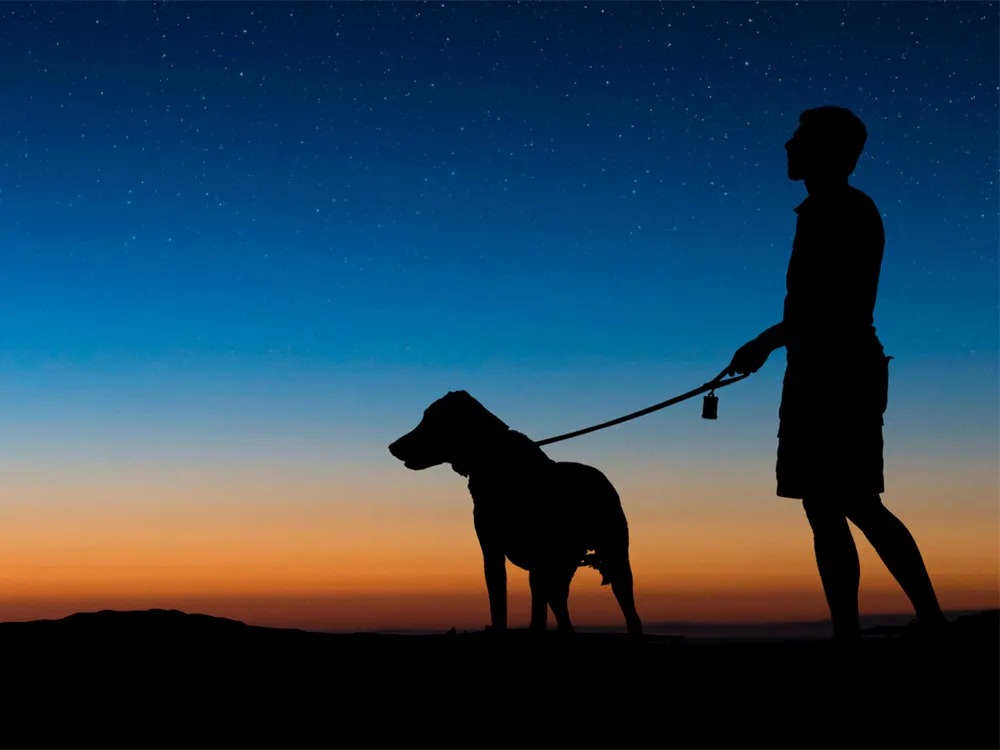
Walk into a dark room at 3 a.m. and there they are: two glowing coins hovering near the floor, watching you. Once your heart restarts and you remember it is just the dog, a better question surfaces than “why is that terrifying.” It is this: did your dog even need the light you just fumbled for? Almost certainly not. Dogs move through darkness that leaves us groping for walls.
But here is the part the “dogs can see in the dark” headline always skips. That night vision was not a free upgrade. It was a trade. To see in near-darkness, the dog’s eye gave up things your eye kept, sharpness and a rich sense of color chief among them. Understanding what dogs sacrificed is what makes their night vision genuinely interesting, and it is also what tells you whether leaving a light on actually helps them.
First, the honest limit
Let’s kill the myth up front. Dogs cannot see in total darkness. Nothing can, because vision is just the detection of light, and no light means nothing to detect. What dogs have is an extraordinary ability to work with tiny amounts of light, levels so low that a human would swear the room was pitch black. So when your dog navigates the hallway you can’t, they are not seeing in the dark. They are seeing in light you can’t use.
Follow the light through a dog’s eye
The best way to understand a dog’s night vision is to trace a beam of light as it travels inward, because every structure it passes has been tuned, in dogs, toward low light.
- Cornea: the clear, domed front surface. In dogs it is large and curved, letting light in from many angles. It is also where many common eye problems start.
- Anterior chamber: a fluid-filled space behind the cornea that light passes cleanly through.
- Pupil: the adjustable opening. The iris widens it in dim conditions to let in as much light as possible, and dogs’ pupils open wider than ours.
- Lens: a clear disc that changes shape to focus light onto the back of the eye. Cataracts form here and block incoming light.
- Posterior chamber: filled with a clear, jelly-like fluid that maintains the eye’s shape.
- Retina: the light-sensing tissue, packed with two kinds of receptors. Rods detect very faint light but give little detail. Cones need more light but handle color and fine detail.
- Tapetum lucidum: the game-changer. This reflective layer sits behind the retina and bounces any light the rods and cones missed back at them for a second chance.
Now the dog-specific tuning becomes obvious. A dog’s cornea covers more of the eye’s surface than ours, gathering more light. Their pupils open wider. Their retinas are rod-heavy, and those rods sit right where incoming light is most likely to land. And the tapetum lucidum recycles stray light that would otherwise be wasted. Stack those adaptations and you get an eye optimized to track movement in almost any lighting.
The price of the upgrade
Every one of those advantages costs something, and this is the heart of it.
Prioritizing rods means fewer cones. Cones are what deliver color and crisp detail, so a rod-dominant retina buys low-light sensitivity by spending visual richness. Dogs see far fewer colors than we do; their world runs mostly in blues and yellows, roughly what a person with red-green color blindness experiences. And their acuity is softer than ours. Estimates put a dog’s best-case vision around 20/70, meaning an object you’d see clearly at 70 feet, they see with the same clarity only at 20.
The tapetum lucidum helps them see at night but also scatters light slightly, which further blurs fine detail. So the trade is real and two-sided: dogs won the dark and lost some of the daylight sharpness and color we take for granted. It is a fair deal for an animal that doesn’t lead with its eyes anyway. Dogs experience the world primarily through smell, and vision is there to supplement the nose, not replace it.
People assume better night vision means better vision, period, and it’s the opposite. Your dog gave up resolution and color to gain sensitivity. That’s why a dog can spot a squirrel twitch across a dark yard but walk right past a still object a few feet away in daylight. Their eyes are motion-and-dim detectors, not high-definition cameras.
Dog versus cat versus you
Rank the three and dogs land squarely in the middle. Humans have smaller corneas and pupils, relatively more cones than rods, denser cones in the focal center, and no tapetum lucidum at all, which is why we are night-blind by comparison but see color and detail beautifully when the lights are on.
Cats outdo dogs in the dark. Their tapetum lucidum covers more area and reflects more light, and as crepuscular hunters their eyes evolved to make the most of dawn and dusk. Cats can reportedly make out detail in conditions roughly six times darker than what looks black to us. Dogs sit between cat and human: much better than we are after dark, not quite feline. The upside of dogs’ balance is flexibility, they kept solid daylight vision too, so they are not locked into hunting at any particular hour.
Why the eyes glow
That eerie glow is not your dog generating light. It is the tapetum lucidum at work. Light that slips past the retina’s receptors hits the reflective layer and bounces back through the retina, giving those receptors a second shot at absorbing it. Whatever still isn’t absorbed exits the eye, and that escaping, reflected light is the glow you see. It usually reads yellow to green in adult dogs, the color of a mature tapetum. Puppies often show a bluish glow that shifts as they grow.
So should you leave a light on?
Here is the practical payoff. A healthy dog does not need a light to get around your home at night; they manage fine in the dark and always have. But a little soft lighting doesn’t hurt and can genuinely help certain dogs. If your dog has reduced vision from cataracts, corneal scarring, or another eye condition, or is a senior whose eyes are aging, a low night light can make navigating obstacles easier and less stressful. For everyone else, it is optional comfort, not a necessity. Your dog is likely more confused about why you keep stubbing your toe.
What’s new since this was written
Research on dog vision has kept refining the picture, and the throughline is that dogs rely on their eyes even less independently than we once thought. Studies of how dogs combine senses show that when smell and sight disagree, many dogs weight scent heavily, which fits the idea that vision is a supporting player. For owners, the practical version is simple: an older dog who seems to be losing their sight often copes remarkably well, because they were already navigating largely by nose and memory.
There is also growing, common-sense attention to aging eyes. Vets increasingly encourage owners of senior dogs to keep furniture layouts consistent and add gentle nighttime lighting, not because the dog has gone blind, but because a little help goes a long way once the low-light edge starts to fade. If your dog suddenly starts bumping into things, misjudging steps, or getting startled in dim rooms, that is worth a vet visit rather than a wait-and-see.
Bottom line
Dogs really do own the dark, but not for free. Their large corneas, wide pupils, rod-rich retinas, and reflective tapetum lucidum let them see in light we’d call nonexistent, at the cost of the sharpness and color our cone-heavy eyes enjoy. They beat us badly after sunset and lose narrowly to cats. The glow is just recycled light, and for most dogs a night light is a nicety rather than a need, unless age or an eye condition has dulled the very advantage this whole story is about.
References
- Miller, Paul E., and Christopher J. Murphy. “Vision in Dogs.” Journal of the American Veterinary Medical Association. https://pubmed.ncbi.nlm.nih.gov/7493905/
- Byosiere, Sarah-Elizabeth, et al. “What Do Dogs (Canis familiaris) See? A Review of Vision in Dogs and Implications for Cognition Research.” Psychonomic Bulletin & Review. https://link.springer.com/article/10.3758/s13423-017-1404-7
- Merck Veterinary Manual. “Eye Structure and Function in Dogs.” https://www.merckvetmanual.com/dog-owners/eye-disorders-of-dogs/eye-structure-and-function-in-dogs
- Kawamura, Satoru, and Shuji Tachibanaki. “Explaining the Functional Differences of Rods Versus Cones.” WIREs Membrane Transport and Signaling. https://doi.org/10.1002/wmts.8
Common questions
Do dogs see better in the dark than humans?
Yes, clearly. Dogs have larger corneas, wider-opening pupils, more rod cells, and a reflective layer behind the retina called the tapetum lucidum that humans don't have. Together those give them far better low-light vision than we have.
Do dogs see in the dark as well as cats?
No. Cats edge them out. A cat's tapetum lucidum is larger and more reflective, and cats evolved to hunt at dawn and dusk. Dogs land in the middle, better than humans, not quite as sharp in the dark as cats.
Why do my dog's eyes glow in the dark?
That glow is the tapetum lucidum reflecting light back through the retina to give the eye a second chance to catch it. Dogs' eyes don't produce light; they bounce it. The color is usually yellow-green in adults and can look bluish in puppies.
Not a substitute for your vet. Our guidance is educational. For urgent symptoms, contact a vet or emergency clinic right away. Editorial standards
Dr. Mehta is a board-certified veterinary nutritionist who evaluates pet food formulations, ingredient quality, and the science behind dietary trends. He writes and reviews all nutrition content at The Pet Times, including our food rankings and feeding guides.
Meet our experts ↗Keep reading
 TrainingLetting Your Dog Sleep in Your Bed Isn't Spoiling Them. The Science Sides With You.Dr. Lena Park · 7 min
 Health & WellnessYour Dog's Breed Is a Remix. The Family Tree Explains the Quirks and the Risks.Dr. Ravi Mehta · 7 min
 TrainingYour Dog Puts Up With Being Picked Up. That's Not the Same as Loving ItDr. Lena Park · 7 min
 TrainingYour Dog Isn't Peeing on His Friend. He's Peeing on the Message Underneath Him.Dr. Amara Solis · 8 min
 Health & WellnessYour Dog Becomes an Adult Three Separate TimesDr. Ravi Mehta · 9 min
 Health & WellnessA Longer Walk Won't Fix This. 7 Signs Your Dog Is Under-Exercised.Dr. Amara Solis · 9 min