


Your Dog Isn't Peeing on His Friend. He's Peeing on the Message Underneath Him.
Dogs on walks aren't emptying a bladder, they're editing a message board. Once you understand what countermarking is actually aimed at, the soaked leash and the peed-on buddy stop being mysteries and start being solvable.

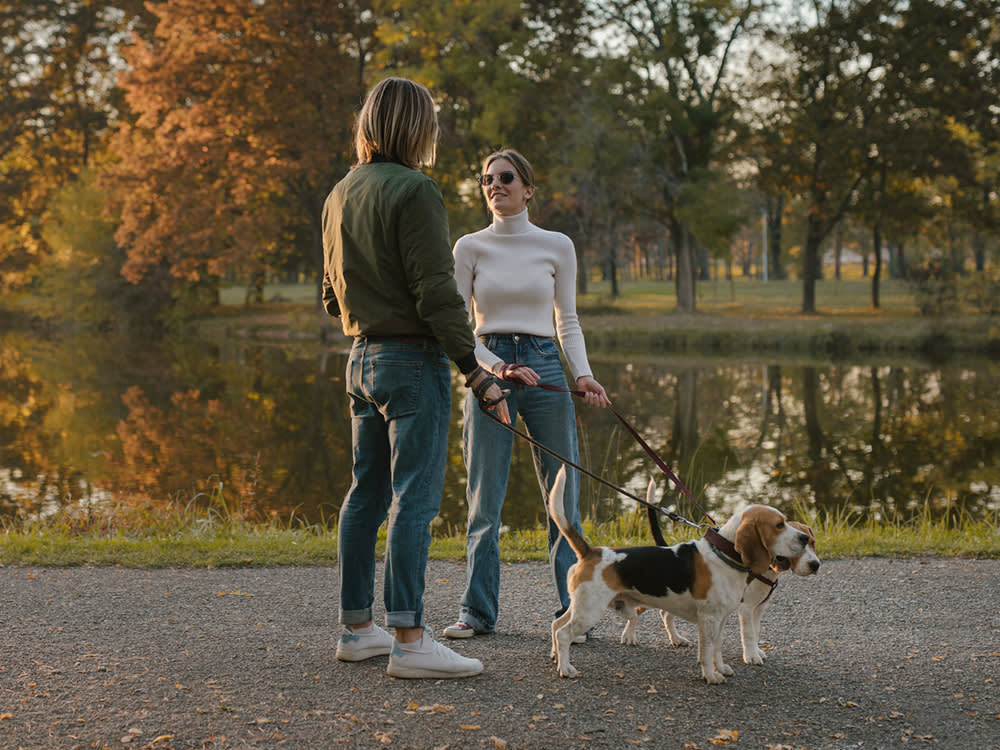
Walking two dogs can feel like walking two watering cans. A splash on the lamppost, a few drops for the hydrant, a dribble on an old pile of poop, a thorough soaking of the neighbor’s roses. And, sooner or later, a soaking of the leash, or of the other dog’s head.
The instinct is to read this as bad aim. It isn’t. Dogs place urine deliberately and they place it accurately, which is precisely what makes the leash and the buddy so vulnerable. Your dog is not spraying wildly and hitting things by accident. He is aiming at something specific, and the leash or the friend simply happens to be lying on top of it.
That distinction changes everything about how you fix it. So let’s start with what the pee is actually for.
Urine is a message board, not a bladder release
Marking is one of those behaviors everybody has watched a thousand times and almost nobody has actually studied. It is famously familiar and scientifically thin, which is a bad combination, because it means most of what “everyone knows” about it comes from casual observation rather than data.
The behavior has a name and two distinct forms. Countermarking is what your dog does to somebody else’s urine, and it comes in two flavors. Overmarking is peeing directly on top of another dog’s mark. Adjacent marking is peeing right next to it, deliberately, without covering it.
Those are not the same act, and the research shows dogs use them for different purposes. Which is the first clue that this is a communication system rather than a plumbing one.
What the data actually found, and what it overturned
A study on countermarking looked at how sex, social status, and neutering affect what dogs do with other dogs’ urine. Social status was measured using tail base position, which is a standard behavioral proxy: a dog carrying their tail base high is displaying differently from one carrying it low.
The findings are worth going through one at a time, because several of them contradict what most owners believe.
- Overmarking by unneutered males was aimed disproportionately at the urine of unspayed females. Directed, sex-specific, and not random.
- Among the males, the ones who overmarked carried their tail base higher than the ones who didn’t. Overmarking tracks with confidence and status, not with a full bladder.
- Whether a dog knew the previous marker made no difference to overmarking. Adjacent marking, however, was aimed exclusively at strangers’ urine. Read that twice. It is a specific signal reserved for dogs the marker does not know.
- Tail base position and sex both failed to predict adjacent marking. So whatever adjacent marking is doing, it isn’t a status display. Every kind of dog does it, and only at strangers.
- Whether a dog had been fixed made no difference at all to whether they countermarked.
That last one deserves a moment, because it demolishes the single most common assumption owners hold. Countermarking is not a hormone problem you can surgically remove. Your neutered dog will still edit the message board.
And at the dog park, the picture got even less tidy. Countermarking and urine investigation showed up in both sexes. Within each sex, the dogs carrying their tail base higher urinated more, countermarked more, and spent more time investigating urine than the lower-tailed dogs of the same sex.
Which means the folk model, that marking is a male thing driven by testosterone, is wrong twice over. Females mark. Fixed dogs mark. What predicts marking better than sex or hormones is social confidence.
“People hear ‘marking’ and picture a male dog claiming territory like a flag on a hill,” says Dr. Mara Chen. “What the data describes is closer to a comment thread. Somebody posts, somebody else replies on top of it, and a stranger replies next to it. Your dog is reading and writing, and neither one is about needing to go.”
Now the leash makes sense
Here is where the theory pays off.
Watch a dog get ready to mark and you will see the circling: twice, three times, four times, tightening in on a spot. That circling is the dog reading the message and lining up the reply. What it also does, on a walk, is wind the leash around them, so that by the time they commit, the leash is lying across the exact patch of ground they have selected as the target.
Your dog is not peeing on the leash. Your dog is peeing on a message, and the leash is in the way of it.
The same logic explains the peed-on friend. Two leashed dogs walk close together, because that’s what leashes do. They sniff the same interesting spot together, because that’s what dogs do. One dog is still nose-down reading it when the other decides to reply to it. Nobody has done anything unusual. The geometry of a shared leash walk simply guarantees that a dog’s head is sometimes going to be in the reply zone.
Plenty of dogs never register the indignity. Some very much do, and those dogs learn fast. It doesn’t take many soakings before a dog starts reading the tells that precede a mark, the circling and the weight shift, and simply steps out of range before it happens. Which is, if you think about it, a dog solving the problem you were about to spend six weeks training.
The rule about who does this, and it isn’t who you think
Leg-lifting makes the mess more visible, which is why the reputation falls on male dogs.
But the research is clear that females countermark too, and squatting does not confer immunity to hitting a leash or a friend. It changes the trajectory. It doesn’t change the aim. Any dog who circles onto a target with a leash under them will eventually hit the leash.
So if you are waiting for this problem to be solved by your dog’s sex or by a trip to the vet for a neuter, you are waiting for something that isn’t coming.
Before you train anything, rule out a medical cause
This is the step people skip, and it’s the one that matters most.
If the marking is new, or noticeably more frequent than it used to be, that is not a behavior story until a vet says it is. A sudden increase in urination, or a dog who suddenly cannot pass a lamppost without emptying a little, can be pointing at a urinary tract infection, bladder stones, kidney disease, diabetes, or, in older dogs, Cushing’s disease. Frequent small volumes, straining, blood in the urine, accidents in the house from a previously reliable dog, or a dog who seems uncomfortable while going are all reasons to book an appointment rather than a training session.
The rule of thumb: a dog who has always done this is a communication problem. A dog who suddenly started is a medical question until proven otherwise.
What actually fixes it
Assuming the vet has cleared your dog, you have three real levers, and they are all about geometry rather than obedience.
Manage the leash first. This is the fastest win and nobody does it. When your dog starts the pre-marking circle, take up the slack and lift the line clear of the ground, or step so the leash trails behind them rather than under them. You are not correcting your dog. You are moving the thing that keeps getting hit.
Give the second dog somewhere else to be. On a double walk, the moment one dog commits to a mark, the other dog’s job is to be two steps away. A simple, well-rehearsed “with me” or “let’s go” that moves your other dog off the spot solves the problem entirely, and it’s a cue worth having regardless. This is genuinely easier than teaching the marker to stop.
Teach pee on cue. The single most useful skill you can build here, and it pays off far beyond the leash. A dog who empties on request in a spot of your choosing is a dog who is not saving it up for a message-board session in the middle of the sidewalk. It’s also the cue you’ll bless every time you’re at a rest stop in the rain, or in a hotel parking lot at six in the morning, or trying to get a dog to go before a long car ride. The step-by-step is in the how-to above.
What does not work: scolding a dog for marking. You’ll suppress the behavior in front of you and get it somewhere else, and you’ll add a layer of anxiety about eliminating that no one wanted.
One thing to do about the leash itself
Nobody covers this and everybody needs it.
A urine-soaked nylon leash does not just smell. It stays wet against the webbing, holds bacteria, and transfers the scent onto your hands, your car, and your dog’s neck. And a leash carrying a strong urine scent is a leash your dog and every dog you pass will find extremely interesting, which is not the vibe you want on a walk.
Wash it. Warm water, a little unscented soap, a soak, a rinse, and hang it to dry completely. An enzymatic cleaner works better than soap on the smell, because it breaks down the compounds rather than covering them. Biothane or coated leashes are worth considering if this is a recurring feature of your life, because they wipe clean and do not absorb anything at all.
What newer research adds
The most useful shift in this area is the growing recognition that marking is an information behavior, and that treating it as a nuisance is a mistake.
Dogs get a genuine amount of their daily mental stimulation from reading and answering urine on a walk. It is one of the few chances they have to gather information about who has been where, and stopping them from doing it turns a walk into a treadmill. A dog who is allowed to sniff and mark on a walk tends to come home more settled than a dog who was marched briskly around the block.
So the goal is not to stop the marking. The goal is to keep the leash out from under it, keep the second dog out of the splash zone, and keep an eye on any sudden change in how often it’s happening. Let the rest be your dog’s correspondence.
References
- Lisberg, A.E., Snowdon, C.T. “Effects of sex, social status and gonadectomy on countermarking by domestic dogs, Canis familiaris.” Animal Behaviour, 2011;81(4):757-764. Link
- Lisberg, A.E., Snowdon, C.T. “The effects of sex, gonadectomy and status on investigation patterns of unfamiliar conspecific urine in domestic dogs, Canis familiaris.” Animal Behaviour, 2009;77(5):1147-1154. Link
- Cornell University College of Veterinary Medicine. “Urinary tract infections in dogs.” Link
- American Animal Hospital Association. “Diabetes management guidelines for dogs and cats.” Link
- Duranton, C., Horowitz, A. “Let me sniff! Nosework induces positive judgment bias in pet dogs.” Applied Animal Behaviour Science, 2019;211:61-66. Link
Dr. Solis is a board-certified veterinary dermatologist with over twelve years of clinical experience. She advises on skin conditions, allergies, and grooming practices that affect coat and skin health. All dermatology and allergy content at The Pet Times is reviewed by her team before publication.
Meet our experts ↗Keep reading
 TrainingThe Most Dangerous Dog Isn't a Breed. It's the One Nobody's Reading.Dr. Mara Chen · 7 min
 TrainingYour Dog Didn't Shred the Bed to Punish You. They Ran Out of Ideas.Dr. Nina Kohl · 8 min
 TrainingYour Dog's Joy Sends 86,000 People to the ER Every YearDr. Nina Kohl · 8 min
 TrainingA Laser Pointer Isn't a Toy. It's a Job Your Dog Can Never Finish.Dr. Nina Kohl · 7 min
 Health & WellnessYour Dog's Tongue Is a Dashboard. Most Owners Never Learn to Read ItDr. Amara Solis · 6 min
 First DaysStop Counting Your Puppy's Sleep Hours. Watch for the Change.Dr. Amara Solis · 8 min