


Your Dog's Joy Sends 86,000 People to the ER Every Year
The enthusiasm is real and you should not train it out of them. What you should train is the landing, because the CDC has counted what happens when nobody does.

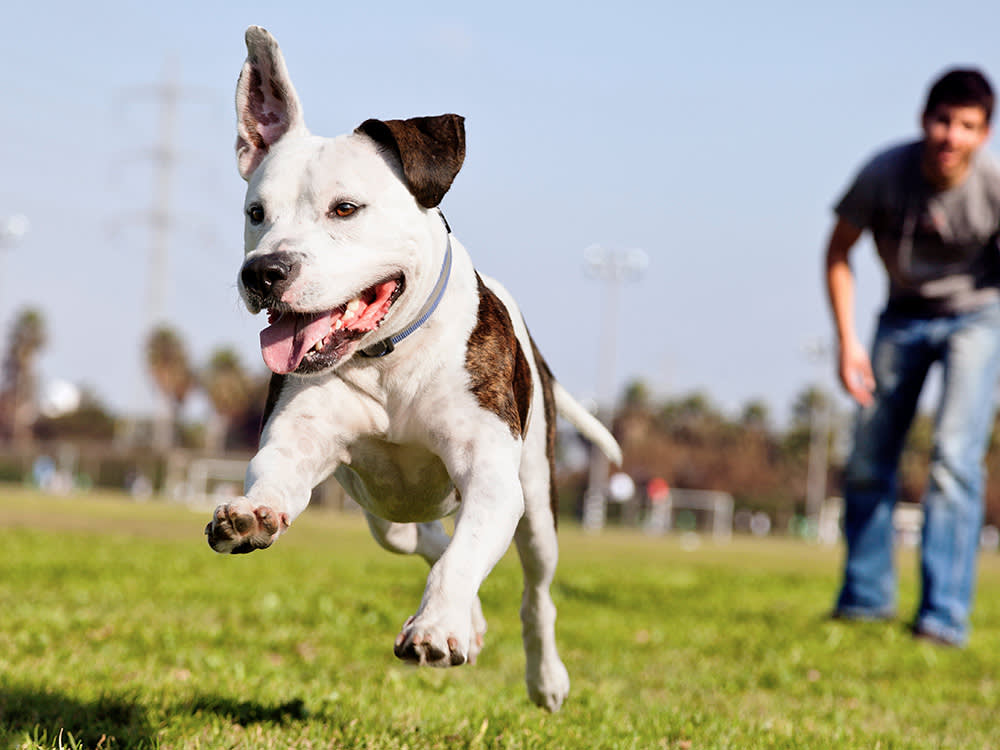
There is a video, and you have seen a version of it: a dog at full sprint, launching into a pile of autumn leaves, disappearing, exploding out the other side, and immediately going back for another. It is the purest available footage of joy. Nobody watches it and thinks that dog needs training.
And they shouldn’t. The enthusiasm is not the problem, and this article is not going to tell you to sand it down.
But there is a number attached to the other end of that enthusiasm, and it is bigger than you would guess. The CDC, examining emergency-department data, estimated that falls associated with cats and dogs send about 86,600 Americans to the ER every year, and that dogs account for nearly 88% of them. The two most common mechanisms were exactly what you would expect: tripping over the dog (31.3%) and being pulled or pushed over by the dog (21.2%). About 61.6% of dog-related falls happened in or around the home, and at least 26% happened while walking the dog.
So the honest framing is not “your dog is too excited.” It is: the joy is real, the takeoff is fine, and nobody has taught the landing.
Where the excitement comes from
Start with the uncomfortable truth: dogs’ nervous systems are not exotic. They run on the same basic machinery as ours.
The most useful comparison in behavior work is to a human toddler. A three-year-old is capable of complete, uncontainable ecstasy about a puddle. They are not defective; they are just not yet running the layers of inhibition that let an adult see a puddle and keep walking. Dogs sit in a broadly similar place: full access to core emotions, limited access to the brakes.
What excites an individual dog is individual, and it is learned. Dogs get excited about things that have reliably produced good outcomes. That is why the near-universal triggers, the leash, the food bowl, the word walk, your keys in the door, are the ones with the most consistent track record behind them. Your dog is not excited about a nylon strap. Your dog is excited about what the nylon strap has always predicted.
Which means the door greeting is not a fixed fact about your dog’s personality. It is a behavior with a reinforcement history, and you wrote it.
The greeting, specifically
The spinning, barking, body-slamming reunion at the front door has a name in trainer circles: pack-greeting behavior, an echo of what canids do when a member of the group returns to the den.
That framing is worth handling carefully, because it slides very easily into nonsense. Dogs are social, they form real attachments, and reunion after separation is a genuinely significant event for them. All true. What is not true is the whole apparatus of pop dominance theory that tends to arrive attached to the word “pack.” Your dog is not calculating rank at the doorway. They are extremely glad you are back and they have no idea what to do with their body.
And here is where you have to be honest about the anthropomorphism problem. Dogs feel core emotions: joy, fear, excitement. They do not do guilt, spite, or stubbornness, and reading those into a dog leads people to punish animals for things the animal cannot possibly have intended. Excitement, though, is safely on the list of things they really do feel. You are not imagining it.
Excitement versus arousal, and how to tell
The trap: stress and excitement look similar from a distance. A panting dog with a lolling tongue and wide eyes reads as thrilled. It can just as easily be a dog who is frightened and coping badly.
Signs of genuine, happy excitement:
- Loose, open body posture, weight moving freely, wiggles running through the whole dog
- Open, relaxed mouth
- Ears forward
- Bright, open eyes with a soft expression
- A “helicopter tail”, spinning in a full circle rather than a stiff metronome
There is a finer-grained cue as well, and it is one of the better bits of trivia in dog science. Research on tail-wagging asymmetry has found that wags biased to the right side of the dog’s body are associated with more positive emotional states, while a left bias tracks with more negative ones. It is a real, replicated effect and it holds up as one signal among many. Do not diagnose your dog off the tail alone, but if the wag is swinging distinctly rightward while everything else looks loose, that is a happy dog.
Signs the arousal has stopped being fun: a stiff or frozen body, a hard stare, a tight closed mouth or tense lips, a high, fast, narrow tail, and an inability to disengage or take a treat.
Note also that dogs, like toddlers, tend to let more out around the people they are closest to. The dog who loses their mind at your return and is composed with the dog walker is not being fake with the dog walker. They are being uninhibited with you.
How excited is too excited?
The answer is not a feeling. It is a threshold, and here it is:
When the excitement produces an outcome nobody chose.
That includes the obvious, a knocked-over grandparent, a dog who bolts through a door, a leash yanked out of a hand at a curb. And the liability is not theoretical: in many jurisdictions, an injury caused by your dog flattening someone is your financial problem, enthusiasm notwithstanding. And it includes the less obvious: a dog who cannot come down from an arousal spike, who is still panting and pacing twenty minutes later, is a dog whose nervous system is not getting a chance to reset. That is a welfare issue, not just an inconvenience.
A greeting that is cute at 25 pounds is a hospital visit at 80.
Train the landing, not the takeoff
The goal is not a subdued dog. The goal is a dog whose joy has somewhere to go that is not your chest.
- Change what gets rewarded at the threshold. Attention is the payoff. So the greeting arrives when four paws are on the floor, and it evaporates when they leave it. No scolding needed, and scolding will not work anyway, because any attention is attention. Just be boring at the wrong moment and be wonderful at the right one. This is slow and it is extremely effective.
- Give the arousal a job. Teach a specific thing your dog does when someone comes in: go to a mat, fetch a toy, find a treat scattered on the floor. A dog holding a toy cannot jump on you, and the search takes the edge off the spike. You are not suppressing the energy; you are routing it.
- Practice the door when it is not real. Ten repetitions of walking in and out on a quiet Sunday teaches more than a year of chaotic actual arrivals, because you can control the difficulty.
- Reward the calm afterward. Most people greet the explosion and then ignore the dog once they settle. That is precisely backwards. Notice the settle. Pay for the settle.
- Get help early if the excitement is explosive. A dog who genuinely cannot regulate, who redirects onto arms and clothing, or who is knocking people over, is worth a session with a qualified trainer or behavior consultant. This is a very trainable problem and it gets harder the longer it runs.
And on the walk, where a quarter of dog-related falls happen: a dog who explodes at the sight of another dog is a dog who can pull an adult off their feet on a wet sidewalk. That is not a personality quirk. That is the fall statistic finding you.
What newer research adds
The most useful correction of the last decade is the separation of arousal from happiness. Old advice treated a high-energy dog as a happy dog and a calm dog as a bored dog. Current behavior work treats arousal as a level, not a mood, and a dog can be highly aroused and delighted, or highly aroused and terrified, and the two can look almost identical from the couch.
That is why the body-language checklist matters more than the volume, and why the tail-asymmetry finding is interesting: it is one of the few signals that speaks to the valence of the emotion rather than its intensity.
The other thing worth carrying away is that fall statistic, because it is the one piece of this that is genuinely counterintuitive. We frame an over-excited dog as a nuisance, a training failure, a funny video. The CDC frames it as an injury vector with a five-figure annual toll. Both are true. Keep the leaf pile. Teach the landing.
References
- Stevens, J. A., Teh, S. L., & Haileyesus, T. (2010). Dogs and cats as environmental fall hazards. Journal of Safety Research.
- Centers for Disease Control and Prevention. (2009). Nonfatal Fall-Related Injuries Associated with Dogs and Cats — United States, 2001–2006. MMWR.
- Quaranta, A., Siniscalchi, M., & Vallortigara, G. (2007). Asymmetric tail-wagging responses by dogs to different emotive stimuli. Current Biology.
- Siniscalchi, M., Lusito, R., Vallortigara, G., & Quaranta, A. (2013). Seeing left- or right-asymmetric tail wagging produces different emotional responses in dogs. Current Biology.
- American Veterinary Society of Animal Behavior. Position Statement on the Use of Dominance Theory in Behavior Modification of Animals.
Common questions
Is my dog excited or stressed?
Look at the shape, not the volume. Loose body, open mouth, ears forward, bright eyes, a wide sweeping tail: excitement. A stiff body, a tight mouth, a high fast tail, a panting dog with a hard stare: arousal that has stopped being fun.
Is it bad to greet my dog enthusiastically at the door?
It is not bad, it is just training. Whatever you reward at the threshold is what you get at the threshold. If the current version knocks people over, change what earns the greeting.
Can a dog's excitement be dangerous?
Yes, mostly to people. The CDC estimated roughly 86,600 fall injuries a year in the US associated with dogs and cats, with dogs responsible for the large majority.
Dr. Kohl is a board-certified veterinary dentist with a particular interest in preventive oral care. She reviews all dental health content at The Pet Times and contributes practical guides on home dental routines, professional cleaning, and oral disease prevention.
Meet our experts ↗Keep reading
 TrainingThe 'Invisible Fence' Isn't a Fence. That's the Whole Problem.Dr. Amara Solis · 7 min
 Health & WellnessThe Underwear Isn't the Joke. The Surgery Is.Dr. Lena Park · 7 min
 Health & WellnessIt's Not the Dog Kiss That's Risky. It's What's on the Tongue and Who's Getting Licked.Dr. Nina Kohl · 5 min
 TrainingYou Can't Out-Command Your Dog's Nose. Here's What Actually WorksDr. Ravi Mehta · 6 min
 Health & WellnessYour Dog Eating Dirt Is Two Problems, Not OneDr. Priya Nair · 7 min
 TrainingThe Viral 'Run Away From Your Dog' Trick Works. You Get to Use It Once.Dr. Mara Chen · 7 min