


You Can't Out-Command Your Dog's Nose. Here's What Actually Works
A dog who inhales everything on walks isn't disobeying, they're scavenging. Stop trying to win with a single cue and build the three layers that actually keep them safe.

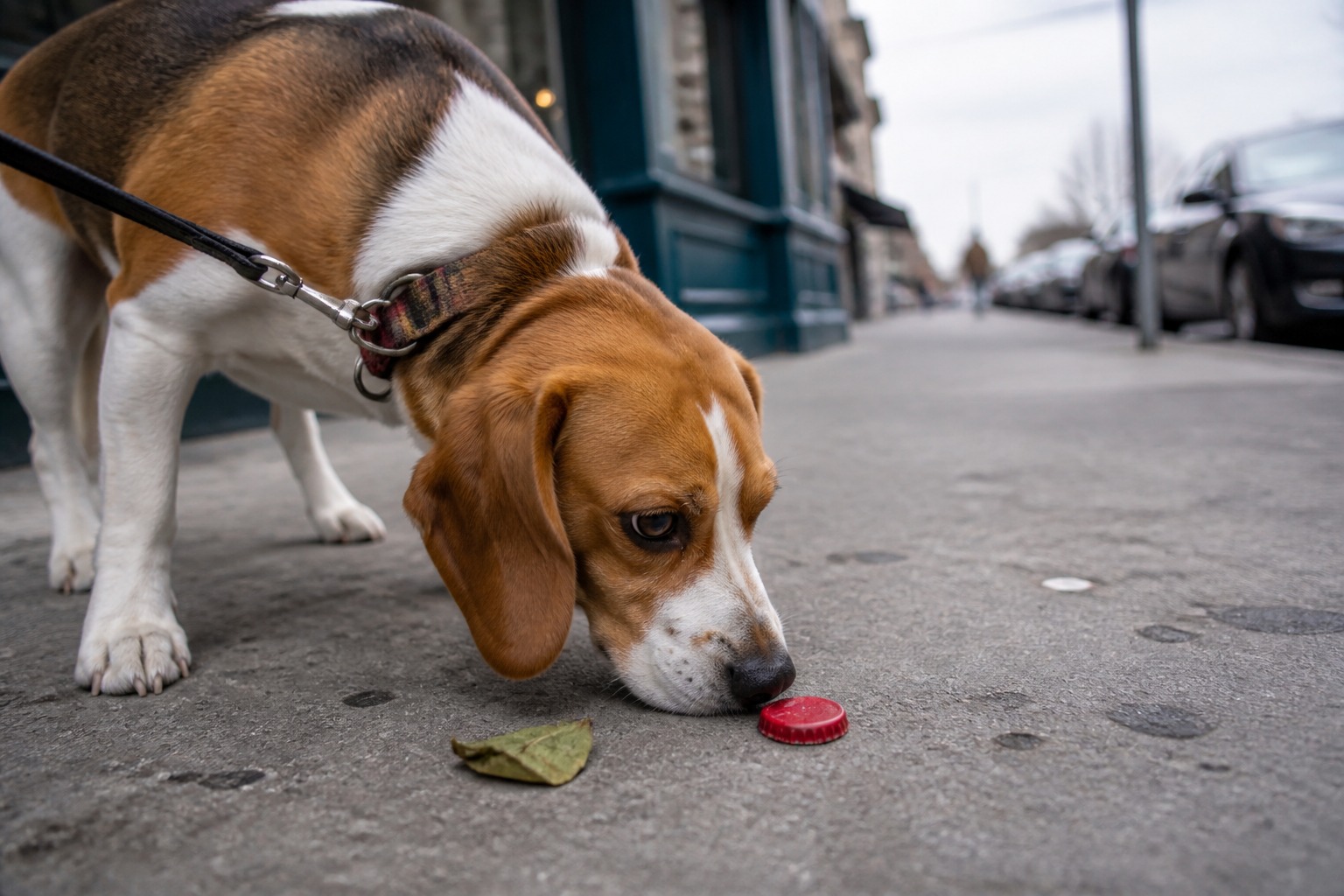
If your dog treats every walk like an all-you-can-eat buffet, gulping chicken bones, wrappers, mystery mush, and the occasional dead thing before you can react, you already know the fear: one wrong bite means a toxin, a choking scare, or an intestinal blockage and a very expensive night at the emergency vet. And you have probably also learned the frustrating truth that yelling “leave it” across the yard does approximately nothing.
Here is the reframe that changes everything. Scavenging is not disobedience. It is instinct. Dogs are scavengers, full stop, and some lean into it harder than others. You will never win by trying to out-command a nose that evolved to find and eat food. What works is treating it as a management problem in three layers: control the environment, give the drive a legal outlet, and train the cues as your backup, not your whole plan. When one layer fails, another catches the dog.
Layer one: control the environment
The fastest way to stop a dog from eating something dangerous is to make sure it is not within reach in the first place. You cannot stop people from littering or nature from producing rot, but you can choose where and how you walk.
Pick routes with the fewest temptations. Some spots are simply worse than others for trash, food waste, and hazards, so steer toward the cleaner ones and flatly avoid areas that could hide toxic items like hickory nuts or pecans. On quiet, low-traffic roads, walking in the roadway itself can keep your dog away from surprises tucked into hedges and lawns. This is not glamorous training. It is the layer that prevents the worst emergencies while everything else is still a work in progress.
The strongest environmental tool of all, for the dog who genuinely eats dangerous things, is a physical barrier. Which brings us to the safety net most people resist.
The muzzle nobody wants to use
Some owners quietly stop walking their dog altogether because they are terrified of what the dog might swallow. That trade, protecting the stomach by sacrificing the walk, is a bad one; walks are quality of life. A far better option is a barrier that lets the walk happen safely.
A well-fitted basket muzzle lets a dog pant, drink, and take treats while making it physically impossible to scarf down road finds. Choose a basket style, never a cloth one, because your dog must be able to pant to cool off. If the shame factor is what is stopping you, please let it go; a muzzle is a safety tool, not a confession that your dog is dangerous, and it can give both of you far better walks. For dogs who inhale rocks, worms, and trash, a mesh OutFox Field Guard, originally designed to protect dogs from foxtail awns, covers the whole head and blocks ingestion without interfering with panting, sniffing, playing, or drinking.
Layer two: feed the drive on your terms
Dogs who hoover up the world often find seeking and eating to be the best part of being alive. Suppress that with nothing to replace it and you are fighting biology. Give it a sanctioned outlet and you take the desperate edge off, which makes every other technique work better.
Turn mealtimes into a hunt. Instead of a bowl gulped in ten seconds, scatter your dog’s kibble across a wide area, or a big chunk of the kitchen floor, so they have to nose out every piece. A snuffle mat does the same job in a tidier package. Then add nose games on purpose: “Find It,” where your dog waits while you hide treats for them to track down, and “Which Hand,” where they nudge the hand hiding the treat and earn it for choosing right. A slow-feed bowl, with its built-in ridges and obstacles, stretches eating into a small puzzle too. None of this erases the scavenging instinct, but a dog whose brain and nose get a daily workout is far easier to redirect out in the world.
Layer three: train the cues as your backup
Now, and only now, the training. Cues are the layer that fails most often under real-world temptation, which is exactly why they should never be your only plan.
Build a bombproof “leave it.” Teaching the cue is the easy part; the real work is “proofing” it, getting your dog to respond in every situation, no matter how distracting the setting or how thrilling the treasure. A dog who obeys “leave it” in a quiet living room but not near a discarded burger has not actually learned it yet. This is where a good trainer earns their fee, because proofing a cue to the point that it works when it truly matters is genuinely hard.
Make checking in with you worth it. On walks, reward your dog every time they voluntarily glance back at you, and reward it with something outrageous: real chicken, a scrap of steak, something that can compete with the smells around them. A dog who learns that the good stuff only appears outdoors starts offering you their attention, which means you can call their focus away from a hazard before they ever reach it.
Teach a reliable trade. A dog who will swap what is in their mouth for something better is much safer. Build the value of trading first with low-stakes objects: the moment your dog grabs a toy, bring a high-value treat to their nose, say your trade cue as their mouth opens, and deliver the treat the instant they let go. Work up to higher-value objects over time. One serious caution: if your dog shows any sign of guarding what they have, stiffening, growling, snapping, or turning away, stop and bring in a qualified trainer before going further.
When scavenging is a red flag
Most scavenging is normal, if nerve-racking, dog behavior. But relentless, indiscriminate eating of non-food objects, sometimes called pica, can occasionally point to an underlying medical issue, so it is worth a vet conversation if the drive seems extreme or comes on suddenly. And know your emergency signs: if your dog swallows something and then vomits repeatedly, strains without producing stool, goes off food, or seems painful or bloated, that is a blockage until proven otherwise, and it is an immediate vet visit, not a wait-and-see.
Owners come in convinced their dog is stubborn, when really the dog is just being a dog. I tell them to stop trying to win the argument at the wrapper and start winning it earlier: manage the walk, drain the drive at home, and keep a muzzle in the bag for the days that matter. The cue is your seatbelt, not your brakes.
Dogs who eat everything are a genuine hazard, to themselves and your budget. But they are also, usually, dogs bursting with appetite for life. You do not have to crush that. You just have to build the layers that let them chase the world safely.
References
- ASPCA Animal Poison Control Center. “People Foods to Avoid Feeding Your Pets.” aspca.org
- Amengual Batle, P., et al. “Prevalence of Pica in Dogs: Behavioural and Medical Associations.” Journal of Veterinary Internal Medicine, 2020. doi.org/10.1111/jvim.15911
- American Kennel Club. “Foxtails: A Seasonal Danger to Dogs.” akc.org
Dr. Mehta is a board-certified veterinary nutritionist who evaluates pet food formulations, ingredient quality, and the science behind dietary trends. He writes and reviews all nutrition content at The Pet Times, including our food rankings and feeding guides.
Meet our experts ↗Keep reading
 TrainingA Laser Pointer Isn't a Toy. It's a Job Your Dog Can Never Finish.Dr. Nina Kohl · 7 min
 Health & WellnessIt's Not the Dog Kiss That's Risky. It's What's on the Tongue and Who's Getting Licked.Dr. Nina Kohl · 5 min
 FoodYou Can't Train a Dog to Eat Slowly. You Make It Physically Impossible.Dr. Lena Park · 6 min
 TrainingAggression Is Not Dominance. It's a Request for Distance That You Missed.Dr. Mara Chen · 11 min
 TrainingThe Most Dangerous Dog Isn't a Breed. It's the One Nobody's Reading.Dr. Mara Chen · 7 min
 TrainingYour Dog Isn't Being Possessive Over That Toy. They're Doing Math.Dr. Amara Solis · 8 min