


Your Dog Isn't Being Possessive Over That Toy. They're Doing Math.
Resource guarding is a cost-benefit calculation about loss, which is why every fix that works does the same thing: it changes what your approach predicts. Signs, training steps, and when to stop and call someone.

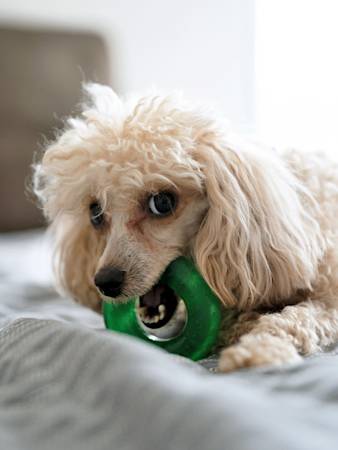
A dog standing over a toy with a hard stare and a low growl is not staging a coup. They are not confused about who owns the house. They are running a very simple calculation:
This thing is valuable. That human has taken valuable things from me before. If I make a noise, they usually stop.
Every part of that is rational, and every part of it is learnable. Which is the good news, because it means the fix is not a battle of wills. It is arithmetic. Change what your approach predicts, and the growl has no job to do.
Understand that, and the difference between the advice that works and the advice that makes things dramatically worse becomes obvious. Nearly everything that fails is a variation on “prove to the dog you can take it.” That does not disprove their math. It confirms it.
What guarding actually looks like
Guarding is common. In one study of shelter dogs, about 15 percent were assessed as resource guarders, and it showed up more in adult and senior dogs than in juveniles, and more in small and large dogs than in medium ones.
It is also mostly quiet, which is where people get hurt. Owners are generally good at spotting the loud end of the ladder and much less reliable at spotting the rungs below it. So learn the whole ladder:
Early, easy to miss: eating faster when you come near. Turning the body so the toy is on the far side. Hunching over it. Carrying it out of the room. Freezing mid-chew. A hard, still stare while the body stops moving.
Middle: a low growl. Lip curled. Whale eye, that white crescent you see when they track you without turning their head. Stiffening across the shoulders. Hackles up.
Late: snapping at the air. Lunging. Biting.
Growling gets punished in a lot of households, and this is one of the most dangerous mistakes in dog ownership. A growl is a warning, and a warning is a gift. Punish it enough times and you do not get a dog who stops guarding. You get a dog who stops warning, and goes straight from stillness to teeth.
What this is not
It is not the same as a dog destroying a toy. That is aggression toward a squeaker, and while it is a choking hazard worth managing, it is not directed at you.
It is not play. Play has a bouncy, loose body, an open mouth, a wagging tail, and play bows. Guarding has a still body, a closed mouth, and a fixed stare.
And it is not a breed trait you can screen out at the shelter. It is normal behavior in a normal dog. The research on which dogs guard points at temperament and history rather than pedigree: impulsivity and fearfulness both turn up as significant factors, as do mixed breeds and neutered males in survey data. Meanwhile “high toy drive” dogs guard more simply because they have more to lose.
Why the value keeps moving
One thing that confuses owners: the guarding is not stable. A tennis ball that triggered a fight on Tuesday might be ignored on Wednesday. Then it becomes precious again the second another dog picks it up.
That is not inconsistency, it is context. Value goes up when the item is scarce, when it is contested, when the dog is aroused, and when the dog has recently lost something. It goes down when they are bored of it.
The practical consequence is that you should not test your progress on the highest-value item you own. Do the training on things that barely matter, so that when the good chew comes out, the answer is already installed.
What to do the day you notice it
Do not wait to see if it gets better on its own. It typically does not, and escalation is the thing you cannot walk back.
Manage first, train second. Pick up the item they guard hardest. Give high-value chews only in a crate, a pen, or a separate room behind a closed door, and let them finish in peace. Management is not cheating. It is what stops a bite happening while you do the slow work.
Never pull anything out of a dog’s mouth. Not a toy, not a sock, not a chicken bone. If it is genuinely an emergency, trade it: throw a handful of good food across the room and pick the object up while they eat it.
Teach “drop” and “trade” when nothing is at stake. Ask for a drop on a boring toy, pay generously, and give the toy back. Do it fifty times. A drop cue that only ever appears when the dog is about to lose something forever is a cue that stops working.
Do not stage confrontations. The old advice to stick your hand in your dog’s food bowl, or to take the toy away “so they learn,” is the exact input that produces guarding. The research is unusually clear here: taking the dish away during meals is associated with more guarding, adding good food to it with less.
Stop the multi-dog free-for-all. In a household with more than one dog, do not leave contested items lying around. Separate spaces for chews. Identical toys if that helps. Scheduled turns with the prized one.
“The single most useful thing you can do is make your approach boring in the best possible way,” says Dr. Mara Chen. “Walk up, drop something wonderful, walk off. Do that a hundred times and the dog stops needing the growl, because the growl was never about the toy. It was about you.”
The step-by-step
The two techniques underneath the training are counterconditioning, changing the emotional meaning of your approach, and desensitization, working at an intensity your dog can handle and building up slowly. The four steps are in the how-to above, and the honest timeline is: days for a mild case, weeks or months for an established one, and it is not a race.
Two rules govern all of it. First, work under threshold, meaning at a distance where your dog is not reacting. If they freeze or stiffen, you are too close, and you have just practiced the thing you are trying to undo. Second, the session always ends with the dog ahead. They keep the toy, or they get it back. Every single time.
When to stop and call someone
Stop doing this yourself and hire a qualified behavior professional if:
- Your dog has snapped at or bitten anyone, at any intensity, including a bite that did not break skin
- There are children in the house
- The guarding is spreading, from toys to food to furniture to a person
- Your dog is guarding from a place of obvious fear, or the behavior appeared suddenly in a dog who never did it before, which can indicate pain and warrants a vet exam first
- You feel unsafe, at all
Look for someone who works with reward-based methods and has specific experience with resource guarding: a veterinary behaviorist, a certified applied animal behaviorist, or a credentialed trainer who will tell you plainly what their protocol is. Anyone who proposes to fix this by confronting the dog, or by “showing them who’s boss,” will make it worse, and you will be the one standing next to it when it does.
What newer research adds
Two findings from the last several years are worth knowing.
The first is that shelter guarding assessments predict less than we assumed. A study of dogs flagged as resource guarders in shelters found that a substantial share of them either did not guard in their adoptive homes, or guarded in ways the adopters managed without difficulty, and that adoption outcomes for these dogs were comparable to others. Behavior in a stressful kennel, over a plastic bowl, with a fake hand, is a poor proxy for behavior on a sofa in a quiet house. Dogs get labeled for life on the basis of a bad day.
The second is about what the guarding is telling you. The dogs who guard hardest are not the confident ones. Impulsivity and fearfulness both track with guarding, which fits the arithmetic model perfectly: an animal who expects to lose things is an animal who has, at some point, lost things.
The treatment follows from that. You are not winning an argument. You are building a track record.
References
- Jacobs, J. A., Coe, J. B., Pearl, D. L., Widowski, T. M., & Niel, L. (2018). Factors associated with canine resource guarding behaviour in the presence of people: A cross-sectional survey of dog owners. Preventive Veterinary Medicine.
- Jacobs, J. A., et al. (2018). Factors associated with canine resource guarding behaviour in the presence of dogs: A cross-sectional survey of dog owners. Preventive Veterinary Medicine.
- Mohan-Gibbons, H., et al. (2019). Characteristics and Adoption Success of Shelter Dogs Assessed as Resource Guarders. Animals, 9(11), 982.
- American Veterinary Society of Animal Behavior. Position Statement on Humane Dog Training. Accessed August 2026.
Common questions
How do I fix toy aggression?
Change what your approach predicts. Manage access to the highest-value items first, then use counterconditioning and desensitization: approach from a distance the dog is comfortable with, toss something better than what they have, and leave without taking anything. Train a paid 'drop' and 'trade' outside of guarding situations, on low-value objects, before you ever need them.
Should I take the toy away to show my dog who's in charge?
No. Taking valued items away by force is the most reliable way to make guarding worse, because it confirms exactly what the dog already believes. Research on resource guarding has found that removing a dog's food dish during meals is associated with more guarding, and adding good food during meals with less.
How do I stop two dogs fighting over toys?
Management first. Pick up the high-value items, feed and give chews in separate spaces, and give each dog their own scheduled time with the prized toy behind a closed door. Never break up a fight with your hands. If either dog has damaged the other, stop the household routine and get professional help.
Dr. Solis is a board-certified veterinary dermatologist with over twelve years of clinical experience. She advises on skin conditions, allergies, and grooming practices that affect coat and skin health. All dermatology and allergy content at The Pet Times is reviewed by her team before publication.
Meet our experts ↗Keep reading
 TrainingThat Bootie Wobble Isn't Funny. You Just Blindfolded Their Feet.Dr. Nina Kohl · 8 min
 TrainingThe Viral 'Run Away From Your Dog' Trick Works. You Get to Use It Once.Dr. Mara Chen · 7 min
 Health & WellnessThe Underwear Isn't the Joke. The Surgery Is.Dr. Lena Park · 7 min
 TrainingYour Dog Hates Citrus. That's a Free Training Tool.Sasha Ford · 5 min
 Health & WellnessIt's Not the Dog Kiss That's Risky. It's What's on the Tongue and Who's Getting Licked.Dr. Nina Kohl · 5 min
 FoodYou Can't Train a Dog to Eat Slowly. You Make It Physically Impossible.Dr. Lena Park · 6 min