


The Viral 'Run Away From Your Dog' Trick Works. You Get to Use It Once.
Trainers agree the TikTok hack can genuinely bring a bolting dog back. They also agree it's an emergency flare, not a recall, and using it as one is how dogs end up in the road.

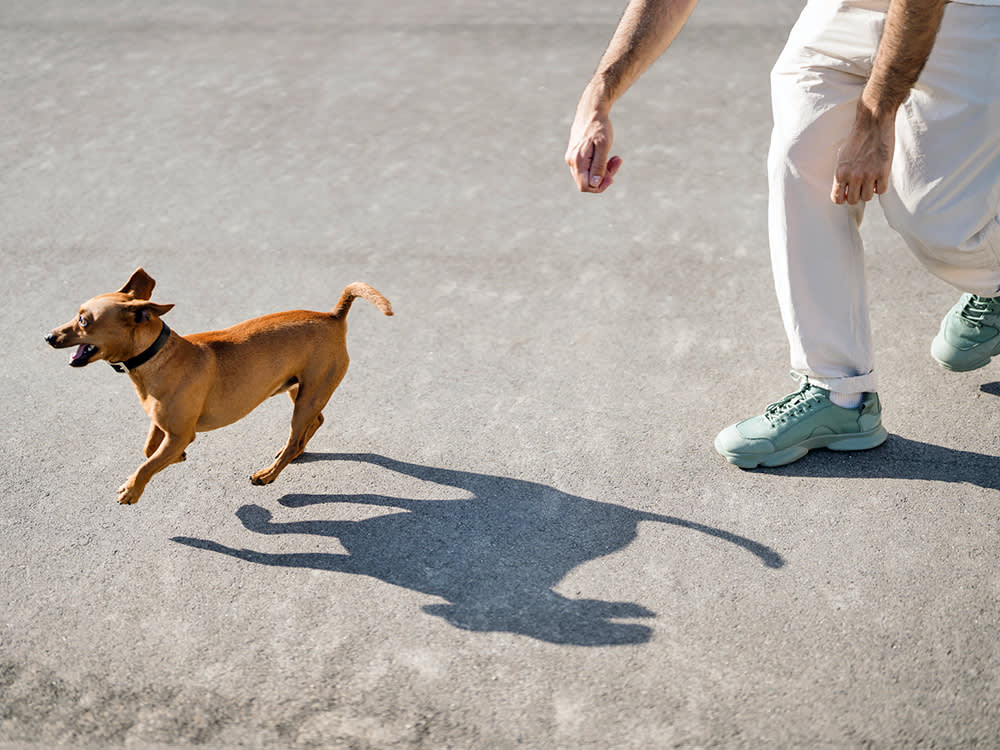
Your dog is gone. Out of the garage, off the leash, across the field, and the gap is widening because there has never been a moment in human history when a person outran a motivated dog.
Here is the piece of advice the internet will give you, and it is not wrong: stop chasing. Turn around. Run the other way, loudly and stupidly, like the whole thing is a game you started.
Plenty of dogs turn and follow. A Rover sitter went viral describing exactly this, after chasing a client’s escaped dog for eight or nine blocks, giving up, turning around, and having the dog immediately give chase. It worked. Comment sections filled up with people saying it had worked for them too, and with one very memorable dissent: it does not work on Huskies.
So the trick is real. But almost everything written about it gets the framing wrong, and the framing is the part that keeps your dog alive.
This is a flare, not a system. It is the thing you fire when the plan has already failed. It works because it exploits an instinct, and instincts do not care about your circumstances. Treat it as a recall, use it casually at the park because it worked once, and you will discover its failure modes at the worst possible moment.
Why it works at all
Two things are happening.
The first is chase drive. Movement away from a dog is the single most compelling stimulus in their world, which is why they chase squirrels, bikes, and joggers, and why they are frankly baffled that you keep failing to run. When you pursue a dog, you are on their side of the game and losing. When you flee, you flip roles and become the most interesting object in the field.
The second is a quirk called oppositional following. Dogs tend to orient to whatever is moving away, not toward. Chasing a dog often accelerates them, because a large predator bearing down on you is a reason to keep going, not to stop.
That is the entire mechanism, and it explains its limits precisely.
When it fails, and what happens when it does
A frightened dog. Terror does not run on chase drive; it runs on flight. A dog in genuine panic, from a firework, a car backfiring, a dog attack, has no attention left for your comedy routine. Running may simply add another moving object to a landscape they are trying to escape.
A dog locked onto scent. A hound following a line is in a different world. Sight-based tricks do not compete.
Anything near traffic. This is the one that matters. If you run and your dog follows, they follow at speed, on the line you chose. Run in a direction that crosses a road, and you have just called your dog into it. Before you use this trick, look at what is behind you.
Independent breeds. The Husky comment is funny because it is true. Dogs bred to work at distance and think for themselves are less reliably captured by “look, a human is doing something.”
What to actually do when a dog bolts
Run this in order. It takes about six seconds and it is worth rehearsing in your head before you ever need it.
-
Stop moving. Do not sprint after them. You will lose, and you will speed them up.
-
Do not scream the recall cue. If you shout “COME” eleven times into the middle distance and nothing happens, you have not failed to be heard. You have just taught your dog that the word is optional. Say it once, if at all, and only if you have something to make it pay.
-
Check the direction before you run. Where does “away” lead? If the answer is a road, a river, or a cliff, do not use this trick. Move so that fleeing from you sends the dog somewhere safe.
-
Then be ridiculous. Turn, run, squeal, slap your thighs, make the noise you make when the leash comes out. Some dogs respond better to a person dropping to the ground and lying flat, or crouching side-on, than to running: it is bizarre enough to be worth investigating and it is not threatening.
-
Do not lunge for the collar. The most common way this goes wrong at the last second: the dog comes back, you grab, they dodge, and now the game is keep-away and you are it. Let them come all the way in, feed them, then take hold of the harness, calmly.
-
Reward the return, always. Whatever they did, whatever they cost you, whatever you shouted. A dog who comes back and gets yelled at has learned that coming back is punished. There is not a trainer alive who will disagree with this, and it is the single hardest rule to follow while your hands are shaking.
Two practical items worth owning before the emergency: a long line (a 15 to 30 foot lead) for any dog whose recall is not proofed, and a GPS tracker on the collar. A microchip identifies your dog after someone finds them. A tracker tells you where they are going right now. Those are not the same product.
The recall you should have instead
None of the above is training. It is triage. The actual answer is boring and it takes months.
Understand why recall breaks. It does not break because dogs are stubborn. It breaks because coming back has historically been the worst available option: it ended the fun, it produced a leash, it was where the bath was. Meanwhile the alternative was a squirrel. Your dog is not defying you. They are choosing correctly, given the payment structure you built.
Make the return worth more than the thing they left. This means finding out what your dog actually values, which is often not the kibble in your pocket. Roast chicken. A tug toy that only exists for recall. A ball. Permission to go straight back to sniffing, which is a reward most people never think to use.
Set them up so failure is impossible. Long line, low-distraction environment, short distance. Every successful recall is a deposit; every ignored one is a withdrawal. Do not practice in an environment where you cannot win.
Say it once. Repeating the cue is the most common way owners degrade it. One clear word, then movement and sound to back it up, then a payment worth having.
Then add difficulty on purpose, one variable at a time. New location. Then mild distraction. Then a real distraction at a distance. Then closer. Do not go from the kitchen to the dog park and call it proofing.
Keep paying, forever. A recall that stops being paid stops being reliable, usually about eighteen months after the training class ends.
“Recall isn’t a word your dog knows, it’s a bet they’re making about what happens next,” says Dr. Ravi Mehta. “Every time they come back and something good happens, the odds shift. Every time they come back and the fun ends, they shift the other way. That’s all this is.”
What newer research adds
Recall is one of the most-studied practical skills in dog training, and the picture is consistent: reward-based methods produce better performance and lower stress than aversive ones, including for recall specifically. Studies comparing dogs trained with electronic collars against dogs trained with reward-based recall protocols have not found the shock collar to deliver superior results, and have found more stress-related behavior in the dogs trained with them. If someone tells you the only way to fix a recall is an e-collar, they are behind the evidence.
The other thing worth knowing, if your dog is a bolter, is that the highest-risk moments are predictable: fireworks holidays, moving house, the first weeks with a newly adopted dog, and open doors during deliveries. Most escapes are not mysterious. They happen on a small number of foreseeable days, which means they can be planned for.
The bottom line
If your dog is running and you have a clear, safe direction to run in: turn and go. It genuinely works, often enough to be worth knowing.
Then, the next morning, buy a long line and start building the thing that would have made it unnecessary. The trick is a party balloon. The recall is a bank account.
References
- China, L., Mills, D. S., & Cooper, J. J. (2020). Efficacy of Dog Training With and Without Remote Electronic Collars vs. a Focus on Positive Reinforcement. Frontiers in Veterinary Science, 7, 508.
- Ziv, G. (2017). The effects of using aversive training methods in dogs: A review. Journal of Veterinary Behavior, 19, 50–60.
- American Veterinary Society of Animal Behavior. Position Statement on Humane Dog Training. Accessed June 2026.
- American Society for the Prevention of Cruelty to Animals. Lost Pet Prevention and Recovery. Accessed June 2026.
Dr. Chen is a small-animal veterinarian who leads health and safety coverage at The Pet Times. She writes and reviews the bulk of our illness, condition, and safety content, translating clinical guidance into clear, practical advice owners can act on at home.
Meet our experts ↗Keep reading
 LivingDon't Teach Your Dog to Swim. Teach Them to Get Out.Dr. Priya Nair · 8 min
 Health & WellnessA Man Shot a Dog for Running at Him. He Was Never Charged.Marcus Webb · 8 min
 LivingThe Kayak Isn't What Hurts Dogs. The Water Is.Dr. Ravi Mehta · 8 min
 Training'Drop It' Is the One Cue That Might Save Your Dog's LifeDr. Nina Kohl · 8 min
 TrainingBefore You Cut a Hole in Your House, Answer This: What Else Can Fit Through It?Marcus Webb · 8 min
 TrainingYou Can't Bribe a Snow-Drunk Dog Inside. One Command Actually Works.Dr. Priya Nair · 7 min