


The Underwear Isn't the Joke. The Surgery Is.
Cloth and socks make up roughly a fifth of the objects surgeons pull out of dogs. Here's why your dog wants your underwear, and why management beats training on this one.

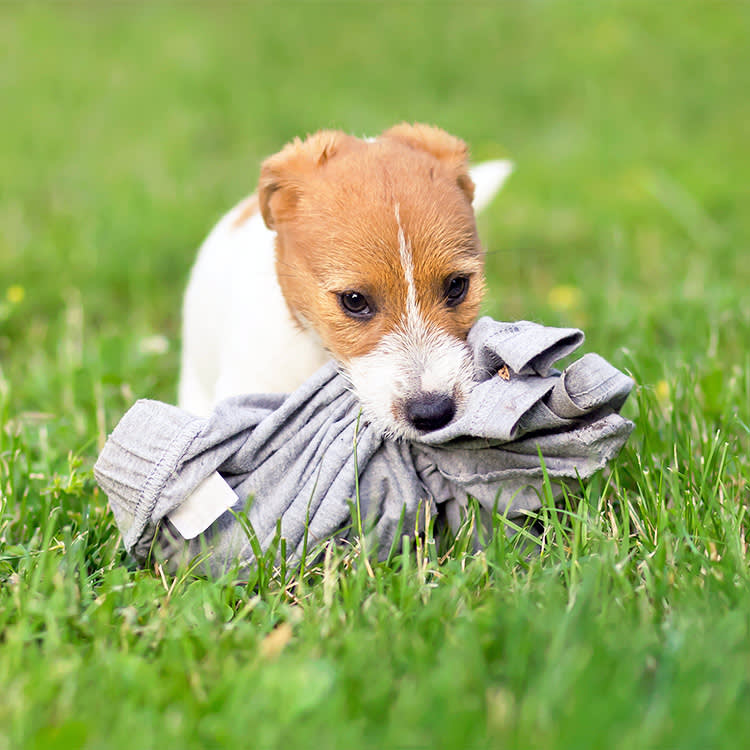
Every dog owner has a version of the story, and every version gets a laugh: the guest whose underwear turned up in the yard, the pair carried proudly into the middle of a dinner party. It is a funny thing that dogs do.
It is also, in the honest version, one of the most common reasons a dog ends up on an operating table.
When researchers catalogued the foreign objects removed from dogs’ digestive tracts in one clinical series, cloth accounted for about 13% of cases and socks another 8%. Put those together and roughly one in five of these dogs was opened up, or scoped, because of fabric. Kids’ toys were the only category that beat it.
So the useful frame is not “why does my dog have a weird thing for my laundry.” It is: your underwear is a swallowable object with a powerful smell attached, and the failure mode is surgical. Understanding the appeal helps. Managing access is what actually protects your dog.
Why underwear, specifically
Because it smells like you, and smell is the sense that matters. A dog’s nose is the primary channel through which they understand the world, and they are strongly drawn to concentrated, novel, salient odors. Underwear is arguably the single most information-dense object you own. It carries your scent at full strength, and dogs simply do not have the hang-ups about that which we do. Your dog is not being pervy. They are reading the most detailed document in the house.
Because they miss you. For a dog with separation anxiety, an object that smells intensely like their person is a coping tool. Chewing it is self-soothing. It is not a coincidence that these thefts so often happen while you are out.
Because they are bored. A dog with no outlet for their brain will find one. Fabric is a fantastic texture to work: it shreds, it gives, it makes noise. If your dog is under-stimulated, your laundry is the most interesting toy in the room.
Because, rarely, something is off medically. Pica, the compulsion to eat non-food items, is uncommon and is often driven by stress or anxiety rather than a nutritional gap, though genuine deficiencies can occasionally play a role. If your dog is eating a lot of non-food things across categories, that is a vet conversation, not a training one.
What happens if they swallow it
This is the part that turns the anecdote into an emergency.
Dogs cannot digest fabric. Once swallowed, one of three things happens. They vomit it back up, which is the good outcome and not one you can count on. It passes, which is the lucky outcome and also not something to plan around. Or it stops somewhere, and food and fluid stop with it.
Large pieces can cause choking on the way down. Once in the gut, fabric can lodge and obstruct, and an obstruction is a genuine emergency: pressure builds, the bowel wall’s blood supply is compromised, tissue starts to die, and perforation follows. Some underwear also contains synthetic materials and dyes that are not things you want dissolving inside a dog.
And here is the thing that makes fabric worse than a tennis ball. Underwear is often a linear foreign body, a long strip of material rather than a discrete lump. Linear foreign material is a specifically identified risk factor for necrosis and perforation, because instead of sitting in one place, it anchors at one end while the intestine keeps trying to pull the rest through, sawing at the bowel wall from the inside.
The number that should scare you into buying a hamper
Outcomes for dogs with gastrointestinal foreign bodies are generally good, which is genuinely reassuring, but the good outcomes are heavily front-loaded. In one series, dogs whose object was retrieved from the stomach, by endoscopy or surgery, survived at a rate of 100%. Dogs who needed an enterotomy, an incision into the intestine to remove the object, survived at 94%.
Dogs who needed an enterectomy, where a section of dead bowel has to be cut out and the ends sewn back together, survived at 33%.
That is the whole argument in three numbers. The difference between the best outcome and the worst is not really about the object. It is about how long it sat there. Duration of clinical signs, rising lactate, linear foreign material, and delay to surgery are all associated with necrosis and perforation.
Which is why the advice, “call your vet immediately,” is not defensive vet-speak. It is the difference between a scope and a resection.
People apologize to me for calling about underwear, and I always tell them the same thing: never apologize for calling early. The dog I worry about is the one whose owner waited two days to see if it would pass. By then I am not removing an object. I am removing intestine.
Signs of trouble
Get to a vet, without waiting, if you see:
- Repeated vomiting, especially if your dog cannot keep water down
- Refusing food, or refusing to eat and then vomiting bile
- Lethargy, or a dog who will not settle and cannot get comfortable
- A tense, painful, or distended abdomen, or a dog who braces when you touch their belly
- Straining to poop, or producing nothing
- A “praying” posture, chest down and rump up, which is a classic sign of abdominal pain
And if you know they ate it, call regardless of how well they look. Early on, an obstructed dog can look completely normal.
Management beats training on this one
Every trainer worth their salt says the same thing about this behavior, and it is not a training tip. It is a hamper.
Make the underwear unavailable. Buy a laundry hamper your dog cannot get into, with a lid, and use it every single time. Do not leave clothes on the floor or draped over accessible furniture. Keep closet doors shut. And do tell house guests, because the alternative is an extremely memorable conversation.
Then give the dog what they were looking for.
Provide chew outlets that are genuinely durable and genuinely appealing. Feed some meals out of puzzle toys. Take real walks with real sniffing time, since scent work is what tires a dog’s brain out. If the theft is anxiety-shaped, a chew toy will not solve it, and separation anxiety needs a proper plan.
Deterrent sprays make fabric taste unpleasant and can help at the margins. They are not a substitute for putting the laundry away.
Train the exchange, not the chase. Teach a solid “drop it,” and pay generously for it. The single fastest way to make underwear-stealing a permanent hobby is to chase your dog around the house for it, because you have just invented the best game they have ever played. Trade instead: high-value treat or favorite toy for the item, every time, no drama.
Be consistent. Cues mean what you consistently make them mean.
Better things to chew
- Durable rubber chew toys, the kind built for power chewers, last a long time and can be stuffed and frozen to buy you an hour.
- Edible chews work well, with supervision, so you can take them away when they get small enough to swallow whole. Skip hard bones for puppies.
- Puzzle and food-dispensing toys work the brain rather than the jaw, and mental work tires a dog out in a way a walk around the block does not.
What’s new since this was written
The surgical literature has gotten more precise about timing, and it all points the same way. Recent work on chronic gastrointestinal foreign body obstruction, cases where the object had been in place for a while before anyone acted, found exactly what you would expect: longer duration of clinical signs and linear foreign material predicted the worst findings at surgery.
The encouraging flip side is that early, uncomplicated cases do very well, and a 2025 study found that even in non-specialist practices, foreign body surgeries done promptly had good outcomes. The prognosis is not really about how good your surgeon is. It is about how fast you picked up the phone.
References
- Hobday, M. M., Pachtinger, G. E., Drobatz, K. J., & Syring, R. S. (2014). Linear versus non-linear gastrointestinal foreign bodies in 499 dogs: clinical presentation, management and short-term outcome. Journal of Small Animal Practice, 55(11), 560–565.
- Rousseau, A., et al. (2022). Endoscopic and Surgical Removal of Gastrointestinal Foreign Bodies in Dogs: An Analysis of 72 Cases. Animals, 12(11).
- Maxwell, E. A., et al. (2021). Outcomes of dogs undergoing immediate or delayed surgical treatment for gastrointestinal foreign body obstruction: A retrospective study by the Society of Veterinary Soft Tissue Surgery. Veterinary Surgery, 50(4), 177–184.
- Clinical findings and patient outcomes following surgical treatment of chronic gastrointestinal foreign body obstructions in dogs and cats: 72 cases (2010–2020). PMC.
- Kokocińska-Kusiak, A., et al. (2021). Canine Olfaction: Physiology, Behavior, and Possibilities for Practical Applications. Animals, 11(8), 2463.
- Uccheddu, S., et al. (2024). Do you need to chew? A case report on dogs’ behavioural needs. Veterinary Record Case Reports, 12(2).
Common questions
What are the signs of a blockage?
Repeated vomiting, refusing food, lethargy, a painful or tense belly, straining or failing to poop, and a dog who cannot get comfortable. Some dogs vomit the fabric back up on their own. Do not plan around that happening.
Will a deterrent spray stop it?
Sometimes, on some dogs, on some fabrics. Deterrent sprays are a support act. The reliable intervention is a lidded hamper and a closed closet door.
Not a substitute for your vet. Our guidance is educational. For urgent symptoms, contact a vet or emergency clinic right away. Editorial standards
Dr. Park is a board-certified emergency and critical care specialist. She reviews our health and safety content for clinical accuracy and contributes guides on recognising urgent conditions. Her focus is helping owners act quickly and correctly when it matters most.
Meet our experts ↗Keep reading
 TrainingYour Dog Hates Citrus. That's a Free Training Tool.Sasha Ford · 5 min
 TrainingYour Dog Isn't Being Stubborn About the Snow. They're Confused.Dr. Amara Solis · 7 min
 TrainingThe Most Dangerous Dog Isn't a Breed. It's the One Nobody's Reading.Dr. Mara Chen · 7 min
 TrainingYou Can't Out-Command Your Dog's Nose. Here's What Actually WorksDr. Ravi Mehta · 6 min
 FoodYou Can't Train a Dog to Eat Slowly. You Make It Physically Impossible.Dr. Lena Park · 6 min
 Health & WellnessYour Dog Eating Dirt Is Two Problems, Not OneDr. Priya Nair · 7 min