


Your Dog Isn't Being Stubborn About the Snow. They're Confused.
A dog who won't poop in snow isn't giving you a hard time, they're having one. The surface they were housetrained on has vanished, and the fix is a surface, not a scolding.

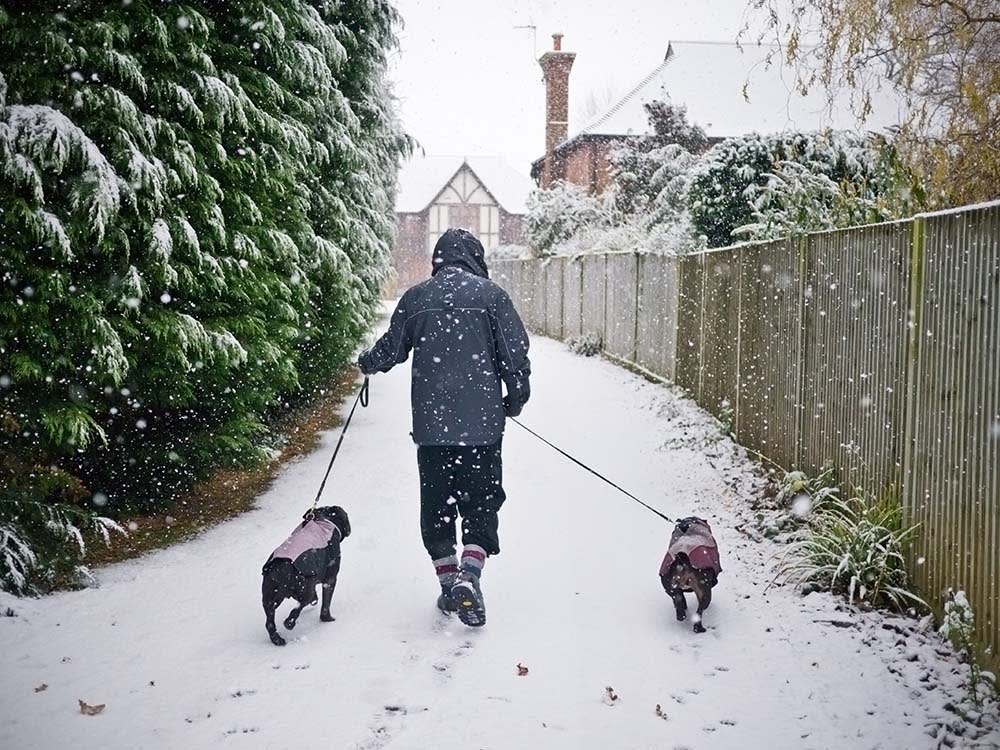
Your housetrained dog is standing in the yard at 6am, ankle-deep in fresh snow, refusing to poop. Twenty minutes later they are inside, and now they will poop, on your floor, with an expression of total innocence.
It is genuinely maddening. And the framing almost everyone brings to it, that the dog is being stubborn, is not just unkind, it is wrong in a way that stops you from fixing the problem.
Your dog is not defying you. Your dog is stuck. There is no negotiation happening here. They are confused, uncomfortable, or both, and every solution that works follows from taking that seriously. The ones that don’t work are the ones that treat this as a battle of wills.
What is actually going on in their head
Two things, and they stack.
They don’t know it’s allowed
Dogs form a substrate preference during housetraining. Whatever surface they learned on, grass, concrete, leaves, pee pads, tends to stay their preferred surface for the rest of their lives. It is one of the more durable things housetraining installs.
Then it snows, and the surface is simply gone. Not modified. Gone. From the dog’s point of view, the bathroom has been removed and replaced with a strange cold thing that they were, as far as they know, never given permission to use.
This is why puppies raised through a real winter, however miserable that is for you, rarely have this problem later. They learned that snow counts.
The encouraging part is that most dogs do figure it out, some instantly, some after a few tries. The evidence is all over every snowbank in America by February.
It physically feels bad
The other half is not psychological at all. It is cold. The air is cold, the ground is cold, and icy snow is unpleasant on paws that have no defense against it.
Worse, on many dogs the fur between the toes and along the legs and belly catches snow and packs it into ice balls that pull at the skin. If that is happening, your dog is not being dramatic. They are standing in something that actively hurts, and a dog who cannot relax cannot poop. Defecation requires a parasympathetic state, and “my feet are burning with cold” is not that state.
Small, slender, short-coated dogs suffer the most, and after a real blizzard, some of them physically cannot get their heads above the snow. Sympathy is not just kinder here, it is more accurate.
Fix the surface first. It solves most cases without training.
Here is the ordering insight that most advice gets backwards: this is usually an environment problem wearing a training problem’s clothes. Before you teach anything, change what is under their feet.
Shovel a path to real ground
Clear a route from the door to a patch of grass or dirt. Better yet, clear to a spot that is naturally protected from snow, under a balcony, against the house, beneath a dense tree. Dogs are far more willing to go when the snow-free zone is easy to reach and they can get back inside quickly.
Put something down
If bare ground is not available, bring the surface to them:
- Straw or hay. Cheap, effective, and enough on its own for a lot of dogs. It can stay in the yard.
- A scrap of old carpet thrown over the snow. Effective, and strictly disposable. By March it has been snowed on and pooped on for months, and no amount of hosing is bringing it back.
- Kitty litter scattered on ice, for traction. A dog who is slipping is a dog who will not squat.
Build the poop tent
Yes, it is a real thing, and yes, it works. It is exactly what it sounds like: a structure that keeps snow off a patch of ground so there is still grass or dirt underneath.
A cheap pop-up sports canopy does it, especially with plywood tacked to the sides so snow cannot blow through. So does a retired camping tent with the base cut away. So does anything you nail together yourself. Two requirements only: snow stays off the ground, and there is no floor, so the dirt underneath still smells like dirt. Some dogs walk to it. Some dogs get carried to it. Both are fine.
Keep the smell right
Keep up with poop pickup, more diligently than in summer, because frozen poop under new snow becomes a genuinely grim spring thaw project. But the spot itself should still smell like the spot. A familiar scent tells your dog the bathroom is still here, it is just wearing a hat.
Then dress them for it
For a lot of dogs, this is the entire fix, and it exposes something people miss: some dogs won’t potty in cold weather even when the ground is dry. It was never about the snow. It was about the temperature. They would simply rather be indoors, and if you insist otherwise, they will wait you out and use the hallway rug.
A coat helps. Boots or socks help more than people expect, especially for the ice-ball-between-the-toes dogs. The point is not fashion, it is buying them enough comfort to stay outside long enough to relax.
Go outside with them
Some dogs have shy bladders and want you gone. Others want the company and will hold it if you abandon them in a snowy yard.
Try standing out there. It works for a lot of dogs, though it may take several outings before it clicks. Set a limit: if five to ten minutes pass and nothing happens, go back inside. Standing there for forty minutes teaches your dog that going outside means being cold and stared at.
If the yard is a lost cause, try walks. Some dogs who freeze up in a snow-blanketed yard will happily go on a neighborhood walk, and following the trail of where other dogs have already gone, the yellow snow, is a genuine encouragement.
Train it, ideally before you need it
Everything above is management. Training is what makes it stick, and the timing is what nobody tells you: the moment to train this is not during a blizzard. It is during the first light dusting of the season.
Go back to housetraining 101. On a day with barely any snow on the ground, take your dog to the spot they normally use, give the potty cue you taught them, and wait. Patience is the whole skill here. When they go, pay them heavily, treats and real praise.
Repeat on every dusting the season gives you. Each one buys you the same lesson, which is the only one that matters here: snow is not a lid over the bathroom. Snow is a floor they are allowed to use.
Take them out to both the yard and on walks, so the skill generalizes. Flexibility about where they can go is the goal. As snow accumulates through the season, you may need to shovel a path or clear an area, depending on your dog’s size and how their attitude is evolving.
How cold is too cold to send them out
There are two questions hiding in this one, and they have different answers.
The safety question has an evidence-based answer. Most dogs are comfortable above 45°F. Small, elderly, or thin-coated dogs start needing protection below that. Between 20°F and 32°F, frostbite and hypothermia risk rises meaningfully, and coats, boots, and shorter outings stop being optional. Below 20°F is dangerous for most dogs, and time outside should be brief and supervised.
The Tufts Animal Care and Condition weather safety scale, which shelters and animal control officers use, adjusts those thresholds by circumstance, and the adjustments are the useful part:
- Cold-adapted breeds (northern, heavy-coated) tolerate more.
- Puppies and senior dogs should be moved up one threat level, meaning they are at risk earlier.
- Active precipitation, rain or snow, moves the threat level up by two. Wet is what actually kills.
- Dry, wind-blocked shelter with bedding moves it down one.
An average Husky handles a winter walk that would be dangerous for an average Basenji. Ask your own vet about your own dog, especially if they are very young, very old, very small, or sick. And note the distinction that matters here: a temperature too cold for a 45-minute walk is often perfectly fine for a two-minute trip to pee.
The other question, the one about at what temperature your dog decides they are done with all this, has a different answer. That one is entirely up to them. On the subject of when it is too cold to poop outside without your help, your dog holds the only expert opinion that counts.
What’s new since this was written
The practical shift in cold-weather guidance over the last few years is the emphasis on wet over cold. Temperature charts are easy to read and slightly misleading on their own, because a wet 30°F dog is in more trouble than a dry 20°F dog. That is why the Tufts scale bumps the risk by two full levels for active precipitation, and it is the single most useful thing to internalize going into a snowy potty routine: a dog who comes in soaked is a dog who lost more heat than the thermometer suggested.
The other update is a nudge toward gear that most people still skip. Boots have gotten dramatically better and cheaper, and for the dogs whose problem is ice packing between the toes, they are frequently the entire solution, no training required.
FAQ
How should I pick up poop out of snow? Immediately, before it freezes into the pack and turns into an archaeological dig come March. Bag or shovel, same as any other month.
What is with the snow-kicking afterward? One explanation is hiding the scent from rivals. Another is that no burying is intended at all, and the scratching is a scent-mark laid down by glands in the paws.
Is this a breed thing? It is a cold-tolerance thing, which tracks breed loosely. The refusers skew small, low-slung, lean, and thin-coated. That is physics, not personality.
References
- “Tufts Animal Care and Condition (TACC) Scales.” Tufts University School of Veterinary Medicine, via the Oregon Veterinary Medical Association.
Dr. Solis is a board-certified veterinary dermatologist with over twelve years of clinical experience. She advises on skin conditions, allergies, and grooming practices that affect coat and skin health. All dermatology and allergy content at The Pet Times is reviewed by her team before publication.
Meet our experts ↗Keep reading
 LivingEvery Trail Closed to Dogs Was Closed Because of a Dog OwnerMarcus Webb · 8 min
 LivingThe Kayak Isn't What Hurts Dogs. The Water Is.Dr. Ravi Mehta · 8 min
 Training'Drop It' Is the One Cue That Might Save Your Dog's LifeDr. Nina Kohl · 8 min
 Health & WellnessA Man Shot a Dog for Running at Him. He Was Never Charged.Marcus Webb · 8 min
 TrainingYou Can't Bribe a Snow-Drunk Dog Inside. One Command Actually Works.Dr. Priya Nair · 7 min
 TrainingBefore You Cut a Hole in Your House, Answer This: What Else Can Fit Through It?Marcus Webb · 8 min