


Stop Counting Your Puppy's Sleep Hours. Watch for the Change.
Everyone wants the magic number: 16 hours? 18? 20? The number is the least useful thing about puppy sleep. What matters is whether today looks like last week.
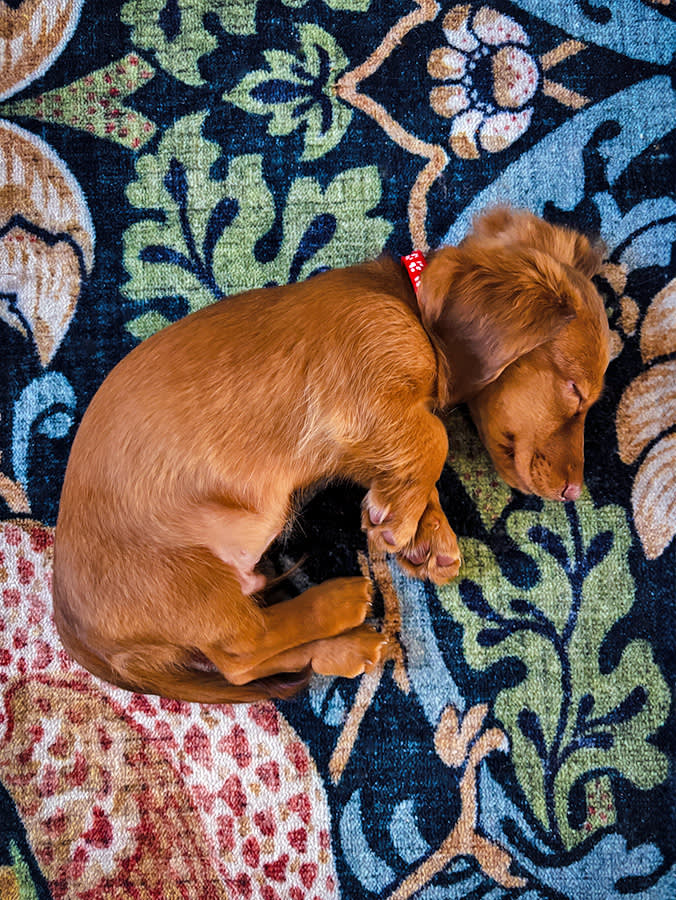
Search “how much should my puppy sleep” and you’ll get a number. Sixteen hours. Eighteen. Twenty. People write the number on the fridge and then spend the next month anxiously auditing a sleeping animal against it.
Here’s the problem with the number: it’s an average of an enormous range, and it will not tell you the one thing you actually want to know, which is whether your puppy is okay.
A Great Dane puppy and a Chihuahua puppy at the same age can be twenty hours apart in a week and both be perfectly healthy. Meanwhile, a puppy who quietly starts sleeping two extra hours a day, on schedule, in the normal range, may be the sick one.
So run a different test. Not “how many hours” but “is this puppy sleeping like themselves?”
The rough map, so you have one
You do need a ballpark, so here it is:
- 0 to 8 weeks: 18 to 22 hours a day, in short cycles of roughly 20 to 30 minutes.
- 8 weeks to 3 months: 18 to 20 hours, tapering.
- 3 to 6 months: around 16 hours, more if they’re a large breed.
- 6 months and up: roughly 12 to 14 hours, settling into an adult pattern.
Two things to notice. First, puppies almost never sleep in one continuous block. They nap every couple of hours, all day. Second, that number keeps shrinking. Sleep hours going down over the months is the shape you want.
Seven reasons the number is that high
1. Growth is expensive
A growing body is running cell division at a rate an adult body never touches, and sleep is when the growth hormone is released and the brain gets a chance to reorganize. That’s also why puppies go through phases of eating like they’ve never seen food. Growth burns fuel and demands downtime.
2. Sleep is where the training sticks
This is the underrated one. Sleep in dogs isn’t a pause in learning, it’s part of learning. EEG work has shown that what a dog is taught before a nap is consolidated during it, and a 2025 study in eNeuro went further, showing that memories could be reactivated and strengthened in family dogs during a plain daytime nap.
Practically: your puppy’s training session doesn’t finish when you put the treats away. It finishes when they sleep. A puppy who never gets the nap doesn’t get the lesson either.
3. Recovery from play
The more active the day, the more sleep the body needs to rebuild it. Puppies spend a much larger share of their waking hours in genuine exertion than adult dogs do, and it’s paid for in naps.
4. Size and breed
The bigger the puppy, the more sleep they generally want. Small dogs are often busier per minute, but a big dog is moving a lot more mass around and expends more total energy doing it. If you have a giant-breed puppy who sleeps more than your friend’s terrier, that’s the physics, not a problem.
5. Meals
Post-meal napping is normal, and it isn’t a “food coma.” Blood flow shifts toward the digestive tract after eating, and puppies get sleepy. Because puppies eat several small meals a day, you get several post-meal naps a day.
6. Temperature
Heat flattens dogs. In hot weather your puppy will sleep more, and that’s usually fine. The reverse is a sneakier problem: a puppy who is too cold often doesn’t sleep enough, because they can’t get comfortable and keep waking up. Keep the sleep space at a steady, moderate temperature, and remember that a cold puppy shows up as a badly behaved puppy, not a shivering one.
7. Illness
Sleeping more is one of the first ways a puppy tells you they feel unwell. It rarely arrives alone. Watch for appetite loss, vomiting, diarrhea, or a fever alongside it.
The actual test: change against their own baseline
Here’s the reframe. Your puppy’s normal is theirs. Learn it, then watch for departures from it.
Signs a puppy is sleeping too much
Not “more than 16 hours.” Look for: they’d rather nap than play, they don’t get up to greet you at the door, they’ve lost interest in the things they used to live for. A puppy who skips the good stuff to keep sleeping is telling you something. That one’s a vet call, even if the raw hours look textbook.
Signs a puppy isn’t sleeping enough
This is the one owners consistently misread, because sleep-deprived puppies don’t act sleepy. They act wired. An overtired puppy is more likely to be mouthy, bitey, noisy, and hard to reach. They may tire out fast on a walk they used to handle. They may get clingy, or take themselves off to hide. Almost every “hyper puppy” I meet is a puppy who has been kept awake by a well-meaning family who thought they needed more stimulation.
“The two mistakes are opposite and equally common,” says Dr. Ravi Mehta. “One family panics because a healthy puppy is sleeping twenty hours a day, and one family exhausts a puppy trying to tire them out. If you’re going to remember one thing, remember that a wild puppy at 8 p.m. is almost never under-exercised. They’re under-slept.”
Night owl puppies
If your puppy is sleeping through the day and looking for a party at 11 p.m., you don’t have a sleep-quantity problem. You have a schedule problem. Shift them: more waking activity, meals, and gentle training during daylight, and a quiet, boring house in the evening. That’s a fix that takes days, not weeks.
How to actually protect the sleep
- Give them a quiet spot that is genuinely out of the way. Not the hallway. Not the middle of the kitchen. A place where they will not be stepped over every four minutes.
- Regulate the temperature. Not too hot, not too cold, and consistent.
- Give them a bed big enough to change position. Puppies sleep curled, sprawled, and belly-up, and they need room to do all three.
- End play and training sessions before they’re wrung out. Some puppies will play until they collapse. Don’t offer them the chance. Short sessions, hard stops.
- Build a nap into the routine after every training session, on purpose, because that’s where the learning gets filed.
- Make the night boring and the day interesting. Nothing shifts a schedule faster.
What newer research adds
The most interesting recent work isn’t about how many hours puppies sleep. It’s about what the sleep is doing.
Family dogs have turned out to be an unusually good model for sleep research, and that’s produced a run of studies on sleep and memory in dogs specifically. EEG studies have shown that dogs learn better across a nap than across an equivalent period of wakefulness. In 2025, researchers went a step further and showed that memories could be reactivated during a daytime nap in ordinary pet dogs, strengthening what the dog had learned beforehand.
For a puppy owner, that changes what a nap is. It’s not the empty time between training sessions. It’s the part where the training gets written down. If your puppy is struggling to retain something you’ve practiced a dozen times, the honest first question is not “are they stubborn” but “when did they last get a real sleep.”
References
- “The interrelated effect of sleep and learning in dogs (Canis familiaris); an EEG and behavioural study.” Scientific Reports, 2017. nature.com
- “The Effect of Targeted Memory Reactivation on Dogs’ Visuospatial Memory.” eNeuro, 2025. eneuro.org
- Bunford, N., et al. “Sleep in the dog: comparative, behavioral and translational relevance.” Current Opinion in Behavioral Sciences, 2020. sciencedirect.com
- “Sleep and cognition in aging dogs. A polysomnographic study.” PLOS ONE, 2023. PMC
Common questions
How much should a three-month-old puppy sleep?
Around 16 hours a day is typical at three months, and large-breed puppies often land above that. Expect it as many short naps rather than one long block.
Why is my three-month-old suddenly sleeping so much?
Growth, a hard week of play or training, recent vaccinations, a new home, heat, or a schedule change can all push sleep up temporarily. But a jump in sleep with any other change, like less appetite, vomiting, diarrhea, or a puppy who won't get up for things they normally love, is a call to your vet.
At what age do puppies stop sleeping so much?
By about six months, most puppies settle into an adult-ish pattern of roughly 12 to 14 hours a day. Large, giant, and very active breeds often stay at the top of that range or above it well past six months.
Can I let my puppy sleep as much as they want?
Mostly yes. A healthy puppy self-regulates. Your job is to make sleep possible, not to ration it. The exceptions are a puppy sleeping through the day and partying at night, which needs a schedule shift, and a puppy sleeping more than their own baseline, which needs a vet.
Dr. Solis is a board-certified veterinary dermatologist with over twelve years of clinical experience. She advises on skin conditions, allergies, and grooming practices that affect coat and skin health. All dermatology and allergy content at The Pet Times is reviewed by her team before publication.
Meet our experts ↗Keep reading
 First DaysYour Puppy's First Vet Visit Is Won Before You Leave the HouseDr. Ravi Mehta · 8 min
 Health & WellnessPuppy Breath Doesn't Go Bad. It Goes on Schedule.Dr. Mara Chen · 6 min
 Health & WellnessYour Puppy Was Probably Born With Worms. Here's the Schedule That Clears Them.Dr. Priya Nair · 6 min
 First DaysThe Only Puppy in the Litter Missed a Class. It Shows Up Years Later as a Bite.Dr. Nina Kohl · 9 min
 First DaysYour Puppy Isn't Manipulating You. Stop Letting Them Cry It Out.Dr. Nina Kohl · 6 min
 TrainingYour Dog's Nibble Is a Dial, Not a Switch. You're Turning It the Wrong Way.Dr. Nina Kohl · 9 min