


Letting Your Dog Sleep in Your Bed Isn't Spoiling Them. The Science Sides With You.
The old rule said the bed was off-limits or you'd lose your dog's respect. That rule was built on a myth that's been dead for years. Here's what sharing a bed with your dog actually does, the good and the genuinely worth-knowing bad.

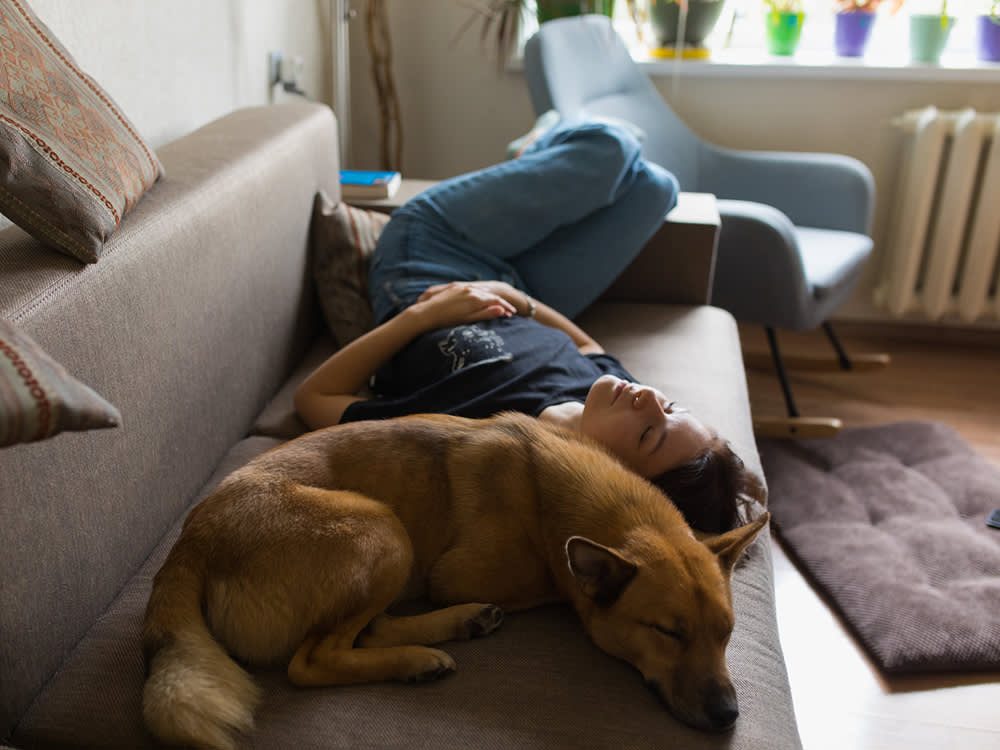
If you have ever felt a flicker of guilt about the dog sprawled across your comforter, taking up more than their fair share and stealing the covers, you can let it go. The rule you are half-remembering, the one that says letting a dog in the bed will cost you their respect and wreck your training, is not a rule. It is a myth, and a thoroughly discredited one.
That myth grew out of old ideas about dominance, the notion that you had to constantly out-rank your dog to have a well-behaved one, and that a dog on the bed was a dog getting ideas. Trainers and behaviorists have spent years explaining why that framework is not just wrong but actively damaging to the relationship. It has been out of favor in the serious dog world for a long time. And yet the residual shame lingers, which is a shame in itself, because most of what sharing a bed with your dog does is good.
So the honest answer to “should I let my dog sleep in my bed” is usually yes, with a few real caveats worth knowing. Here they are, in both directions.
Why it’s mostly a good idea
Most dogs want to be right there at night, whether that looks like pressed against our side, curled at our feet, or draped directly on top of us. That desire is not a problem to manage. It is a bid for connection, and meeting it does real things for both of you.
It calms both of you down. The closeness lowers stress. For a dog, having their person nearby can take the edge off the noises that would otherwise put them on alert, and plenty of people sleep more soundly with a dog beside them for the same reason. There is also a straightforward chemical payoff: physical contact with a dog, the kind that is basically unavoidable when you share a bed, triggers oxytocin, the same bonding hormone that links a parent and infant. Petting a dog lowers blood pressure and eases you into the relaxed state that makes for better rest. Add the plain animal comfort of a warm body on a cold night, the literal meaning behind the phrase “three-dog night,” and the case mostly writes itself.
It can alert you to problems. Sleeping in contact with your dog means you notice things, restlessness, itchy skin, a bad dream, a night that is somehow off. That proximity turns you into an early-warning system for your dog’s health without any effort at all.
I tell clients the burden of proof runs the other way now. The question isn’t whether you’ve earned the right to let your dog on the bed. It’s whether you have a specific reason to keep them off, like allergies or a partner who can’t sleep. Absent that, the bond you build overnight is worth far more than an outdated worry about dominance.
The downsides worth taking seriously
This is not a blanket endorsement. A few genuine drawbacks deserve an honest look.
Allergies and asthma. This is the big one. Many people with asthma or allergies find their symptoms worsen with a dog in the bed, or even just in the bedroom overnight. If that is you, this is a medical question, not a willpower one. Talk to your doctor, and know that the answer is rarely all-or-nothing: more distance, less frequent co-sleeping, or targeted treatment can sometimes make it workable. Follow the medical advice you get.
Your relationship with a human. People hold strong and opposing views on dogs in the bed, and couples have genuinely feuded over it. If you and your partner do not agree, the friction can strain the relationship, and the dog often senses the tension over being unwelcome. A shared bed with a dog is wonderful when everyone in it, humans included, is content and sleeping well. When it is quietly wrecking someone’s rest or the partnership, that is a real cost.
Your sleep quality, a little. The data here is reassuringly mild. A 2017 study measured sleep efficiency, the share of time in bed actually spent asleep, for healthy middle-aged women with a dog on the bed versus a dog in the room but off the bed. On the bed scored 80 percent; in the room scored 83 percent. That is a small gap, and sleep experts consider both figures perfectly good. In separate research, upward of 40 percent of the people who shared a bed with their dog reported no disruption to their rest whatsoever, and a subset said it actually helped, pointing to warmth, comfort, and companionship that felt especially welcome when a human partner was away. Only around one in five described any genuine disruption. For most people, the sleep cost is negligible.
The myth that won’t die: separation anxiety
Somewhere along the way, people got told that letting a dog sleep in the bed causes separation anxiety. There is no evidence for it. The confusion is a classic mix-up of cause and effect. Dogs with separation anxiety desperately want to be near their person, at night included, so of course they gravitate to the bed. The co-sleeping is a symptom of the anxiety, not its source. Kicking an anxious dog off the bed will not fix the anxiety; it just removes one of the comforts helping them cope.
The genuinely cool part: sleep makes your dog smarter
Here is a reason to value your dog’s sleep, wherever it happens, that most people never hear. Sleep is when learning sticks, for dogs as much as for us.
In one Hungarian experiment, dogs were taught brand-new cues, the English words “sit” and “lie down,” which were meaningless to them going in, so the commands were genuinely novel. A nap followed, and while the dogs slept their brains produced the same sleep-wave signatures tied to memory consolidation in other species. The key players are sleep spindles, bursts of activity during non-REM sleep that predict how well memories lock in, in people and rats alike. Dogs with denser spindles after a training session recalled the new cues better later. Intriguingly, and just as in humans, female dogs showed more spindles and better retention than males.
Sleep quality tracks the day, too. In another study, dogs put through something unpleasant, tied up on their own, or made to sit while a silent stranger stared at them, slept worse than dogs who had spent the time playing or being petted. The stressed dogs actually dropped off faster but got less deep sleep and more REM, the fitful pattern of a rough night. A bad day can genuinely cost a dog a good night, which may leave them tired and irritable the next day, exactly as it would you. Sleeping close to your dog can both help them cope and let you notice when their sleep is off.
About those sleeping positions
None of this is meant to police how your dog sleeps once they are up there. Dog sleeping positions are gloriously strange, dogs folded off furniture like a Dali painting, twisted upside down, sprawled in shapes that look anatomically impossible. As long as your vet sees nothing worrying in the way your dog sleeps, this is just one more case of letting dogs be dogs. Getting a front-row seat to the contortions is, honestly, one of the underrated perks of sharing a bed.
The short version: dogs love being near their people, people love being near their dogs, and a shared bed makes most of both feel safe, warm, and loved. Barring allergies or a sleep-deprived housemate, the guilt is unwarranted. Steal the covers back and enjoy it.
References
- Kortekaas, K., and Kotrschal, K. “Does the Dog on the Bed Improve or Impair Sleep? Sleep Efficiency in Human-Dog Co-Sleeping.” Sleep research on co-sleeping arrangements.
- Iotchev, I.B., et al. “The Interrelated Effect of Sleep and Learning in Dogs (Canis familiaris): An EEG and Behavioural Study.” Scientific Reports.
- Kis, A., et al. “Sleep Macrostructure Is Modulated by Positive and Negative Social Experience in Adult Pet Dogs.” Proceedings of the Royal Society B.
- Chomel, B.B., and Sun, B. “Zoonoses in the Bedroom.” Emerging Infectious Diseases (CDC). cdc.gov
Dr. Park is a board-certified emergency and critical care specialist. She reviews our health and safety content for clinical accuracy and contributes guides on recognising urgent conditions. Her focus is helping owners act quickly and correctly when it matters most.
Meet our experts ↗Keep reading
 TrainingYour Dog Isn't Peeing on His Friend. He's Peeing on the Message Underneath Him.Dr. Amara Solis · 8 min
 Health & WellnessYour Dog Doesn't See the World. They Smell It.Dr. Ravi Mehta · 10 min
 Health & WellnessYour Old Dog Staring at the Wall Is Veterinary Medicine's Most Missed DiagnosisDr. Nina Kohl · 8 min
 Health & WellnessYour Dog Sleeps 14 Hours a Day. That's Not Lazy, It's Wiring.Dr. Lena Park · 8 min
 First DaysStop Counting Your Puppy's Sleep Hours. Watch for the Change.Dr. Amara Solis · 8 min
 TrainingYour Dog Puts Up With Being Picked Up. That's Not the Same as Loving ItDr. Lena Park · 7 min