


Your Dog's Sleeping Position Is Mostly a Thermostat. One Pattern Isn't.
Most of what your dog's sleeping position tells you is about temperature and joints, not trust. But there is one shape that's worth paying attention to, and one thing that matters far more than any pose.

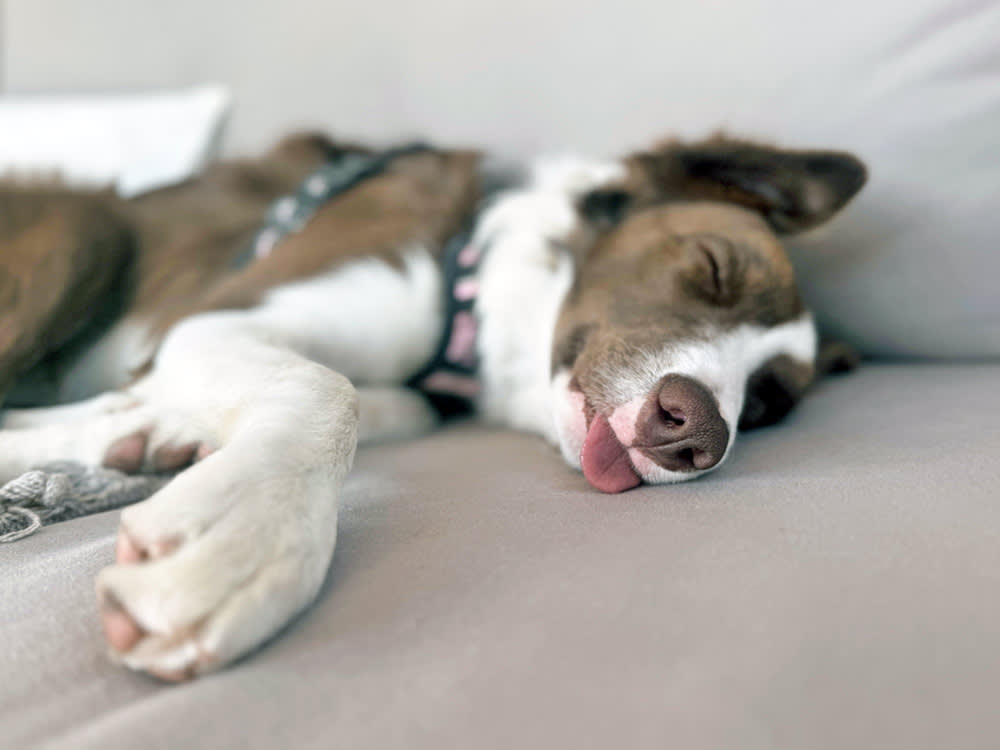
There is an entire cottage industry built on the idea that the shape your dog makes when they fall asleep is a window into their soul. Belly up means they trust you completely. Curled tight means they’re afraid. Sphinx means they’re on guard.
Here is the less romantic truth, and the more useful one: the single biggest driver of how a healthy dog arranges their body for sleep is heat. The second is joints. Emotional state is real, but it is the third variable, and it almost never shows up in one pose on one afternoon. It shows up as a pattern that doesn’t change.
So instead of reading your dog like a tarot card, read them like a thermostat, then look for the one thing that actually deserves your attention.
Start with the boring explanation, because it’s usually right
A dog on their back with their legs in the air has exposed the thinnest-furred part of their body, the belly and the groin, to the air. That is not a philosophical statement. That is a cooling strategy, and it is the same one they use when they flop onto tile in August.
A dog curled into a tight ball with their nose tucked under their tail has done the opposite. They’ve minimized the surface area losing heat and covered the nose, which is one of the few places a dog sheds warmth efficiently. Cold room, thin coat, drafty floor: the donut appears.
Run the temperature check before you run the psychology. Is the room warm? Is your dog a lean, short-coated breed sleeping on a hardwood floor in January? Has the heat just kicked off? Most “my dog suddenly sleeps curled up” mysteries end right here, and they end with a blanket.
Then check the joints
The second driver is orthopedic, and it’s the one people most often miss because it looks like a preference.
Young dogs sprawl. They flop onto their backs, they sploot with their back legs stretched flat behind them, they contort into shapes that make your own hips ache to look at. They can, so they do.
Older dogs stop. A dog who spent eight years sleeping belly-up and now sleeps only on their side, or who used to sploot and now won’t, has usually made that change because a position that used to feel fine no longer does. Hip dysplasia, arthritis, and lumbosacral pain all quietly edit a dog’s sleeping repertoire before they ever produce a visible limp.
Sleeping posture is one of the earliest places I see orthopedic pain announce itself, and owners almost never bring it up because it doesn’t look like pain. The dog isn’t crying. They just stopped lying a certain way. If a position your dog loved for years quietly disappears, that’s worth a physical exam long before you’d think to book one.
Seniors also sploot for a reason that has nothing to do with flexibility: pressing the belly and groin against a cool floor is an efficient way to dump heat when a thick coat and a slow metabolism are working against you.
The pose that actually deserves attention
Now for the exception, because there is one.
The signal is not the tight curl. The signal is a tight curl that never relaxes.
A dog who is new to your home, whether they came from a shelter, a foster, or a boarding kennel, will often sleep compressed for the first several days. Small, tucked, nose covered, back to a wall. That is an animal in a place they have not yet decided is safe, and it is completely normal for a while.
What is not normal is that shape still being there three or four weeks in. A dog who has lived with you for a month, in a warm room, on a soft bed, and still cannot bring themselves to unfold is telling you something. Not that they hate you. That they have not yet concluded the environment is predictable enough to let their guard down in it.
The fix is not more affection, which usually reads to an unsettled dog as more pressure. It’s predictability. Feed at the same times. Walk the same route. Give them a spot they can retreat to that nobody, including you, invades. Let them approach you rather than the reverse. The unfolding, when it comes, is one of the better things you’ll get to watch.
Where you both sleep matters more than how
Here’s the part that gets left out of every sleeping-position explainer, and it’s the part with the best evidence behind it.
Researchers using non-invasive polysomnography, the same setup used in human sleep labs, have been recording family dogs’ brain activity while they nap. One recent study found that dogs’ sleep architecture is measurably worse when they sleep in the company of a stranger instead of their own person. Not just “the dog seemed restless.” Different sleep structure, on an EEG.
Other work from the same group has shown that disrupting a dog’s non-REM sleep specifically changes how they process human emotional expressions the next day. Sleep quality in dogs isn’t cosmetic. It feeds directly into how well they read you.
Which means the useful question isn’t “what does the donut mean.” It’s: does your dog have somewhere warm, quiet, and defensible to sleep, near the people they trust, without being stepped over every ten minutes? That does more for them than any amount of pose-reading.
When the sleeping position is a medical problem
A few things move this out of the realm of curiosity:
- Sleeping with the head propped up, or the neck extended, night after night. Dogs with compromised airways or fluid in the chest will instinctively position themselves to open the airway. On its own it’s often nothing. Paired with any breathing change, it isn’t.
- Labored breathing while asleep, visible effort in the belly or ribs, gum color that looks off, or a respiratory rate that stays above roughly 30 breaths per minute in a resting, sleeping dog.
- An abrupt, unexplained change in preferred position, especially toward stiffness, guarding one side, or refusing to lie down at all.
- Restlessness and circling before finally settling, in a dog who used to just flop.
Twitching, paddling, muffled woofing, and eye movement under closed lids are all ordinary REM sleep and are not causes for concern. A dog who cannot be woken, or who wakes disoriented and aggressive, is a different conversation, and one to have with your vet.
What newer research adds
The most interesting recent work on dog sleep isn’t about poses at all. It’s about who your dog sleeps near.
Sleep researchers now record dogs’ brain waves the way they record ours, using sensors taped to the head while the dog naps normally. In one 2025 study, dogs slept measurably worse when their owner wasn’t the person in the room with them. Their sleep didn’t just look choppier, it was structurally different.
That’s a small finding with a practical edge. If your dog is boarding, staying with a sitter, or newly adopted, expect their sleep to be genuinely poor for a while, and expect that to show up as a shorter fuse, a slower recall, and more reactivity the next day. It isn’t stubbornness. They’re tired in a way you can now measure.
FAQ
Does sleeping on their back really mean my dog trusts me? It’s compatible with a relaxed dog, but it’s weak evidence on its own. Warm room, young joints, and a soft surface will get you a belly-up dog whether or not there’s any deep bond involved. Trust shows up in the whole pattern, not one nap.
My newly adopted dog only sleeps curled up. Should I be worried? Not in the first few weeks. That’s typical for a dog still deciding whether a place is safe. If it’s still the only shape they sleep in after a month in a warm home, work on routine and predictability, and talk to a trainer or your vet if it isn’t budging.
Why does my dog burrow under blankets? Usually warmth, sometimes the enclosed feeling itself, occasionally both. It only becomes a question worth asking when the burrowing is a response to something, a noise, a visitor, a specific room, rather than a bedtime habit.
Is splooting bad for my dog’s hips? For most dogs it’s a comfortable position they choose because it feels good, and a cool floor is doing thermal work for them. A dog who suddenly starts or stops splooting is more interesting than one who always has.
References
- Bunford, N., et al. “Sleep in the dog: comparative, behavioral and translational relevance.” Current Opinion in Behavioral Sciences, 2019. https://www.sciencedirect.com/science/article/pii/S2352154619301378
- Kis, A., et al. “REM versus Non-REM sleep disturbance specifically affects inter-specific emotion processing in family dogs (Canis familiaris).” Scientific Reports, 2020. https://www.nature.com/articles/s41598-020-67092-5
- “Family Dogs’ Sleep Macrostructure Reflects Worsened Sleep Quality When Sleeping in the Absence of Their Owners: A Non-Invasive Polysomnography Study.” PubMed Central, 2025. https://www.ncbi.nlm.nih.gov/pmc/articles/PMC12608857/
- Carreiro, C., et al. “Potential Physiological Parameters to Indicate Inner States in Dogs: The Analysis of ECG, and Respiratory Signal During Different Sleep Phases.” Frontiers in Behavioral Neuroscience, 2019. https://www.ncbi.nlm.nih.gov/pmc/articles/PMC6755330/
Dr. Kohl is a board-certified veterinary dentist with a particular interest in preventive oral care. She reviews all dental health content at The Pet Times and contributes practical guides on home dental routines, professional cleaning, and oral disease prevention.
Meet our experts ↗Keep reading
 TrainingYour Dog Puts Up With Being Picked Up. That's Not the Same as Loving ItDr. Lena Park · 7 min
 Health & WellnessYour Dog Sleeps 14 Hours a Day. That's Not Lazy, It's Wiring.Dr. Lena Park · 8 min
 Health & WellnessA Longer Walk Won't Fix This. 7 Signs Your Dog Is Under-Exercised.Dr. Amara Solis · 9 min
 TrainingLetting Your Dog Sleep in Your Bed Isn't Spoiling Them. The Science Sides With You.Dr. Lena Park · 7 min
 Health & WellnessYour Dog Becomes an Adult Three Separate TimesDr. Ravi Mehta · 9 min
 TrainingYour Dog Isn't Peeing on His Friend. He's Peeing on the Message Underneath Him.Dr. Amara Solis · 8 min