


Your Cat Holds a Picture of You in Their Head, Even When You Leave the Room
A cat tracking your voice through the wall isn't just good hearing. It's evidence they keep a mental image of you when you're out of sight, and newer research suggests their minds do even more.

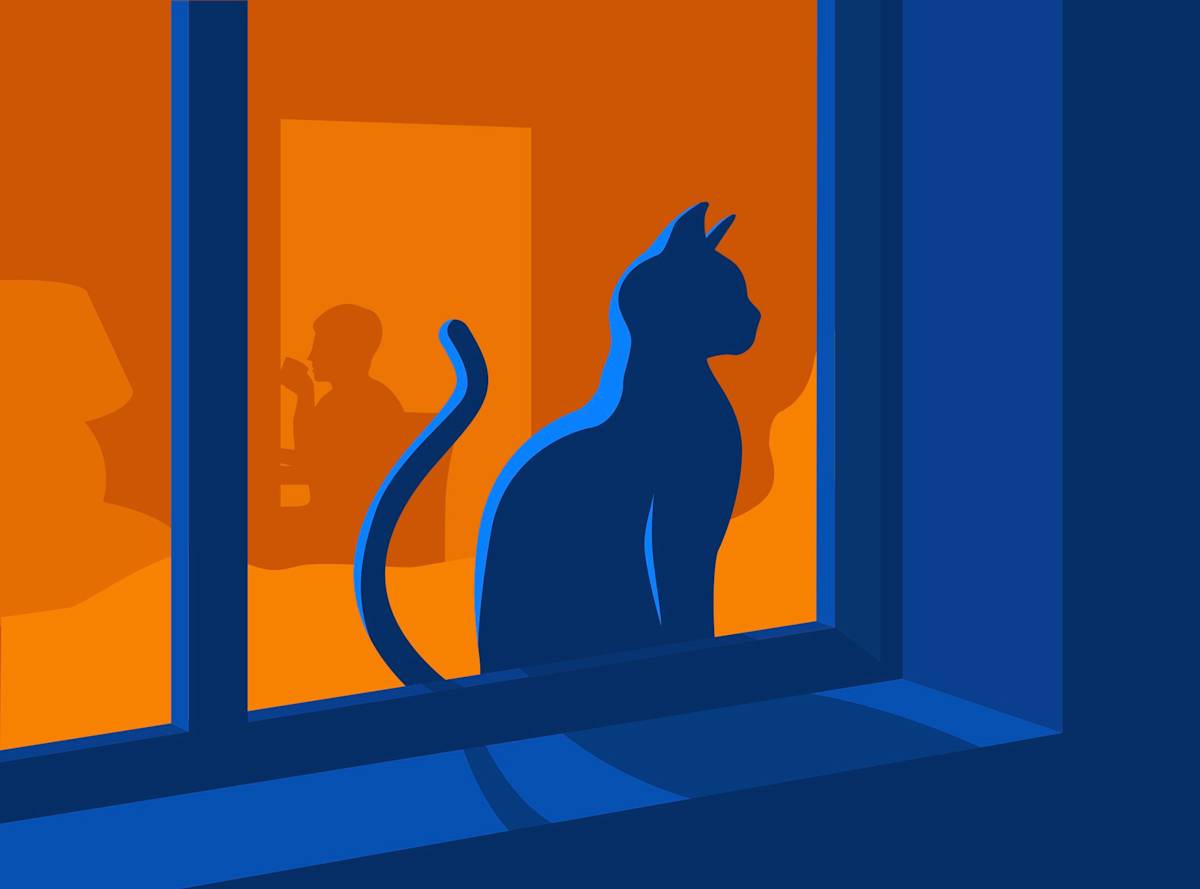
The headline version of this study is that your cat can tell where you are from your voice. True, but it undersells the interesting part. The reason scientists got excited is not that cats have sharp ears. It is what the ears imply about the mind behind them. To track your location through a wall, a cat has to be holding a picture of you in their head, a “you are over there” that persists even when there is nothing to see. That is a small act of imagination, and it is not the sort of thing cats are usually credited with.
So set aside the aloof-cat cliché for a minute. The better question this research answers is: when you walk out of the room, does your cat still, in some sense, have you in mind? The evidence says yes.
What’s striking here isn’t the hearing, it’s the mental placeholder. The cat is maintaining a representation of a person who has become invisible. That’s a real cognitive step. It means a cat can reason about where you are, not just react to where you were a second ago.
The experiment that showed it
The study came out of Kyoto University and was published in the journal PLOS One in November 2021, led by researcher Saho Takagi. The setup was elegantly simple. Each cat was placed alone in a familiar room rigged with a window, two doors, video cameras, and speakers positioned at different spots.
The researchers first played a recording of the cat’s owner calling the cat’s name from one speaker, establishing “my human is over there.” Then, seconds later, they played the same voice from a second speaker on the far side of the room, as if the person had somehow teleported across the space in an instant.
That teleport is the clever trick, because it can only surprise a cat who was holding a mental map in the first place. And surprise them it did. On camera, the cats reacted with visible confusion when the voice jumped somewhere it physically shouldn’t have been able to reach that fast. A cat with no internal model of where their person was wouldn’t blink at the relocation. These cats did, which is how the researchers knew the map was there. The effect showed up across 50 domestic cats, roughly half living in homes and half in cat cafés.
Why a cat would evolve this
This kind of location-tracking-by-sound has deep survival roots, and understanding them makes your cat’s behavior less mysterious. In the wild, pinpointing something you cannot see, by ear alone, is exactly what you need to hunt hidden prey and to keep tabs on rival cats moving nearby. For a house cat, that same machinery gets pointed at the most important figure in their world: the human who feeds and protects them. Earlier work had already shown cats can pick their own person’s voice out from a stranger’s, so the food-and-safety connection is baked in.
It’s not a one-off: the mind keeps surprising researchers
The reason this study matters more now than it did in 2021 is that it turned out not to be a fluke of feline cognition. It was an early data point in a run of findings that keep landing on the same conclusion: cats process more about their world, and about us, than their reputation suggests.
The same research group later published a study in Scientific Reports in 2024 showing that cats can rapidly form associations between images and the words spoken alongside them, learning a picture-word pairing after only a couple of exposures, faster in some respects than human infants in comparable tasks. Put the two findings together and a picture emerges of an animal that is quietly modeling its environment: mapping where you are, linking sounds to meanings, running a richer inner life than the “cats don’t care” stereotype allows. Separate research has also found that cats form attachment bonds with their people at roughly the rate human infants bond with parents, and that for most cats, time with humans edges out even food as a preferred reward.
The practical takeaway is a sweet one, and it’s backed by more than one study now. If you’re the kind of person who narrates your day to your cat, keep going. They are tracking you, associating your voice with meaning, and, as far as the science can tell, finding it a comfort.
“People see a cat sleeping and assume the lights are off upstairs,” Dr. Chen notes. “The research keeps suggesting the opposite. A resting cat may be doing a surprising amount of thinking about their world, and a fair amount of it is about you.”
References
- Takagi, Saho, et al. “Socio-spatial cognition in cats: Mentally mapping owner’s location from voice.” PLOS One, vol. 16, no. 11, 2021, e0257611.
- Takagi, Saho, et al. “Rapid formation of picture-word association in cats.” Scientific Reports, vol. 14, 2024.
- Vitale, Kristyn R., et al. “Attachment bonds between domestic cats and humans.” Current Biology, vol. 29, no. 18, 2019, R864-R865.
Dr. Chen is a small-animal veterinarian who leads health and safety coverage at The Pet Times. She writes and reviews the bulk of our illness, condition, and safety content, translating clinical guidance into clear, practical advice owners can act on at home.
Meet our experts ↗Keep reading
 TrainingYour Cat Isn't Attacking You. You Became the Best Toy in the House.Dr. Priya Nair · 6 min
 TrainingThe Paw in the Water Glass Is 10,000 Years of InstinctDr. Mara Chen · 6 min
 TrainingCalico 'Cattitude' Is Half Myth. Science Found the Other Half.Dr. Nina Kohl · 5 min
 Health & WellnessYour Cat Eating Your Shoelaces Isn't a Quirk. It Might Be Pica.Dr. Mara Chen · 7 min
 TrainingThe Paw on Your Mouth at 4 A.M.? You Trained That.Dr. Amara Solis · 6 min
 TrainingLittermates Don't Replace a Mother Cat. The Study Is Blunt About It.Dr. Amara Solis · 6 min