


The Paw in the Water Glass Is 10,000 Years of Instinct
Paw-dipping looks like feline nonsense. It's actually desert ancestry, play, and control, and decoding which one your cat is running changes what you should do about it.

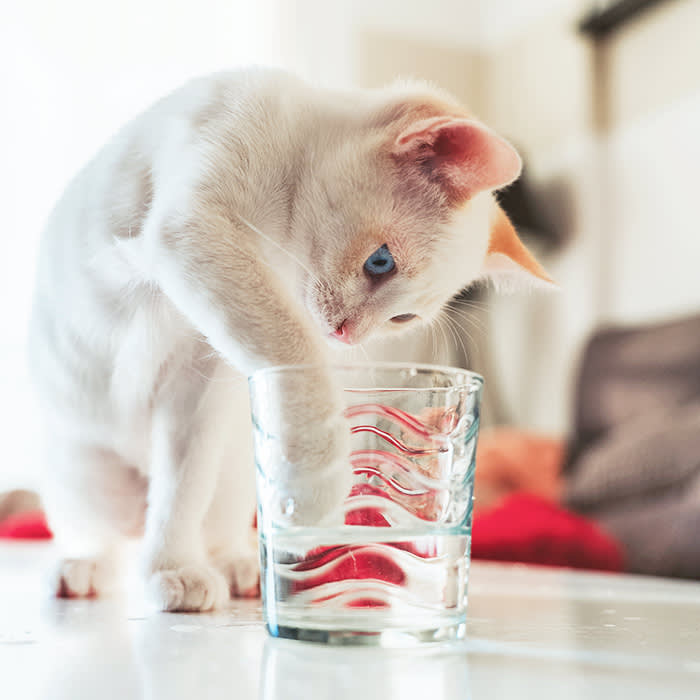
Few household rituals are as baffling to watch as a cat marching up to a full water bowl, pausing, and plunging one paw in before drinking, then padding away afterward, leaving a dotted line of tiny puddles across the floor as commentary.
The internet’s favorite explanations, bad eyesight, clumsiness, feline dementia, mostly miss. The real answer is more interesting: paw-dipping is usually not a malfunction at all. It is a bundle of perfectly sensible cat strategies wearing a silly costume, and figuring out which strategy your cat is running tells you whether to buy a fountain, schedule more playtime, or just accept the puddles as rent.
First, clear the myths
Start with the eyesight theory, because it feels so plausible: the cat cannot judge the water’s depth, so they test it with a paw. In reality, cats have excellent functional vision, and a cat who nails four-foot leaps onto furniture and tracks a wand toy’s string like a missile is not suddenly blind at the water bowl. Depth-testing is rarely the story.
Age can be a factor, to be fair. Senior cats do develop feline cognitive dysfunction, a condition with real parallels to Alzheimer’s disease, and odd repetitive behaviors sometimes ride along with it. But behaviorists see paw-dipping constantly in young, cognitively pristine cats. On its own, a wet paw is not a symptom. It is a preference.
The desert logic under the behavior
The most compelling explanation reaches back to the cat’s ancestral job posting. Domestic cats descend from desert-dwelling wildcats of North Africa and the Near East, animals for whom water safety had a simple rule: moving water is fresher than still water. Stagnant pools breed bacteria and parasites; a trickle is a safer bet. A paw that stirs the surface makes still water behave like moving water, and a cat who bats the bowl, drinks from the dripping faucet, or worships the shower sill is expressing the same ancient preference in three different dialects.
When a cat swirls the water before drinking, I tell people they’re watching an instinct older than the pyramids run on modern plumbing. The bowl is new. The rule, moving water is safer water, is ancient.
That same logic explains the infamous glass-knocking. A tipped-over glass produces gloriously moving water, plus a bonus: a human who comes running.
Sometimes it’s just recess
Not every wet paw is ancestral wisdom. Plenty of cats simply find water fun, a swattable, sparkly, endlessly renewable toy. Some develop connoisseur habits, like dipping a paw and licking the water off it, which may appeal for the same obscure reason some humans prefer drinking through a straw. And because cats famously run a curious-but-cautious relationship with water, a single extended paw is the feline equivalent of testing the pool with a toe: engagement, strictly on their own terms.
There is a third, sneakier read: attention engineering. If knocking the glass or splashing the bowl reliably summons you, with reactions, cleanup, and refills, your cat may have learned that water games are the most effective human-remote-control in the house. That version is really a boredom signal, and the cure is not at the water bowl. It is more play, more hunting games, and more scheduled interaction, so the water show becomes unnecessary.
Working with the instinct instead of against it
If your cat enjoys water, you can let them have it on sane terms. Offer a dripping faucet session, a shallow tray of water to pat at, or an inch or two in the bathtub for supervised exploration. Contain the splash zone somewhere tile-friendly, and keep water games far from electrical cords and outlets, because a splashing cat near a power strip is a genuine hazard rather than a cute quirk.
For committed moving-water drinkers, a pet fountain is the obvious appliance, and they now come in every style imaginable. Fair warning: fountains are a hypothesis, not a guarantee, and the evidence on them is genuinely mixed, which is worth knowing before you spend money (more below).
A few safety rails around bigger water: even water-loving cats generally like it in small doses, so keep sessions short and supervised. Never leave a cat alone with a full tub. A tired swimmer can inhale water, which risks aspiration pneumonia or worse, and cats with chronic ear trouble should stay dry altogether, since water in the ear canal aggravates infections. Some breeds, famously Turkish Vans, and some Maine Coons and Bengals, will genuinely swim for pleasure; most cats would rather not, and forcing any cat into water buys you nothing but a damaged relationship.
What newer research adds
The fountain industry runs ahead of the fountain science, and cat owners deserve the honest version. A pilot study in the Journal of Veterinary Behavior offered cats still versus flowing water and found no significant group-level preference, though individual cats had strong personal favorites in both directions. A later controlled study in the Journal of Feline Medicine and Surgery measured actual intake across still, free-falling, and circulating water sources in laboratory cats and again found no overall increase in water consumed from fountains.
The practical translation is not “fountains are useless.” It is “fountains are individual.” Some cats drink meaningfully more from one; some ignore the expensive gadget and continue dipping a paw in the old bowl out of spite or love, who can say. Test before you invest: run the faucet-drip experiment, or borrow a fountain, and keep the regular bowl available either way. For cats with urinary or kidney concerns, where every milliliter of intake matters, ask your vet about wet food and multiple water stations, which have steadier evidence behind them than any fountain.
And if your cat’s strange little ritual is doing no harm? You do not have to understand a behavior to support it. Refill the bowl, mop the dotted line, and let the desert ghost have its ceremony.
References
- Pachel, C., & Neilson, J. (2010). Comparison of feline water consumption between still and flowing water sources: A pilot study. Journal of Veterinary Behavior.
- Robbins, M. T., et al. (2019). Quantified water intake in laboratory cats from still, free-falling and circulating water bowls, and its effects on selected urinary parameters. Journal of Feline Medicine and Surgery.
Dr. Chen is a small-animal veterinarian who leads health and safety coverage at The Pet Times. She writes and reviews the bulk of our illness, condition, and safety content, translating clinical guidance into clear, practical advice owners can act on at home.
Meet our experts ↗Keep reading
 TrainingThe Sideways Cat Crab-Walk Looks Alarming. It's Almost Always a BluffDr. Nina Kohl · 6 min
 TrainingThe Silent Meow Is Almost Always Adorable. Here's the Version That Isn'tDr. Mara Chen · 5 min
 TrainingYour Cat's Meow Isn't Their Voice. It's a Tool They Built for You.Dr. Nina Kohl · 7 min
 TrainingYour Cat Isn't After Your Earwax. But the Q-Tip in the Trash Is a Real Problem.Dr. Priya Nair · 7 min
 TrainingYour Cat Remembers More Than You Think, Especially the Things You Wish They'd ForgetDr. Mara Chen · 6 min
 TrainingYour Cat Isn't Aloof, Waterproof, or Low-Maintenance: 8 Myths to RetireDr. Nina Kohl · 8 min