


The Silent Meow Is Almost Always Adorable. Here's the Version That Isn't
That soundless little meow is usually a harmless quirk. But a near-identical loss of voice can signal a throat problem, so the useful skill is telling the cute one from the medical one.

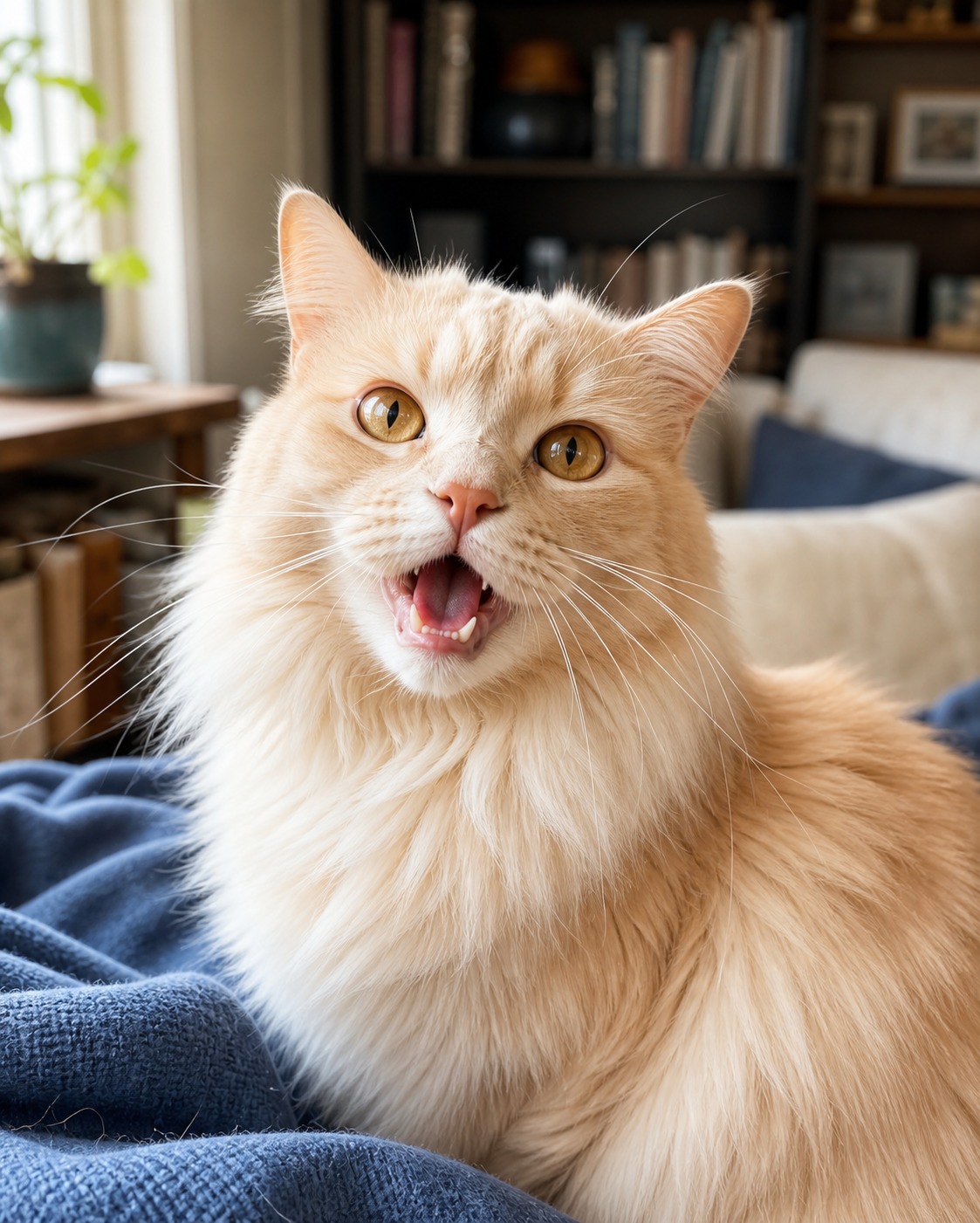
Most of the time, the silent meow is exactly the delight it appears to be. Your cat opens their mouth, runs through the full physical motion of a meow, and out comes a tiny squeak or nothing at all. It is rare, it is charming, and it is almost always meaningless in the best way. But there is a catch that the cute-video framing skips: a genuinely soundless meow and a cat who has lost their voice can look nearly identical from across the room. One is a quirk. The other is a symptom. The single most useful thing you can learn about the silent meow is how to tell them apart, so this starts there and saves the charming mystery for the end.
The one distinction that actually matters
Ask two questions, and they sort almost every case.
Is this old news or brand new? A cat who has done the occasional silent meow for as long as you have known them is showing you a stable, personal quirk. Nothing to chase. A cat whose voice has recently changed, gone hoarse, dropped in volume, or vanished, is showing you something new, and new is the word that should get your attention.
Is it traveling alone, or with company? A silent meow from an otherwise bright, eating, playing, normally breathing cat is almost certainly benign. A silent or hoarse meow riding alongside other changes is a different animal entirely.
Here is the short list of company that turns a cute quirk into a vet call:
- A voice that has gone raspy, hoarse, or disappeared over days
- Lethargy or hiding, or a drop in appetite
- Coughing, gagging, drooling, or bad breath
- Any change in breathing: faster, noisier, more effort, open-mouth breathing
- Repeated swallowing or pawing at the mouth
Any of those, especially the breathing ones, moves this from “adorable” to “get it checked.”
What a lost voice can actually mean
When a cat truly loses its meow, there is a real medical differential behind it, and it is worth knowing so the red flags above have weight. The common and less scary cause is an upper respiratory infection or laryngitis, inflammation of the voice box from a virus, irritation, or even a stretch of excessive meowing. Cats with a URI often have a hoarse or squeaky meow alongside sneezing, discharge, or watery eyes, and most recover with supportive care.
The one to take seriously is laryngeal paralysis, in which the voice box no longer opens and closes properly. It changes the voice, but it can also narrow the airway, and in cats it is treated as an emergency because a compromised airway can progress to real breathing trouble. Noisy breathing or visible effort to breathe alongside a voice change is never a wait-and-see situation. Less commonly, a mass or growth on the larynx can quietly change a cat’s voice over time, which is another reason a persistent, unexplained change deserves a look rather than a shrug.
The phrase I give clients is: a quirk is old and alone, a symptom is new and accompanied. A cat who has always done a silent meow and is otherwise thriving, I am not worried about. A cat whose voice suddenly changed, especially with any change in breathing, I want to see that day. Airway problems in cats can escalate fast.
The genuinely charming part
Assuming you have cleared the red flags, the silent meow gets to just be what it looks like: a small, sweet, mostly mysterious feature of your particular cat. And the honest state of the science is that we do not really know what it means, because it has never been formally studied. That is not a gap in this article; it is a gap in the research, and there is a good reason for it. To study a behavior you have to reliably trigger it, and there is no dependable way to prompt a silent meow. An audible one is easy, just shut a door or serve dinner late, but the silent version arrives on its own schedule, which is part of what makes it so captivating.
The most grounded guess is that it is learned. Because the gesture is so disarming, we tend to reward it hard: we coo, we pet, we tell the cat how loved they are. The cat quickly learns that this tiny move reliably summons affection, and so they keep doing it. That makes the silent meow less a declaration of love and more a very effective request for one, which is arguably more impressive.
And it may not even be silent
One last twist worth enjoying: the silent meow may not be silent at all. A great deal of cat vocalization sits above the range human ears can detect, a little like a dog whistle, so your cat may be producing a real sound pitched too high for you to hear. We genuinely cannot say whether a given silent meow is a meow with no sound, a sound above our hearing, or a cat barely trying, and the same problem blocks the answer: you cannot reliably prompt the behavior to record it. Which is a fittingly cat-like place to land. Once you have ruled out the version that matters medically, the silent meow gets to keep its secret, and you get to keep being charmed by it.
References
- Merck Veterinary Manual. “Laryngeal Disorders in Cats.” merckvetmanual.com
- Merck Veterinary Manual. “Disorders of the Upper Respiratory Tract in Cats.” merckvetmanual.com
- Cornell Feline Health Center. “Feline Vocalization and Communication.” vet.cornell.edu
Common questions
Is the silent meow a sign my cat loves me?
Probably not in the way we mean it. Behaviorists think it is most likely a learned bid for attention: the gesture reliably earns cooing and petting, so the cat repeats it. It has never been formally studied, so any meaning is an educated guess.
When should a silent meow worry me?
When it is new and sudden in a normally vocal cat, when their voice has gone hoarse or disappeared, or when it comes with lethargy, poor appetite, coughing, drooling, bad breath, or any change in breathing. Those point to a possible throat or airway problem, not a cute quirk.
Can a cat lose its meow from a medical problem?
Yes. Upper respiratory infections, laryngitis, and, more seriously, laryngeal paralysis can all reduce or silence a cat's voice. Noisy breathing or breathing distress alongside voice loss is an emergency.
Dr. Chen is a small-animal veterinarian who leads health and safety coverage at The Pet Times. She writes and reviews the bulk of our illness, condition, and safety content, translating clinical guidance into clear, practical advice owners can act on at home.
Meet our experts ↗Keep reading
 TrainingYour Cat Isn't Being Dramatic. 8 Things That Genuinely Wound ThemDr. Nina Kohl · 6 min
 TrainingYour Sleeping Cat Purrs for a Reason. Usually a Good One.Dr. Priya Nair · 6 min
 Health & WellnessThe Toy Brick Your Cat Swallowed Won't Show Up on an X-RayDr. Mara Chen · 7 min
 TrainingWhy a Cat Will Nurse a Duckling, and Why You Should Still Watch CloselyDr. Amara Solis · 6 min
 TrainingA Wagging Tail on a Cat Isn't a Happy Tail. Here's What It Actually Means.Dr. Nina Kohl · 8 min
 TrainingThe Cat Your Kitten Becomes Is Mostly Decided by Week SevenDr. Nina Kohl · 7 min