


A Wagging Tail on a Cat Isn't a Happy Tail. Here's What It Actually Means.
The single biggest mistake dog people make with cats is reading a swishing tail as a friendly one. In cats, a wag is more often a warning. A behavior vet decodes the whole vocabulary, from the annoyed thrash to the loving wrap.

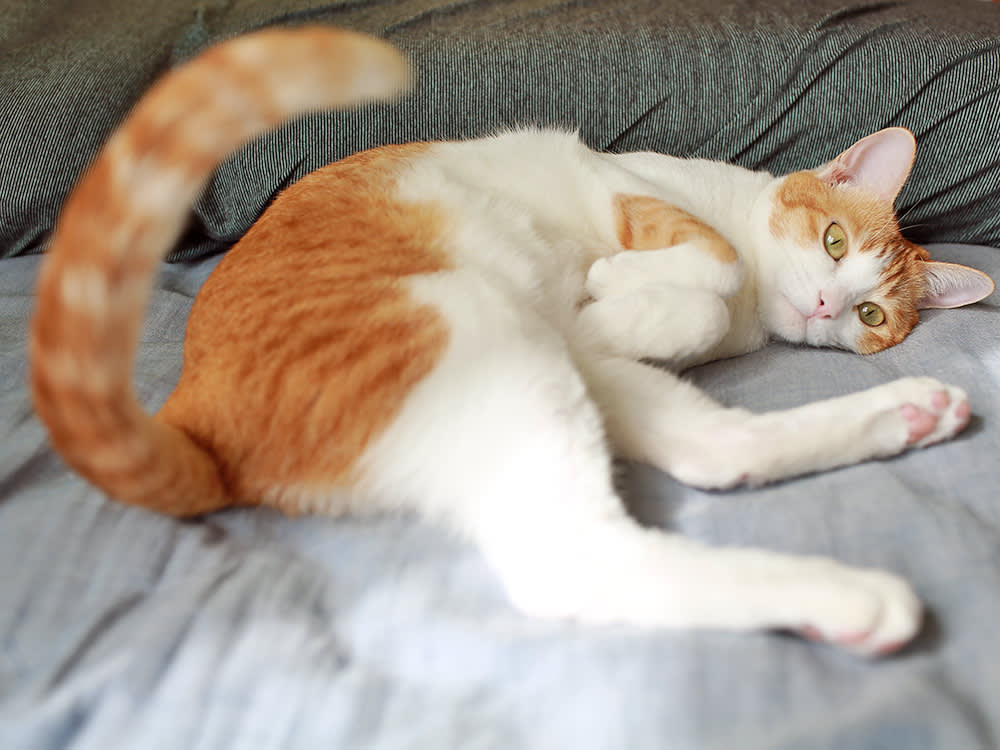
If you grew up with dogs, your body already knows what a wagging tail means. Loose, happy, come-say-hi. So the first time a cat sits in your lap, tail swishing, and then sinks its teeth into your hand, it feels like betrayal. It isn’t. You just read a sentence in a language you don’t speak yet.
Here is the correction that fixes most cat misunderstandings in one move: a cat’s wagging tail is usually not a happy tail. Where a dog wags to say yes, a cat far more often swishes, thrashes, or twitches to say back off, I’m focused, or I’ve had enough. Misreading that as friendliness is the single fastest way to get swatted. Once you flip that default, an enormous amount of cat behavior stops being mysterious.
The rule that changes everything
Cats are not small dogs, and their tails prove it. A dog’s tail is mostly a mood broadcast pointed at you. A cat’s tail is a running readout of arousal and intention, and much of what it broadcasts is some flavor of “not right now.”
The number one thing I tell new cat parents is to unlearn the dog reflex. With a dog, tail movement usually means approach. With a cat, tail movement usually means give me a beat. It’s not that cats are unfriendly, it’s that their tail is doing a completely different job. It’s telling you their arousal level, and high arousal in a cat is often the moment right before a nip.
The second rule, just as important: the tail is never the whole sentence. A cat talks with its ears, whiskers, eyes, posture, and voice all at once. The same swish means one thing next to a purr and something very different next to a flattened ear and a low growl. Read the tail with the rest of the cat, always.
Reading the tail, motion by motion
With those two rules in hand, the vocabulary gets learnable. Here is what the common tail signals tend to mean, remembering that context sits underneath every one of them.
Held low, wagging near the ground. Rarely good news. A tail carried low and moving usually signals anxiety or fear, and can also point to pain. Read the situation and give a low-tailed cat room rather than reassurance-by-petting.
Thrashing or thumping. The clearest “I’m done” in the feline dictionary. A tail slapping the floor or thrashing side to side means irritation, sometimes real anger. If you are petting a cat whose tail starts to thump, the move is to stop and back off. Push past it and you may get a hiss, a growl, or teeth.
Slow swish, side to side. Focus. A gentle, deliberate sweep usually means your cat is locked onto something, a bird at the window, a toy, another animal. It can precede a pounce, and in a tense standoff it can signal aggression toward another cat. Interesting to watch, but not an invitation.
Quick swish. Ambiguous, and that’s the point. A fast side-to-side can mean playful or annoyed, and you can only tell which by looking at the rest of the scene. Toy in play equals fun; another cat in the room equals maybe not. Check the context before you join in.
Quick tip twitch. A rapidly twitching tail tip often means intense focus, the hunting-mode tell, concentration coiled and ready to spring, even if the “prey” is a feather wand.
Just the end twitching. Mild irritation or frustration, and a yellow light if you’re nearby. A cat playing may swat to pull you into the game; a cat that’s annoyed may escalate. Either way, an end-of-tail twitch is a good moment to pause and see which way it’s tipping.
Quivering, held upright. Often excitement, especially in greeting. (One caveat: an upright quiver against a vertical surface can also be urine marking, but the context there is usually unmistakable.)
Wrapped around you. Finally, an easy one. A tail curled around your arm or leg, or looped over another cat, is affection and trust, a greeting, a willingness to connect. Think of it as a hug from a friend. This is the signal you can read exactly the way it looks.
Puffed up like a bottle brush. Fear. A fluffed tail, usually with an arched back, means your cat perceives a threat and is trying to look bigger. Give space, remove the trigger if you can, and don’t reach for them until the fluff goes down.
Twitching in their sleep. Not a mood at all. A tail flick while your cat dozes usually just means they’re comfortable enough to keep sleeping and are half-aware of you without needing to wake. Watching-you-sleep energy, and completely benign.
Waving while lying down. Worth attention. A cat lying down and repeatedly waving its tail, especially a cat acting otherwise off, may be signaling pain or discomfort. Cats have no words for “this hurts,” so they lean hard on body language. A new, persistent version of this deserves a vet’s eyes.
When tail language is really pain language
Most tail signals are about mood. A few are about health, and those are the ones not to explain away. The lying-down tail wave, a low uneasy tail that won’t settle, or any sudden change in how your cat normally carries and moves its tail can all be a cat telling you something feels wrong. Cats are relentless at hiding illness, so a shift in body language is sometimes the loudest signal you’ll get.
“Behavior is medical information,” Dr. Kohl says. “When a cat’s tail language changes and stays changed, especially in an older cat, I don’t want the owner filing it under ‘moody.’ Persistent low or waving tails, a cat suddenly guarding its back end, that can be arthritis or something internal. Behavior is often the first place pain shows up.”
If a tail behavior is new, persistent, and paired with any other change, hiding, eating less, litter-box trouble, reluctance to jump, get it checked.
Reading the whole cat
Put it together and the tail stops being a trap. Watch the ears (forward and neutral, or flat and swiveled?), the whiskers, the eyes, the posture, and listen for the soundtrack, a purr or a chirrup is a very different story than a growl. When the tail’s message and the rest of the body agree, believe them. When they seem to disagree, trust the higher-arousal signal and give your cat room.
The reward for learning this is real. A person who can read a cat’s tail stops triggering the pets-then-bites cycle, knows when their cat wants company and when it wants to be left alone, and catches discomfort early. You don’t have to guess at a cat. You just have to stop reading them like a dog, and start reading the whole sentence.
References
- Deputte, Bertrand L., et al. “Heads and Tails: An Analysis of Visual Signals in Cats, Felis catus.” Animals, vol. 11, no. 9, 2021, p. 2752. https://doi.org/10.3390/ani11092752
- Bradshaw, John W. S. “Sociality in Cats: A Comparative Review.” Journal of Veterinary Behavior, vol. 11, 2016, pp. 113–124. https://doi.org/10.1016/j.jveb.2015.09.004
Common questions
Does a cat wagging its tail mean it's happy?
Usually not. Unlike a dog, a cat that's swishing or thrashing its tail is most often irritated, overstimulated, or focused, not delighted. A wagging cat tail is more often a request for space than an invitation to keep petting. Read it with the rest of the body to be sure.
Why does my cat wag its tail while lying down?
A slow tail-tip flick from a relaxed, lying-down cat can just be mild interest or drowsy contentment. But a cat lying down and repeatedly waving or thumping its tail, especially if it doesn't want to move or be touched, may be signaling pain or discomfort and is worth a vet check if it's new.
What does it mean when a cat wraps its tail around you?
That's one of the clearest friendly signals a cat gives. A tail curled around your arm or leg, or looped around another cat, is a greeting and a sign of trust, the feline equivalent of a hug or a warm hello. Unlike most tail motion, this one you can take at face value.
What does a puffed-up cat tail mean?
A bottle-brush, fluffed tail means your cat is frightened or feels threatened and is trying to look bigger. It's a defensive reaction, often paired with an arched back. Give them space, remove whatever's alarming them if you can, and don't try to pick them up until they settle.
Dr. Kohl is a board-certified veterinary dentist with a particular interest in preventive oral care. She reviews all dental health content at The Pet Times and contributes practical guides on home dental routines, professional cleaning, and oral disease prevention.
Meet our experts ↗Keep reading
 LivingHating Cats Doesn't Make You a Narcissist. The Rush to Diagnose Says More.Claire Sutton · 6 min
 TrainingYour Cat Is Trying to Bury Something. The Question Is What.Dr. Lena Park · 8 min
 LivingYour Cat Isn't Watching You Cook. He's Reading the Room.Dr. Mara Chen · 7 min
 TrainingYour Cat Isn't Being Weird. Your Bowl IsDr. Ravi Mehta · 8 min
 TrainingYour Cat Is Not Judging You. Your Cat Cannot Judge You.Dr. Mara Chen · 9 min
 TrainingThat Sound Isn't a Meow. And It Isn't Good News.Dr. Lena Park · 8 min