


Your Cat's Meow Isn't Their Voice. It's a Tool They Built for You.
New research found that a cat's purr carries their identity and their meow barely carries any. The meow is deliberately flexible, which is exactly why it gets louder every night you answer it.

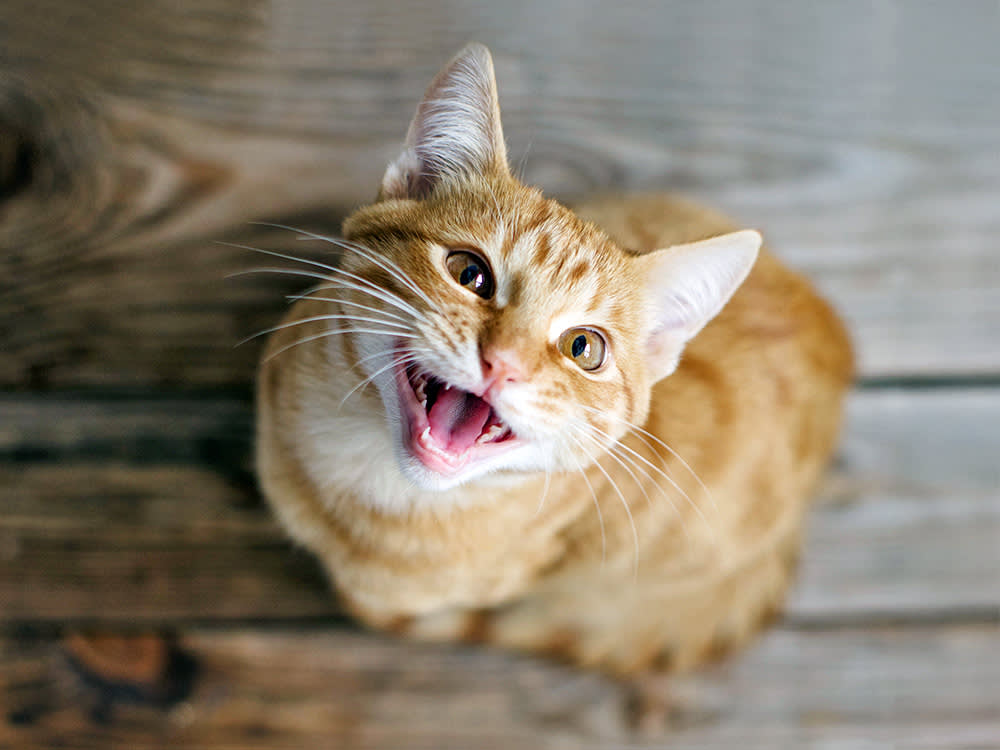
You are standing at the counter. The can is open. Your cat can see the can. Your cat can smell the can. Your cat is watching the food go into the bowl with their own eyes.
And they are screaming.
This is the part that makes no sense to people. Meowing to ask for dinner is perfectly logical. But your cat has already been heard. The request is being processed. Why keep filing it?
Because you have the relationship backwards. You think the meow is your cat talking. It isn’t. The meow is not your cat’s voice. It is a tool your cat built, specifically for you, and it does not switch off just because the job is nearly done.
The research that makes this concrete
For a long time this was a nice story behaviorists told. In late 2025 it got some hard numbers behind it.
Researchers at the Museum für Naturkunde Berlin and the University of Naples Federico II analyzed 276 meows from 14 cats and 557 purrs from 21 cats, and asked a simple question: how much does each sound tell you about which cat is making it?
The purr turned out to be a signature. It was individually identifiable with 84.6% accuracy and carried 4.47 bits of information. Stable, consistent, recognizably that cat.
The meow was nothing of the kind. It identified the individual cat only 63.2% of the time and carried just 2.65 bits. It was, in the researchers’ framing, highly variable, shifting strongly with the situation rather than with the animal.
Sit with that for a second, because it inverts the intuitive picture. The sound your cat aims at you constantly is the one that says the least about who they are. It is not an expression of self. It is a flexible instrument, shaped on the fly to suit the moment and, overwhelmingly, aimed at humans.
Adult cats barely meow at each other. They have body language for that, plus scent, plus a repertoire of sounds they mostly reserve for conflict and mating. Kittens meow at their mothers to summon care. Domestic cats kept that channel open, pointed it at us, and turned it into a general-purpose lever for getting food and attention out of a species that is, frankly, not very good at reading a tail.
A cat’s purr tells you who they are. A cat’s meow tells you what they want from you. That is why the meow is so plastic. A tool has to be adjustable. An identity doesn’t.
Which explains the bowl, exactly
Once you see the meow as a tool rather than a report, the kitchen makes complete sense.
Your cat is not narrating. Your cat is not confirming receipt of your order. Your cat is operating a lever that has produced food before, and they will keep operating it until the food actually arrives, because from their side the outcome is not guaranteed until it is in the bowl.
The ability to meow is instinctive. Aiming it at a specific outcome is learned. Somewhere early on, your cat vocalized, and food happened. That was enough. The association got made and reinforced every single day after, twice a day, for years.
And the reinforcement runs both directions, which is the uncomfortable part. Each time a louder meow gets a faster bowl, the loud version gets stronger. The escalating yowl that starts as soon as you touch the cupboard is not your cat being dramatic. It is a behavior that has been carefully, unintentionally trained by you, on a schedule, with the most powerful reward available.
You did not teach your cat to speak. You taught your cat that volume works.
The fix is counterintuitive: feed more often, not less loudly
Most people try to solve mealtime noise by managing the noise. Wait them out. Ignore it. Say no.
At mealtimes, waiting them out is not really available, because you are going to feed the cat. That is the whole point of the interaction. So the usual counsel, which boils down to the noise is a lever, therefore either pull it for them or refuse to be pulled, falls apart the second there is an open can in your hand.
So attack the hunger instead of the sound.
More meals, same amount of food. This is the change that pays. A cat’s natural pattern is lots of tiny feeds spread through the day, not two big ones, and a cat who never reaches real hunger never reaches real volume. Six little meals is about right if you can manage it. Four is not a compromise so much as a genuine improvement, and most people can hit four. Note the wording: more meals, from the same daily ration. This is not permission to overfeed.
Put a machine between you and the bowl. An automatic feeder takes you out of the equation entirely. It is predictable, it does not respond to volume, and your cat learns when food comes rather than learning what noise makes it come. You cannot be trained by a cat you are not present for.
Keep meal times fixed. Unpredictability creates urgency. Urgency creates volume.
Wait for the pause. Where you can, let the bowl go down in a quiet second rather than at peak yowl. You will not get silence. You will, over time, stop paying for the loudest version.
Make them work for some of it. Puzzle feeders and feeding toys give a cat mental stimulation and physical exercise, and let them use the hunting sequence they were built for. A cat who has hunted a little is a different animal at dinner than a cat who has spent nine hours doing nothing but waiting for you.
And check the basics before you assume it is a training problem. Are they getting an appropriate amount of food for their age and size? Are they getting played with? A great deal of “demanding” behavior is just a bored, under-exercised cat with one reliable lever and nothing else to do.
The meow that means something is wrong
Nearly all mealtime noise is ordinary. Two patterns are not, and both are easy to miss precisely because the cat is meowing about food, which looks normal.
The cat who calls for food and then walks away. This is the one to know. Vocalizing at the sight of food and then leaving the bowl untouched can be a sign of pain, very often oral pain. The cat wants the food. The cat then discovers that eating hurts. What you are watching is not fussiness, it is frustration, and it deserves a vet and a look inside the mouth.
The cat who is ravenous and not gaining. If your cat acts perpetually starving while eating what should be plenty, and the weight does not go on, that is a signal. Diseases like diabetes and hyperthyroidism interfere with normal absorption, so the food goes in and the body does not get it. The cat is not being greedy. The cat is genuinely, chronically undernourished, and the yowling is a survival response.
Nutritional needs also shift across a cat’s life stages, and a cat being underfed for the stage they are actually in will vocalize about it. That is worth a conversation with your vet at every annual visit, not just when something goes wrong.
So: a cat who is permanently starving without gaining an ounce, or who calls for the bowl and then abandons it, has a medical problem and not a behavior one. Book the appointment.
So are they thanking you?
It is a nice theory and everyone who feeds a cat has had it.
The blunt answer is that gratitude is a human frame, and a cat expressing satisfaction through body language and vocalization is not the same thing as a cat saying thank you. Reading a thank-you into a meow tells you more about the person than the cat.
The softer answer is that not every sound at the bowl is a demand. Cats do direct friendly vocalizations at people they like, and if what you get when the dish lands is a short trill or chirp rather than a yowl, that is a different sound doing a different job, and it is a fair thing to enjoy.
Take the trill as affection if you want to. Just don’t take the yowl as manners. The yowl is a tool, and it is pointed directly at you.
What’s new since this was written
The Berlin and Naples work published in Scientific Reports in late 2025 is the piece that upgrades this from folk wisdom to something measurable. Purrs identify the cat; meows barely do. The meow trades away recognizability in exchange for flexibility, which is precisely what you want in a signal designed to negotiate with another species.
A separate 2025 study in Ethology added a strange and rather funny wrinkle: cats meow more at men than at women when greeting them at the door, producing about 4.3 meows in the first 100 seconds with men versus about 1.8 with women. The likeliest explanation is not that cats prefer men. It is that they are adjusting the tool to the audience, working harder on the human who tends to be less responsive.
Which is, if you think about it, the entire thesis in one finding. The meow is not what your cat is. It is what your cat has learned to do about you.
References
- “Meows encode less individual information than purrs and show greater variability in domestic than in wild cats.” Scientific Reports, 2025. https://www.nature.com/articles/s41598-025-31536-7
- “Prosodic matching beyond humans: On the interactional basis of ‘cat-directed’ talk.” Language & Communication, 2025. https://www.sciencedirect.com/science/article/pii/S0271530925000461
- Tavernier, C., et al. “Feline vocal communication.” Journal of Veterinary Science, vol. 21, no. 1, 2020. https://pmc.ncbi.nlm.nih.gov/articles/PMC7000907/
- Prato-Previde, E., et al. “What’s in a Meow? A Study on Human Classification and Interpretation of Domestic Cat Vocalizations.” Animals, vol. 10, no. 12, 2020. https://pmc.ncbi.nlm.nih.gov/articles/PMC7765146/
Common questions
Will feeding my cat when they meow make the meowing worse?
It can. A behavior followed by a reward gets stronger. At mealtimes this is hard to avoid entirely, but you can weaken the link by feeding on a fixed schedule, using an automatic feeder, and waiting for a quiet moment before the bowl goes down.
What actually stops mealtime meowing?
Feeding more often, not more food. Cats prefer to eat many small meals, and a cat who never gets very hungry never gets very loud. Four feedings a day makes a real difference, and up to six is closer to how cats naturally eat.
When is meowing at food a medical problem?
Two patterns matter. If your cat meows for food and then walks away from the bowl, that can signal pain, often in the mouth. And if your cat seems ravenous all the time without gaining weight, conditions like diabetes and hyperthyroidism can interfere with how food is absorbed and leave them genuinely, chronically hungry. Both are reasons to see a vet.
Dr. Kohl is a board-certified veterinary dentist with a particular interest in preventive oral care. She reviews all dental health content at The Pet Times and contributes practical guides on home dental routines, professional cleaning, and oral disease prevention.
Meet our experts ↗Keep reading
 FoodPeas Off Your Plate Are Fine for Cats. Peas in the Bag Are the Ones to Read AboutDr. Amara Solis · 6 min
 FoodYou're Probably Overfeeding Your Cat. The Bag Is Part of the Problem.Dr. Nina Kohl · 4 min
 FoodYour Cat Isn't a Picky Diva. It's a Supertaster Built for MeatDr. Mara Chen · 5 min
 FoodHigh Protein Isn't a Health Upgrade for Cats. It's a Prescription.Dr. Mara Chen · 7 min
 FoodYour Cat Isn't Picky. The Bowl Is Just Boring.Dr. Priya Nair · 7 min
 FoodYour Senior Cat Isn't Picky. The Food Is the Wrong Temperature.Dr. Mara Chen · 7 min