


Peas Off Your Plate Are Fine for Cats. Peas in the Bag Are the Ones to Read About
A few peas won't hurt your cat. The peas hidden high on your cat food's ingredient list are the ones worth a closer look. Here's how to tell a harmless snack from a diet worth questioning.

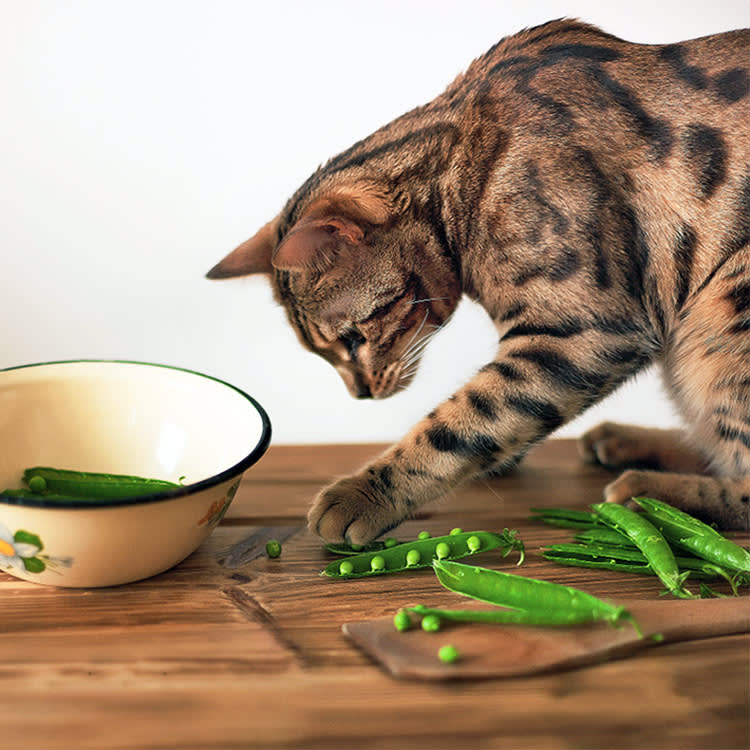
Your cat can eat a pea. That is the short, boring, true answer, and if it is all you came for, you can stop reading and hand over a couple. A plain pea is not toxic, it will not hurt a healthy cat, and if yours likes to bat one across the kitchen floor and then eat the evidence, no harm done.
But the pea that rolls off your dinner plate is not really the pea worth talking about. The peas that matter are the ones you never see, the ones packed by the cupful into the bag of food your cat eats every single day. Over the last several years those hidden peas have drawn real scientific attention, and that is the part of this story most “can cats eat peas” articles skip. So let’s flip the usual order and start there.
The peas you should actually think about are already in the bag
Peas turn up in a lot of commercial cat food, especially recipes marketed as grain-free. They are cheap, they add plant protein and fiber, and they help hold a kibble together. As a minor ingredient, sitting low on the label, they are nothing to lose sleep over.
The concern is about proportion. Starting in 2018, the U.S. Food and Drug Administration began investigating a possible link between diets heavy in peas, lentils, and other legumes and a serious heart condition called dilated cardiomyopathy, in which the heart muscle weakens and struggles to pump. The bulk of the reports involved dogs, and the picture is still not fully understood. But the agency has also logged a small number of feline cases, and a review of its early reports found that more than 90 percent of the flagged products were grain-free and about 93 percent contained peas and lentils.
That does not mean peas cause heart disease, and it does not mean you should panic over a food that lists them somewhere in the middle. It means the smart move is to read the label with proportion in mind.
The dose is the whole story here. A few peas as a treat is a non-event. A food that is built around legumes, day in and day out, for the entire life of an obligate carnivore, is a different conversation, and it’s one worth having with your own vet rather than a bag.
Here is the practical test. Ingredient lists are ordered by weight, so scan the top three or four. If peas, pea protein, pea flour, lentils, chickpeas, or other legumes are stacked up there, the recipe leans heavily on plants. If a single “peas” sits lower down among the vitamins and minor players, that is ordinary formulation and not a red flag. When a food is legume-forward and your cat has any history of heart trouble, that is the moment to call your veterinarian.
Why a snack of peas is genuinely fine
Now the reassuring half. As an occasional nibble, peas are a perfectly reasonable thing for a cat to eat, and they even bring a few things to the table.
Peas are the seeds that grow inside the pods of the Pisum sativum plant, a member of the same bean family as lentils and chickpeas. For their size they are surprisingly nutrient-dense. They carry fiber, which supports digestion, helps bulk up the stool, and feeds the gut microbiome. They offer plant protein, whose amino acids are the building blocks for muscle, enzymes, and hormones. They contain B vitamins along with minerals like magnesium, phosphorus, and iron that support growth, oxygen transport, nerve signaling, and muscle function. And they hold antioxidant compounds such as saponins, flavonols, and carotenoids, which help mop up the free radicals tied to inflammation and aging.
If you want to feed a pea or two, keep it plain. Fresh or plainly cooked, mashed or whole, is fine. What you skip is anything cooked with the peas: butter, salt, and above all onions, garlic, and chives, which are all toxic to cats.
Where a good thing goes wrong
Everything that makes peas useful in small amounts is also what makes them a problem in large ones.
That fiber is the first catch. A little helps digestion, but too much, too fast, can cause gas, vomiting, or diarrhea, and a cat who rarely eats plants is especially prone to it. This is exactly why “start with one” beats “offer a handful.”
Starch is the second. Peas are rich in carbohydrates, and cats are not built to run on carbs. As obligate carnivores, they metabolize starch far less efficiently than we do, so a diet padded with starchy plant matter can nudge a cat toward weight gain and the health problems that ride along with it, including diabetes.
And the pea plant, for all its non-toxic parts, is genuinely fibrous. The stems, leaves, flowers, and pods will not poison your cat, but they are tough to digest, and a cat who grazes on them can end up with an upset stomach.
A quick map of the rest of the snack drawer
Peas are one square on a much bigger board. A few other human foods a cat can have in small amounts:
Shrimp, plainly cooked, is a high-protein treat that actually fits a carnivore’s wiring. Unsweetened plain yogurt is usually tolerated in tiny servings. And low-sugar fruits like strawberries and other berries can be offered as an occasional bite.
The hard no’s matter more. Grapes contain compounds that can be toxic to cats. Hot dogs and other processed meats are loaded with salt and additives, and some carry seasonings that are outright dangerous. And anything in the allium family, garlic, onions, and chives, can damage a cat’s red blood cells and cause anemia, so it stays off the menu entirely.
The line that keeps all of this simple
Cats are obligate carnivores. Unlike you and unlike dogs, they are built to get what they need from animal sources, and they do not require much plant matter at all. The single rule that keeps treats from quietly derailing a diet is the 90/10 split: at least 90 percent of your cat’s calories should come from a complete and balanced cat food, leaving the last 10 percent for snacks and extras. Lean on treats too hard and your cat may crowd out the real food that carries their nutrition, and deficiencies can creep in over months.
So yes, share a pea. Just remember that the pea in your hand was never the one that mattered. The one that counts is sitting in the bag, and it takes ten seconds with the label to check on it.
What newer research adds
The FDA has stepped back from regular public updates on the legume-and-heart-disease question, saying it will only report again when there is meaningful new science to share. That is not the same as an all-clear. Researchers are still working to understand whether and how these diets affect the body, including how legume-heavy recipes might interfere with taurine, an amino acid a cat’s heart truly depends on.
For a cat owner, the takeaway is calm and practical. There is no recall on peas and no reason to fear a pea as a treat. The reasonable habit is simply to know where legumes sit on your cat’s food label, and to bring it up at your next checkup if the recipe is built around them, especially for a cat with any heart concerns.
References
- U.S. Food and Drug Administration, FDA Investigation into Potential Link between Certain Diets and Canine Dilated Cardiomyopathy
- American Veterinary Medical Association, Until more science is available, FDA will end public updates on potential link between certain diets and canine dilated cardiomyopathy
- Freeman, L. et al., Journal of Veterinary Cardiology, Dilated cardiomyopathy of possible dietary origin in a cat
- Harvard T.H. Chan School of Public Health, The Nutrition Source, Legumes and Pulses
- North Carolina State Extension Gardener Plant Toolbox, Pisum sativum
Common questions
Are peas safe for cats to eat?
Plain, cooked or fresh peas with nothing added are safe for cats in small amounts. The pea plant itself, including stems, leaves, flowers, and pods, is non-toxic too, though the fibrous parts are hard to digest and can upset a cat's stomach.
Why does my cat like peas?
Often it's the game more than the food. A round pea skitters across the floor like prey, so plenty of cats bat and chase them. Some also go for the taste, since peas carry a bit of protein.
Can cats eat pea pods and pea shoots?
They're non-toxic, so a nibble won't poison your cat, but pods and shoots are very fibrous and easy to overdo. Keep it to a tiny taste if at all.
Should I worry about peas in my cat's food?
A few peas as a minor ingredient are not a concern. What's worth a second look is a food that lists peas, lentils, or other legumes near the very top, meaning they make up a large share of the recipe. Talk to your vet if your cat's food is built around legumes.
Not a substitute for your vet. Our guidance is educational. For urgent symptoms, contact a vet or emergency clinic right away. Editorial standards
Dr. Solis is a board-certified veterinary dermatologist with over twelve years of clinical experience. She advises on skin conditions, allergies, and grooming practices that affect coat and skin health. All dermatology and allergy content at The Pet Times is reviewed by her team before publication.
Meet our experts ↗Keep reading
 FoodYour Cat Wants Your Salad. Here's What Lettuce Actually Does.Dr. Amara Solis · 4 min
 FoodRaw Chicken for Cats Got Measurably More DangerousDr. Mara Chen · 6 min
 FoodThe 'Natural' Raw Diet Is Failing Cats on Two FrontsDr. Amara Solis · 7 min
 FoodYour Cat Can Eat Dog Food. One Missing Nutrient Means They Can't Live on ItDr. Ravi Mehta · 7 min
 FoodYogurt Won't Fix Your Cat's Gut. Here's What Actually Might.Dr. Lena Park · 6 min
 FoodYour Cat Is Built to Eat Pork. The Deli Counter Is Where It Goes WrongDr. Amara Solis · 6 min