


Raw Chicken for Cats Got Measurably More Dangerous
Cats are built to eat meat, so raw chicken sounds natural. But between Salmonella and a wave of H5N1 bird flu deaths tied to raw poultry, cooked chicken is the clear winner. Here's the case.

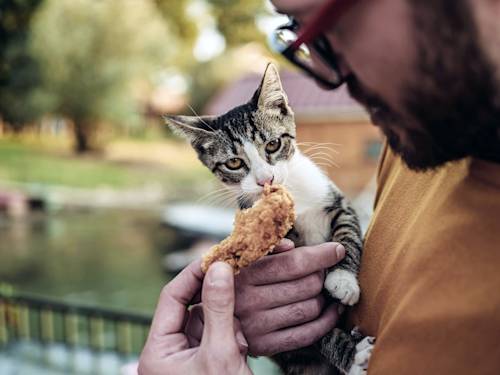
Cats are obligate carnivores, so feeding raw chicken can feel like the most natural thing in the world. Your cat certainly agrees, circling the cutting board while you trim a breast. But “natural” and “safe” are not the same word, and over the past couple of years the gap between them has widened. Raw chicken was already a Salmonella risk. Now it sits at the center of an ongoing H5N1 bird flu outbreak that has killed pet cats. The nutrients your cat needs from chicken survive cooking perfectly well. The pathogens do not. That trade is the whole story.
Chicken is great for cats. Cooked chicken.
Let’s give chicken its due, because the nutrition is real. Cats have a higher protein requirement than dogs or humans and specific needs that only animal foods meet, and chicken delivers on all of it.
Protein comes first: cats build and maintain their bodies from the amino acids in animal protein, and AAFCO guidelines require adult cat foods to supply at least 6.5 grams of protein per 100 kilocalories. Chicken clears that easily. It also brings arginine, an amino acid cats cannot make themselves and will become acutely ill without, and vitamin D3 in the animal-source form cats use most readily, since they can’t synthesize vitamin D from sunlight the way we do. Chicken fat supplies linoleic acid, an omega-6 fatty acid tied to healthy skin, coat, and immune function.
Here’s the crucial part: none of that depends on the chicken being raw. Studies show cooking doesn’t meaningfully reduce the protein, fat, or amino acid value of meat for cats. Cooking changes the safety, not the nutrition. So the “raw preserves nutrients” argument, the usual justification for the risk, doesn’t hold up.
The old risk: Salmonella and what cats shed
Raw chicken commonly carries Salmonella and related bacteria, picked up during slaughter and processing. Grocery-store poultry isn’t treated or tested to be eaten raw; the entire system assumes you’ll cook it to a temperature that kills those bugs. Feed it raw and you skip the one step designed to make it safe.
The danger isn’t only to the cat. A cat can eat contaminated raw chicken, show no symptoms at all, and still shed Salmonella in their saliva and stool for days, seeding the household through grooming, litter boxes, and shared surfaces. That puts everyone at risk, especially infants, elderly people, anyone immunocompromised, and other pets. Raw chicken out on a counter or in a bowl contaminates the environment around it, not just the animal eating it.
The new risk changes the math
For years the honest summary was: healthy cats often tolerate raw chicken, but the Salmonella risk to the household isn’t worth it. Recent events pushed that from “not worth it” toward “genuinely hazardous,” and the reason is H5N1 avian influenza.
Since late 2024, veterinary and public-health agencies have documented clusters of pet cats sickened and killed by H5N1 after eating raw poultry-based food or raw milk. Multiple raw pet food brands were recalled after cats died and genome sequencing matched the virus in the food to the virus in the cat, an exact link, not a coincidence. Cases have been confirmed across several states, including strictly indoor cats whose only plausible exposure was their food. The outcomes have been severe: in cats, H5N1 infection carries a very high fatality rate, and unlike a typical bout of food poisoning it can progress to neurological signs like tremors and seizures.
The raw-poultry conversation genuinely changed with the bird flu outbreaks. I used to frame raw chicken as a Salmonella and household-hygiene issue. Now I tell owners that raw poultry has been directly linked to fatal H5N1 in indoor cats, and cooking to a safe temperature reliably inactivates the virus. There’s no nutritional upside to raw that justifies that downside anymore.
Grocery raw chicken carries some avian-influenza risk too, and even commercially prepared raw pet foods have been implicated. Cooking chicken thoroughly inactivates H5N1, which is exactly why cooked poultry sits nowhere on the recall lists.
The parts of the chicken that are never okay
Beyond the raw-versus-cooked question, some parts of a chicken are unsafe in any form. Skip bones entirely, cooked or raw: they cause choking, can lodge in or perforate the digestive tract, and lead to painful constipation. Skip the skin, which is high in fat and can trigger vomiting or diarrhea. And serve chicken plain, no oil, salt, garlic, or onion, since common seasonings range from irritating to outright toxic for cats.
How to feed chicken the safe way
Cook boneless, skinless chicken thoroughly, plain, with nothing added. Let it cool, cut it into small pieces, and offer it as an occasional treat, remembering the 90/10 rule: complete, balanced cat food should be at least 90 percent of the diet, with treats and table scraps under 10 percent. If you’re drawn to raw feeding specifically, talk to your vet, and understand that during an active H5N1 outbreak most veterinary organizations advise against raw poultry-based diets for cats altogether.
What’s new since this was written
The H5N1 situation is the headline update. Through 2025, agencies including the FDA, CDC, and AVMA tracked repeated raw-pet-food recalls tied to bird flu after cat deaths, with confirmed feline cases in multiple states and at least one documented instance of a cat transmitting the virus to a person in the household. Public-health guidance now explicitly links raw poultry, raw meat, and raw milk to severe, often fatal H5N1 in cats and urges owners to avoid these foods while the outbreak continues.
If you notice a cat that ate raw poultry developing fever, lethargy, loss of appetite, labored breathing, or any neurological signs such as wobbliness, tremors, or seizures, call your vet right away and mention the raw food, so they can take proper precautions. These signs separate a possible H5N1 infection from an ordinary stomach upset, and time matters.
Foods that are good for cats
The safe way to indulge a chicken-loving cat is cooked, plain poultry, or the many complete cat foods built around it. A little cooked turkey or a bit of plain cooked egg works too. If you want a fishy treat, a small amount of canned tuna in water is fine occasionally.
Foods to keep away from cats
Garlic and onion, and any dish cooked with them, can cause life-threatening anemia. Grapes and raisins can harm the kidneys. Chocolate is toxic. And during the current outbreak, raw poultry and raw milk belong on the avoid list for a whole new reason.
FAQs
Is raw chicken safe for cats? No. It can carry Salmonella and, in the current outbreak, H5N1 bird flu. Cooked chicken provides the same nutrients without the infection risk.
Can cats eat chicken skin or bones? No. Skin is too fatty and hard to digest, and bones cause choking, obstruction, and constipation whether raw or cooked.
Why does my cat prefer warm chicken? Cats are wired to eat freshly caught, body-temperature prey, so many prefer warm cooked meat over cold or raw. Warming cooked chicken slightly can make it more appealing.
References
- US Food and Drug Administration. Get the Facts! Raw Pet Food Diets Can Be Dangerous to You and Your Pet.
- American Veterinary Medical Association. Cat deaths linked to bird flu-contaminated raw pet food, sparking voluntary recall, 2025.
- Cornell Feline Health Center. H5N1 Avian Influenza and Your Cat.
- Centers for Disease Control and Prevention. Managing Cats Exposed to Bird Flu (H5N1).
- American Association of Feed Control Officials. Nutrient profiles for cat foods.
Not a substitute for your vet. Our guidance is educational. For urgent symptoms, contact a vet or emergency clinic right away. Editorial standards
Dr. Chen is a small-animal veterinarian who leads health and safety coverage at The Pet Times. She writes and reviews the bulk of our illness, condition, and safety content, translating clinical guidance into clear, practical advice owners can act on at home.
Meet our experts ↗Keep reading
 FoodFor a Carnivore, 'Is It Safe?' Is the Wrong Question About Human FoodDr. Priya Nair · 6 min
 FoodYour Cat Can Eat Dog Food. One Missing Nutrient Means They Can't Live on ItDr. Ravi Mehta · 7 min
 FoodPeas Off Your Plate Are Fine for Cats. Peas in the Bag Are the Ones to Read AboutDr. Amara Solis · 6 min
 Food'Freeze-Dried' Tells You Nothing About Your Cat's Food. Two Labels Do.Dr. Priya Nair · 8 min
 FoodWet Cat Food and the 2-Hour Rule: The Clock Starts the Second You Open the CanDr. Amara Solis · 7 min
 FoodYour Cat Ate a Cockroach. The Bug Isn't the Problem. What's on It Is.Dr. Priya Nair · 5 min