


Your Cat Can Eat Dog Food. One Missing Nutrient Means They Can't Live on It
A stolen bowl of dog food won't hurt your cat. A diet of it can blind them. The difference comes down to a single amino acid dogs make and cats can't, and a few others besides.

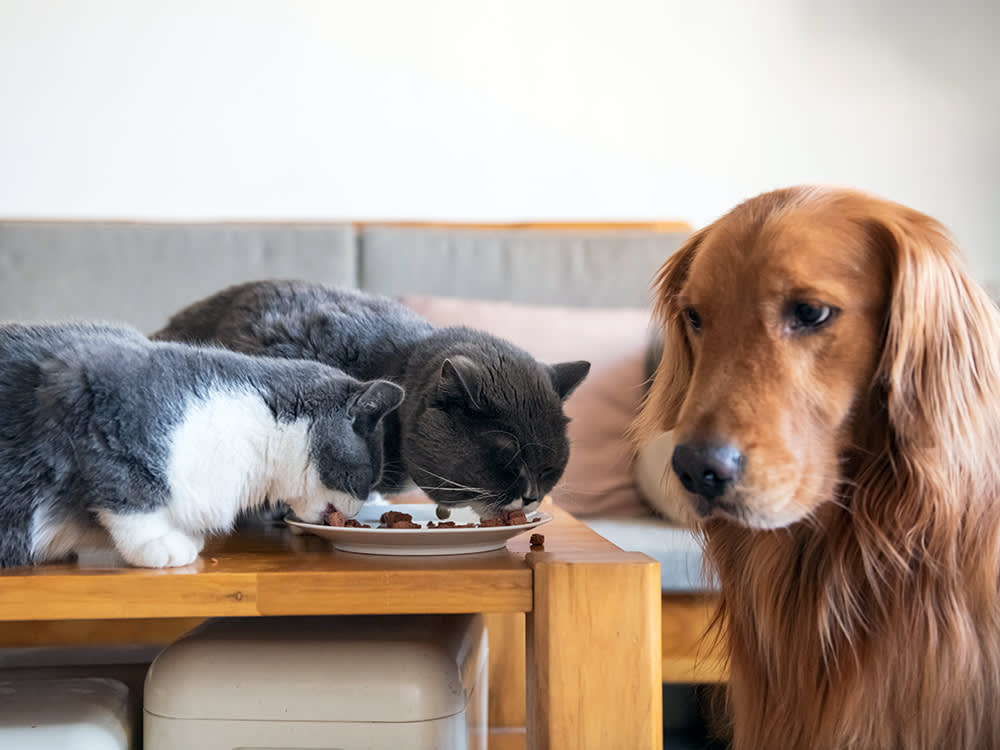
Here’s the reassuring half of the answer, up front: if your cat just helped themselves to the dog’s bowl, don’t panic. There is nothing in dog food that is toxic to a cat. A bite, a meal, even an occasional raid is a non-event.
Now the half that matters more. A cat fed dog food as their diet can, over months, go blind and develop heart failure, not from a poison, but from an absence. Dog food is missing things a cat’s body cannot manufacture and cannot do without. The whole “can cats eat dog food” question hinges on that distinction between a meal and a diet, so let’s start with the single nutrient that makes the difference starkest, then cover the rest.
The one that turns a convenience into a crisis: taurine
If you remember nothing else, remember taurine. It’s an amino acid, and it’s the cleanest illustration of why cats and dogs cannot share a bowl long-term.
Dogs synthesize their own taurine, so dog food isn’t formulated to supply much. Cats can’t make enough of it and have to get it from food. Taurine is essential to feline vision and heart function, and a sustained deficiency causes two specific, devastating outcomes: retinal degeneration that can progress to permanent blindness, and dilated cardiomyopathy, a serious heart-muscle disease. A cat bumping into furniture or wandering as if disoriented can be showing early signs of a taurine shortfall.
“Taurine is the reason ‘cats are just small dogs’ is a dangerous idea in the food aisle,” says Dr. Mara Chen. “Dog food can be perfectly complete for a dog and still slowly starve a cat of something their retina and heart literally depend on. The food isn’t bad. It’s just not built for the species eating it.”
That’s the engine of the whole issue: cats are obligate carnivores. Their bodies are tuned to run on meat-based protein and animal fat, and several of the nutrients that follow share taurine’s pattern, dogs make or convert them, cats can’t, so cats have to eat them preformed.
The rest of the gap, nutrient by nutrient
Taurine is the headline, but it doesn’t travel alone. Here’s what else dog food underdelivers for a cat.
Protein, and more of it. Cat food carries substantially more protein than dog food because cats depend on it for tissue repair, energy, and hormone production at levels an omnivore-leaning dog diet isn’t designed to hit.
Arachidonic acid. This fatty acid supports skin and coat health and matters for fetal development and blood clotting. Dogs can synthesize it from other fats; cats have only a limited ability to, so they need it directly from animal sources like meat and fish.
Preformed vitamin A. Dogs convert beta-carotene from plants into vitamin A. Cats can’t, so they must eat vitamin A in its ready-made form. A shortfall causes dry eye and skin problems and can progress to corneal ulcers and poor vision. (Cats also can’t make vitamin D in their skin from sunlight the way some animals do, so as much as your cat worships a sunbeam, their vitamin D comes entirely from diet.)
Niacin. Dogs can manufacture some niacin from the amino acid tryptophan. Cats can’t make enough, so dietary niacin is essential for them.
The calorie trap. Here’s a subtle one. Because cat food is so protein-dense, it’s also more calorie-dense than dog food. So a cat trying to meet their energy needs on dog food would have to eat a larger volume of it, and still wouldn’t get the right nutrient balance, all while taking on more fat than cats handle well. Excess fat in cats can drive gastritis, pancreatitis, and obesity, and weight matters more than people realize: cats kept at a healthy weight across their lives can live meaningfully longer than overweight ones.
The part biology already handles for you
There’s a quiet safeguard built into this whole problem: most cats don’t want dog food.
Cat food is deliberately engineered with a stronger flavor and aroma to win over famously finicky felines, and plain dog kibble just doesn’t compete. Many cats will sniff a bowl of it and walk away. So if your cat snubs the dog’s food, that’s instinct doing your job for you. And if your cat does steal a bite, the worst likely outcome is some short-term stomach upset from the abrupt change, so keep an eye out for vomiting or diarrhea after a raid.
How to keep the bowls separate
If your cat has actually developed a taste for dog food, the fix is refreshingly blunt: don’t let them have it. In a two-pet household, the simplest reliable method is to feed the dog in a separate area and pick the bowl up the moment they finish, rather than leaving food down for grazing. No free-access dog bowl means no opportunistic cat.
If you want to give your cat a little variety beyond their cat food, there are plenty of safe additions, broccoli, cantaloupe, carrots, cooked chicken, fish oil, green beans, pumpkin, salmon, sardines, turkey, offered as toppers, not replacements. A complete, balanced commercial cat food should always be the foundation, and a strictly homemade diet is best avoided unless you’re working from a veterinary nutritionist’s recipe, because it’s dangerously easy to recreate exactly the deficiencies we just walked through.
What newer research adds
The taurine story has a sobering modern footnote. Beginning around 2018, the FDA investigated a rise in dilated cardiomyopathy, the same taurine-linked heart disease, in dogs eating certain grain-free, legume-heavy diets. The investigation is ongoing and the mechanism still isn’t fully settled, but it underlines the central point of this article from the other direction: getting a carnivore’s amino acids right is not a detail. It’s the difference between a complete diet and a slow-motion medical problem, and it’s exactly why species-specific food exists.
The reassuring news for cat owners is that any reputable commercial cat food sold as “complete and balanced” is formulated to meet established feline taurine and nutrient minimums. The danger was never the occasional stolen bite. It’s the well-meaning decision to make the wrong species’ food someone’s everyday diet.
References
- Association of American Feed Control Officials (AAFCO). “Cat Food Nutrient Profiles.”
- Morris, James G. “Idiosyncratic Nutrient Requirements of Cats Appear to Be Diet-Induced Evolutionary Adaptations.” Nutrition Research Reviews, vol. 15, no. 1, 2002, pp. 153–168.
- U.S. Food and Drug Administration. “FDA Investigation into Potential Link Between Certain Diets and Canine Dilated Cardiomyopathy.” Updated 2022.
- Cornell Feline Health Center. “Feeding Your Cat.”
Common questions
Why can't cats live on dog food?
Cats are obligate carnivores with needs dog food isn't built to meet. The headline gap is taurine, an amino acid dogs make on their own but cats must eat, and a chronic shortage can cause blindness and heart disease. Cats also need more protein, plus preformed vitamin A, arachidonic acid, and niacin that dog food underdelivers.
How do I stop my cat from eating the dog's food?
Separate the bowls. Feed the dog in a different area and pick the bowl up the moment they're done rather than leaving it down. In a multi-pet home, that one change prevents most mealtime raids.
Not a substitute for your vet. Our guidance is educational. For urgent symptoms, contact a vet or emergency clinic right away. Editorial standards
Dr. Mehta is a board-certified veterinary nutritionist who evaluates pet food formulations, ingredient quality, and the science behind dietary trends. He writes and reviews all nutrition content at The Pet Times, including our food rankings and feeding guides.
Meet our experts ↗Keep reading
 FoodThe 'Natural' Raw Diet Is Failing Cats on Two FrontsDr. Amara Solis · 7 min
 FoodFor a Carnivore, 'Is It Safe?' Is the Wrong Question About Human FoodDr. Priya Nair · 6 min
 FoodYour Cat Wants Your Salad. Here's What Lettuce Actually Does.Dr. Amara Solis · 4 min
 FoodIgnore the Cute Kitten on the Bag. One Line of Fine Print Settles the Cat-Food Question.Dr. Amara Solis · 7 min
 FoodYour Cat Is Slightly Dehydrated Right Now. Here's the Fix (Cocktail Optional)Dr. Amara Solis · 5 min
 FoodYour Cat Won't Eat Without You. That's Sweet Until It Isn't.Dr. Nina Kohl · 7 min