


Mango and Cats: The Flesh Is Fine, the Family Tree Is the Catch
Ripe mango flesh is non-toxic to cats, so the real question isn't 'is it poison?' It's how much sugar a five-pound carnivore can spare and why the peel belongs to the poison-ivy family. Here's the sugar math and the one part to never share.

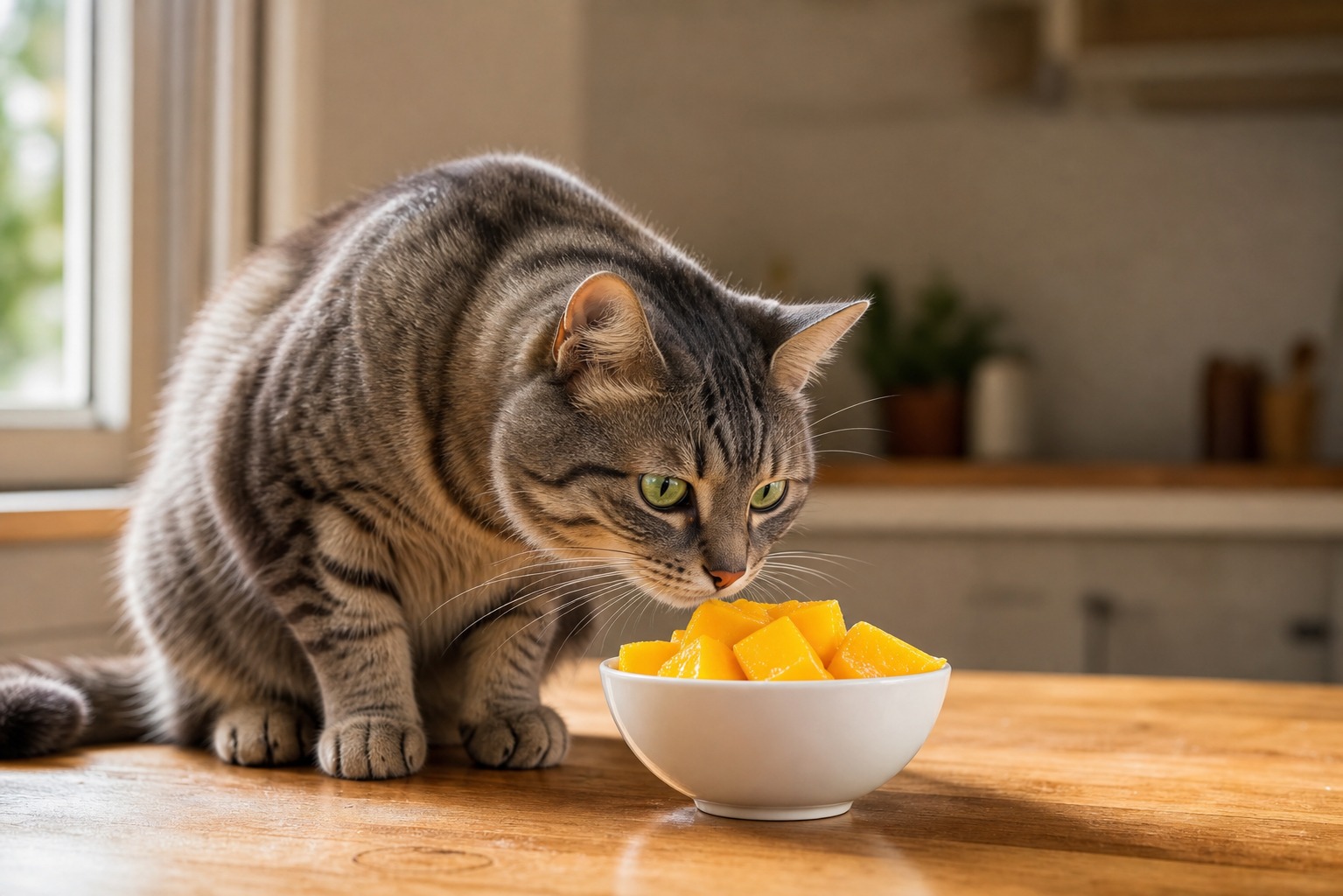
Here’s the honest answer most “can cats eat mango” pieces bury under a list of vitamins: yes, the flesh is safe, and no, that isn’t really the interesting part. Ripe mango isn’t toxic to cats the way onions or lilies are. The two things actually worth knowing are that a cat is a five-pound obligate carnivore with almost no room in its day for sugar, and that the mango you’re holding is a close relative of poison ivy. Get those two facts straight and you’ll handle mango correctly without memorizing a nutrient chart.
So this isn’t a “here are the benefits” article. Mango’s “benefits” for a cat are mostly theoretical, because a complete cat food already delivers everything on the list. This is a piece about portion math and one part of the fruit to keep away from your cat entirely.
The part nobody warns you about: mango is in the poison-ivy family
Mangoes grow on Mangifera indica, a member of the Anacardiaceae family. That family includes cashews and pistachios, and it also includes poison ivy, poison oak, and poison sumac. They’re all relatives, and they share a chemical calling card: urushiol, the oily compound that causes that miserable, blistering rash.
In mango, urushiol concentrates in the peel and the sap just under it, not the sweet flesh. In people, contact with mango skin can cause an allergic reaction dermatologists actually call “mango dermatitis,” and it tends to hit those already sensitized to poison ivy. There are no documented cases in cats, which means we genuinely don’t know how reactive a cat’s skin or mouth is to it. That uncertainty is exactly why the peel is a hard no: you’d be running the experiment on your own cat. Beyond the urushiol, the skin is fibrous, tough to chew, and a choking and GI-upset risk on its own.
The rule that falls out of this is simple. Peel it, cube the flesh, and never let your cat gnaw the skin or the pit.
The sugar math, done properly
The reason mango stays a once-in-a-while treat has nothing to do with toxicity and everything to do with size and metabolism. Cats are obligate carnivores. They’re built to run on protein and fat, and they lack the sweet-taste receptor entirely, so they aren’t even chasing the flavor the way a dog might. Their bodies also handle fructose poorly, and a steady sugar habit nudges a cat toward weight gain and, over time, diabetes.
Now put numbers on it. Veterinary nutritionists use a ten-percent rule: treats and extras should make up no more than ten percent of a cat’s daily calories, so the complete-and-balanced food can do the actual nutritional work. An average ten-pound indoor cat eats somewhere around 200 to 250 calories a day, which leaves roughly 20 to 25 treat calories. A one-inch cube of mango is about 6 calories. That means one or two small cubes fits; a small bowl of it, like the one in the photo above, is a day’s entire treat budget spent on sugar water with fiber. This is the framing that matters: mango isn’t dangerous in small amounts, it’s just easy to overdo on a body this small.
Owners hear ‘not toxic’ and treat it as a green light. On a cat, the honest limit is a cube or two. Everything a cat needs is already in the bowl of cat food, so anything sweet is spending a very small calorie budget for basically no nutritional return.
What the flesh does and doesn’t add
Because you’ll see mango sold as a superfruit, it’s worth being precise about what a cat actually gets from a bite, so you’re not talked into offering more than makes sense.
Mango is famous for vitamin C, and here’s the twist that undercuts most of the health pitch: cats synthesize their own vitamin C and don’t need it from food at all. It does carry small amounts of vitamins A, E, B6, B9 (folate), and K, plus potassium, magnesium, and copper, and a bit of soluble and insoluble fiber that can gently help a constipated cat or add fullness for one watching their weight. It also contains mangiferin, an antioxidant under study for anti-inflammatory and other effects, almost entirely in lab and human research, none of which changes the practical advice for a house cat. The through-line: every one of these shows up in a balanced cat food in a form built for cats. Mango adds sugar on top.
Introduce it like any new food, and watch the fiber
If you do share a bite, treat it as a small trial rather than a habit. Offer one small cube of ripe, peeled flesh and wait a day. Too much fiber too fast, especially for a cat that never eats plants, can bring on loose stool or an upset stomach, so a slow start tells you whether your cat tolerates it before it becomes a routine. Skip mango entirely for kittens, diabetic cats, and any cat on a prescription diet unless your vet signs off, and never offer dried mango or the sweetened, syrup-packed kind, which concentrate the sugar dramatically.
Better sweet shares, and the hard no’s
If the goal is a fruity treat, some choices sit better with feline metabolism than mango, and a few common foods are genuinely dangerous. Keep this short list in mind:
- Lower-sugar berries (a single blueberry, raspberry, or a sliver of strawberry) are a smarter sweet than mango.
- A flake of cooked, unseasoned fish or a bit of plain cooked chicken matches what a cat is actually built to eat and makes a more satisfying treat than fruit.
- Never share: grapes and raisins, chocolate, onions and garlic (life-threatening anemia in cats), and anything sweetened or heavily salted.
The bottom line
Cats can have a nibble of ripe, peeled mango flesh, and it won’t hurt them. But “not toxic” is the floor, not a recommendation. The peel belongs to the poison-ivy family and stays off the menu, and the flesh is sugar your carnivore doesn’t need, capped at a cube or two by simple calorie math. Keep a complete cat food as the foundation, lean toward plain proteins when you want to share, and when a new food gives you pause, your vet or a pet poison hotline is the right call before the fruit bowl.
References
- Merck Veterinary Manual: Nutritional Requirements of Small Animals
- Tufts Cummings School Petfoodology: What Nutrients Does My Pet Need?
- Clinical Practice and Cases in Emergency Medicine: Mango Dermatitis After Urushiol Sensitization
- Trends in Food Science & Technology: Mangiferin, a Bioactive Compound of Mango
- ASPCA Animal Poison Control: People Foods to Avoid Feeding Your Pets
Common questions
How much mango can a cat eat?
Very little. Treats should stay under ten percent of daily calories, which for an average cat is only about 20 to 25 calories. A single one-inch cube of mango is roughly right; two is the ceiling.
Can cats eat mango skin?
No. The peel is tough to chew and digest, and it carries urushiol, the same irritant found in poison ivy and poison oak, both botanical cousins of the mango tree.
Not a substitute for your vet. Our guidance is educational. For urgent symptoms, contact a vet or emergency clinic right away. Editorial standards
Dr. Kohl is a board-certified veterinary dentist with a particular interest in preventive oral care. She reviews all dental health content at The Pet Times and contributes practical guides on home dental routines, professional cleaning, and oral disease prevention.
Meet our experts ↗Keep reading
 FoodYour Cat Can Eat Sweet Potato. Your Cat Also Doesn't Care About ItDr. Mara Chen · 6 min
 FoodPeanut Butter Is a Dog Trick. Here's Why It's Riskier for Your CatDr. Mara Chen · 4 min
 FoodCats and Marshmallows: The Bag Your Dog Should Worry About MoreDr. Priya Nair · 6 min
 FoodYogurt Won't Fix Your Cat's Gut. Here's What Actually Might.Dr. Lena Park · 6 min
 FoodPumpkin Is the Rare 'Human Food' Your Cat Might Actually NeedDr. Lena Park · 5 min
 FoodYour Cat Begs for Olives and Cheetos. There's a Chemical Reason Why.Dr. Priya Nair · 7 min