


Your Cat Begs for Olives and Cheetos. There's a Chemical Reason Why.
The weird foods cats obsess over aren't random. Each one hijacks a real biological pull, umami, fat, or a scent that mimics meat. Here are eight surprising cravings, the chemistry behind them, and a nutritionist's verdict on which are safe to share.

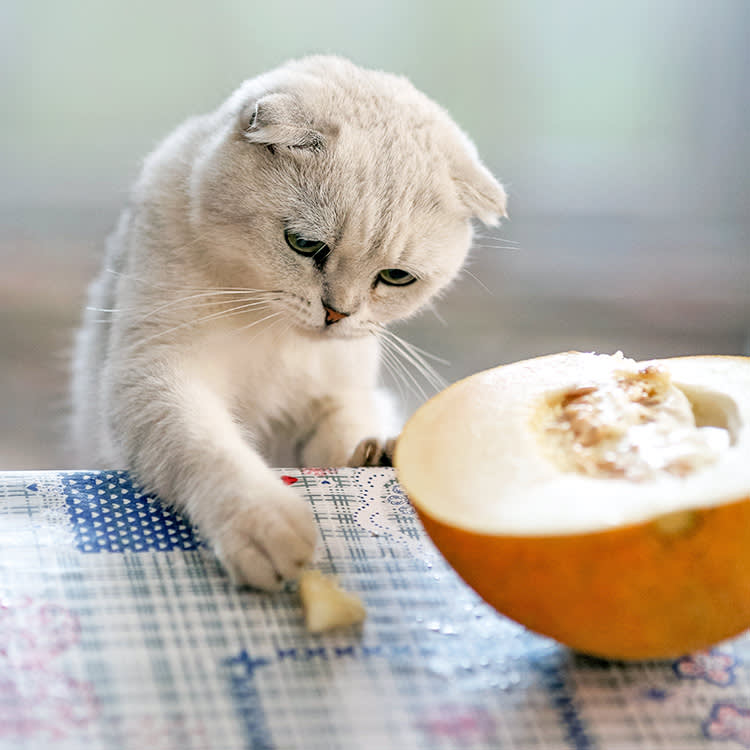
Every cat owner eventually witnesses something baffling: the cat who muscles you aside for an olive, stalks a bowl of popcorn, or loses its mind over a wedge of cantaloupe. It is easy to file this under “cats are just strange.” But the strangeness is a cover story. Almost every odd food your cat fixates on is tugging a specific, ancient string, umami, fat, or a smell that whispers meat, and once you know which string, the whole circus makes sense.
Almost none of these cravings are really about the food itself, they’re about a signal the food happens to send. Once you learn to ask what a snack is imitating, umami, fat, a meaty smell, you can usually tell in a second whether it’s a harmless indulgence or something to keep on a high shelf.
Cats are obligate carnivores, built to run on animal protein and generally poor at digesting plant matter. That does not stop them from developing passions for foods that have no business appealing to a hunter. The useful question is not why is my cat weird but what is this food faking, and, just as important, is it safe to give in. Here are eight of the most surprising cravings, the chemistry underneath each, and a straight answer on whether to share.
1. Cheese and butter
Start with the classics. Plenty of cats will risk life and limb for a stick of butter or a fistful of shredded cheese, and the pull is fat. As obligate carnivores, cats are drawn to the rich, fatty texture of animal fat, and the mouthfeel of butter and cheese mimics it almost perfectly. Cheese has a bonus: proteins like casein and whey that register as tasty for the same carnivore reasons.
The verdict: Most cats are lactose intolerant, so dairy can upset a sensitive stomach. If yours tolerates it, a nutritionist’s rule of thumb is to keep it to no more than about four grams a day, as an occasional treat rather than a habit.
2. Salty snacks: popcorn, chips, and Cheetos
The cat who paws into your popcorn bowl or goes feral for cheese puffs is chasing umami. Cats have a strong preference for savory, meaty flavors, and processed snacks are loaded with umami boosters like MSG and yeast extract. To a cat, that savory hit reads as almost meat, which is enough to trigger the beg.
The verdict: Skip it. The umami cats want in these foods comes packaged with salt levels that are bad for them, especially at the concentrations in human snack food. Enjoy your chips solo.
3. Seaweed and nori
Here is one that surprises even seasoned cat people: the cat who steals a sheet of nori off your sushi. It fits the same pattern as the salty snacks, because seaweed is naturally rich in the umami compounds cats are wired to seek, without necessarily carrying the same processed-snack baggage.
The verdict: A small piece of plain, unseasoned nori is generally low-risk as an occasional nibble, and some cats adore it. The catch is seasoning, many packaged seaweed snacks are heavy on salt and flavorings, so plain is the only version worth sharing, and only in tiny amounts.
4. Olives
The cat who reacts to a green olive like it is catnip is not imagining the resemblance. Green olives carry a compound called oleuropein, whose chemistry closely echoes nepetalactone, the compound that makes catnip work. That overlap can trigger a comparable, if usually milder, response, the rolling, rubbing, blissed-out routine.
The verdict: The trouble with olives is their sodium load, which cats handle poorly and which can tip into salt poisoning at high enough amounts. If you can find truly low-sodium green olives, a nutritionist puts the ceiling at around eight grams a day, roughly one to two olives.
5. Melon
A cat who chews through a cantaloupe rind to get at the flesh is following its nose to what smells like prey. Melons, cantaloupe especially, contain amino acids with a scent profile faintly resembling the proteins in meat. Given a cat’s powerful sense of smell, that whiff of meatiness is enough to make a melon intriguing.
The verdict: Fine as an occasional treat. Keep it to no more than about fifteen grams a day, and treat it as a novelty rather than a staple.
6. Spicy foods, like hot wings
Most cats want nothing to do with spice, but there is always an outlier who lunges for the hot wings or the tajín-dusted mango. Why some cats enjoy the burn is not well understood.
The verdict: Be careful here, because the danger is rarely the spice itself. Spicy foods are often loaded with salt and with ingredients that are outright toxic to cats, onion, garlic, and the like. If yours happens to be a rare lover of heat, the non-negotiable step is reading the full ingredient list before you let them near it.
7. Spinach, broccoli, and leafy greens
Some cats go genuinely crazy for greens, and even a nutritionist will admit it is not fully clear why. What we do know is that broccoli and spinach carry trace vitamins like A, C, and K, plus minerals like iron and calcium, that can complement a cat’s diet at the margins.
The verdict: Safe in small amounts. If you make your own cat food, one guideline is to cap spinach at about forty grams and broccoli at about thirty-five grams a day, remembering that a cat’s diet should still be overwhelmingly meat.
8. Gummy candies
The cat obsessed with gummy bears or sour worms is not chasing sweetness, cats cannot taste sweet at all. The likely draw is gelatin, an animal by-product, whose faint meaty scent or taste can appeal to a carnivore on a primal level.
The verdict: This one comes with a real warning. Sugar is bad for cats, who digest it poorly, and far more dangerously, many gummies are sweetened with xylitol, which is toxic. Keep candy well away from your cat.
The foods that are never worth the beg
A craving is not a permission slip. Some foods are toxic no matter how hard your cat lobbies for them: alcohol, grapes and raisins, chocolate, macadamia nuts, and mint. Cats do not know any of this, which is the whole point, they only know what they like, so the safeguarding is on you. Mint in particular can cause liver damage and serious digestive upset, yet some cats are weirdly drawn to menthol; the cat who attacks a mentholated tissue or cough drop is a real phenomenon, and a reason to keep those things out of reach. When in doubt about any food your cat is fixated on, ask your veterinarian before giving in.
What’s new since this was written
One toxic ingredient deserves a fresh flag, because it has quietly gotten harder to spot. Xylitol, the sweetener that shows up in sugar-free gummies, gum, mints, some peanut butters, and even certain baked goods, is increasingly labeled under a friendlier name: “birch sugar” or “wood sugar.” Same compound, same danger. The FDA has warned pet owners to watch for it, and the name change means a quick label scan is no longer enough if you do not know the aliases.
There is a small silver lining for cat households specifically. Because cats have no sweet taste receptors and tend to disdain sweets, they are less likely than dogs to gorge on xylitol-laced candy, and appear to be at least partly spared its worst effects. “Less likely” is not “safe,” though, so the guidance stands: keep sugar-free products, under every name they go by, out of paw’s reach.
References
- U.S. Food and Drug Administration. “Paws Off Xylitol; It’s Dangerous for Dogs.” FDA Consumer Updates.
- ASPCA Animal Poison Control Center. “People Foods to Avoid Feeding Your Pets.”
- Bradshaw, John W. S. “The Evolutionary Basis for the Feeding Behavior of Domestic Dogs (Canis familiaris) and Cats (Felis catus).” The Journal of Nutrition, vol. 136, 2006.
Common questions
Is it safe to let my cat eat human food?
Some of it, in tiny amounts. A little plain cheese, melon, or cooked greens is usually fine occasionally. But salt, onion, garlic, and xylitol are genuinely dangerous, so check every ingredient and keep portions small.
My cat loves salty snacks. Is that a problem?
Yes. The umami cats crave in chips and cheese puffs comes bundled with salt levels that are unhealthy for them, so these are best kept out of reach rather than shared.
Not a substitute for your vet. Our guidance is educational. For urgent symptoms, contact a vet or emergency clinic right away. Editorial standards
Dr. Nair is a veterinarian focused on diet and feeding. She covers everyday nutrition, treats, and the many "can they eat this?" questions owners ask, grounding each answer in what is actually safe and sensible for dogs and cats.
Meet our experts ↗Keep reading
 FoodYogurt Won't Fix Your Cat's Gut. Here's What Actually Might.Dr. Lena Park · 6 min
 FoodFor a Carnivore, 'Is It Safe?' Is the Wrong Question About Human FoodDr. Priya Nair · 6 min
 FoodMango and Cats: The Flesh Is Fine, the Family Tree Is the CatchDr. Nina Kohl · 6 min
 FoodThe Real Problem With Feeding Your Cat Ham Isn't Toxicity. It's MathDr. Ravi Mehta · 4 min
 FoodYour Cat Can't Taste Sweet. So Which Fruits Are Even Worth Offering?Dr. Amara Solis · 6 min
 FoodPumpkin Is the Rare 'Human Food' Your Cat Might Actually NeedDr. Lena Park · 5 min