


The Real Question About Cats and Cheese Isn't Whether, It's Which
A cube of cheddar won't hurt most cats, but the cheese you grab matters far more than people think. Here's a lactose ranking, the hard-no list, and better pill-hiders than cheese.

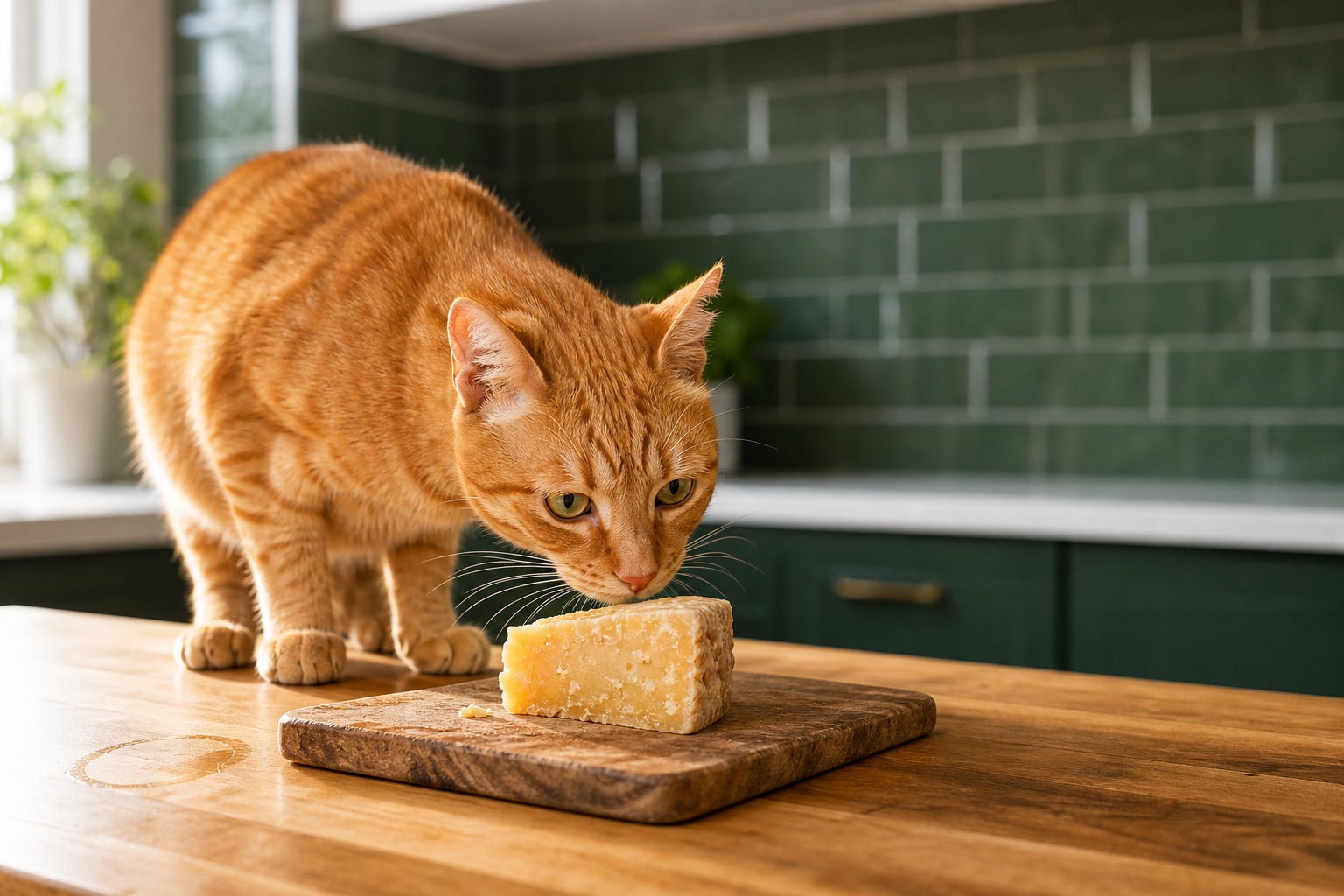
Almost nobody actually wants to feed their cat cheese for cheese’s sake. They want to do one of two things: hide a pill, or hand over a little something at the counter so the cat feels included. Cheese is the default for both, and that is exactly where the trouble starts, because “cheese” is not one food. An aged Parmesan and a slice of brie are about as different, from your cat’s gut’s point of view, as steak and a milkshake.
So the useful question isn’t the one everybody types into a search bar. It’s not “can cats eat cheese,” it’s “which cheese, and is there something better for what I’m actually trying to do.” Get the type right and a nibble is a non-event. Get it wrong and you’ve handed your obligate carnivore a fermenting lump of lactose.
Start with the job you’re hiring cheese to do
Most cheese moments fall into one of two buckets, and naming the bucket changes the answer.
If you’re hiding medication, you want the smallest possible vehicle that the cat will swallow whole without chewing. Cheese works because it’s sticky and smelly, but it’s also the highest-risk option on the tray (more on the lactose problem below). A pea-sized dab of plain meat paste, a commercial pill pocket, or a smear of a cat-safe lickable treat usually does the same job with none of the dairy downside.
If you’re sharing a moment, the portion should be so small that the cheese type barely matters, but it still does, because even a sliver of the wrong cheese can ruin an evening. That’s where the ranking comes in.
I tell clients to separate the two uses in their head. If it’s a pill, I’d rather they reach for a meat-based pill pocket than cheese, because then lactose never enters the equation. If it’s a treat, fine, but it has to be tiny and it has to be the right cheese.
Rank cheese by lactose, not by how much your cat begs
Here is the single most useful fact, and the one the internet usually skips: the lactose in cheese drops as the cheese ages and the moisture leaves. Fresh, soft, and spreadable means high lactose. Hard, aged, and crumbly means low. That one rule sorts almost every cheese in your fridge.
| Cheese | Lactose load | Verdict for cats |
|---|---|---|
| Aged Parmesan, aged cheddar, Swiss/Gruyère | Very low | The least risky options, in tiny amounts |
| Young cheddar, Gouda, Edam | Low-to-moderate | Occasional sliver, watch the gut |
| Mozzarella, string cheese | Moderate | Better skipped |
| Cottage cheese, cream cheese, ricotta | High | Skip |
| Brie, camembert, any raw-milk cheese | High + pathogen risk | Hard no |
| Blue cheese (Roquefort, Gorgonzola, Stilton) | Mold toxin risk | Hard no |
Why the hard-no list is non-negotiable: raw, unpasteurized cheeses raise the risk of listeria and salmonella, and blue cheeses are made with Penicillium molds that can produce compounds toxic to cats. These aren’t “give a smaller amount” cheeses. They’re “not in the cat’s mouth at all” cheeses.
And don’t assume the vegan block on the counter is a loophole. Non-dairy cheese skips the lactose but tends to be loaded with fat, salt, and starches, none of which belongs in a cat built to run on meat.
Why even the “safe” cheeses stay tiny
Cats are obligate carnivores. They’re engineered to pull their protein from animal tissue, and while an ounce of cheddar does carry about seven grams of protein, dairy was never meant to feed a cat. Two things work against it.
First, lactose. Adult cats produce very little lactase, the enzyme that breaks lactose down, so most of it sits in the gut, ferments, and comes back out as gas, diarrhea, or vomiting. Kittens make more lactase than adults, which is a big reason “cats love milk” became folklore even though most grown cats can’t tolerate it.
Second, fat. Cheese is calorie-dense, and a cat who gets regular cheese is a cat trending toward extra weight and everything that rides along with it: diabetes, pancreatitis, fatty liver disease, and arthritis. A treat that shows up nightly stops being a treat and becomes a habit with consequences.
How to share cheese without regret
If you’ve decided a bite of the right cheese is your move, keep it to a portion smaller than a fingernail, offer it no more than occasionally, and watch the litter box for the next day. Introduce it once and in isolation so that if your cat does react, you know the cause. If your cat raids a cheese board, demolishes a slice of pizza, or gets into anything on the hard-no list, call your veterinarian rather than waiting it out, especially if you see repeated vomiting or diarrhea.
What changed recently, and why it sharpens the raw-milk warning
The raw-milk line on the avoid list got a lot more serious in the last two years. Starting in 2025, the FDA began requiring pet-food makers that use unpasteurized milk or uncooked meat to treat H5N1 bird flu as a known hazard in their safety plans, after cats became seriously ill or died from contaminated raw products. Pasteurization exists precisely to kill the pathogens that raw-milk cheeses can carry, which is the whole reason brie and camembert sit on the never list. It’s the same biology, just a louder reminder.
A cheddar treat you can actually control
If you want to bake something cheesy that’s gentler than table scraps, this keeps the ingredient list short and cat-appropriate. Offer the finished treats in moderation, like any snack, not as a meal.
Ingredients
- 1 cup flour
- 1/2 cup shredded aged cheddar
- 1/4 cup vegetable oil
- 2 tablespoons water
Directions
- Preheat the oven to 400 degrees.
- Combine the flour, oil, and cheddar in a bowl and mix well.
- Add water slowly until it forms a workable dough.
- Roll marble-sized balls, flatten them on a baking sheet, and bake until lightly golden.
- Cool completely, then store in the refrigerator.
The bottom line
Cheese is never health food for a cat, but it isn’t a single yes-or-no either. Match the cheese to the job: skip it for pills when a meat-based hider will do, and if you’re sharing, reach only for a fingernail-sized bite of an aged, low-lactose hard cheese. Keep the soft, fresh, raw-milk, and blue varieties off the menu entirely, and let cheese stay a rare extra on top of a complete and balanced diet, not a fixture of it.
References
Common questions
Why is cheese hard on cats?
Adult cats make very little lactase, the enzyme that breaks down the lactose in dairy, so most of the lactose ferments in the gut and causes gas, diarrhea, and vomiting. The softer and fresher the cheese, the more lactose it carries.
My cat ate a piece of cheese pizza. Should I worry?
A small amount usually just risks a stomachache. Call your vet if your cat ate a large quantity, or any cheese on the avoid list like blue cheese or a raw-milk variety, or if vomiting or diarrhea lasts more than a day.
Not a substitute for your vet. Our guidance is educational. For urgent symptoms, contact a vet or emergency clinic right away. Editorial standards
Dr. Chen is a small-animal veterinarian who leads health and safety coverage at The Pet Times. She writes and reviews the bulk of our illness, condition, and safety content, translating clinical guidance into clear, practical advice owners can act on at home.
Meet our experts ↗Keep reading
 Food'Superfood' Means Nothing to Your Cat. Spinach Included.Dr. Nina Kohl · 5 min
 FoodYour Cat Can't Taste Sweet. So Which Fruits Are Even Worth Offering?Dr. Amara Solis · 6 min
 FoodCats Can Eat Eggs. Just Never Raw.Dr. Mara Chen · 4 min
 FoodYour Cat Begs for Olives and Cheetos. There's a Chemical Reason Why.Dr. Priya Nair · 7 min
 FoodCats Can Eat Pineapple. They Literally Can't Taste the Point.Dr. Ravi Mehta · 3 min
 FoodYour Cat Can Eat Pomegranate. That's Not the Same as Should.Dr. Priya Nair · 5 min