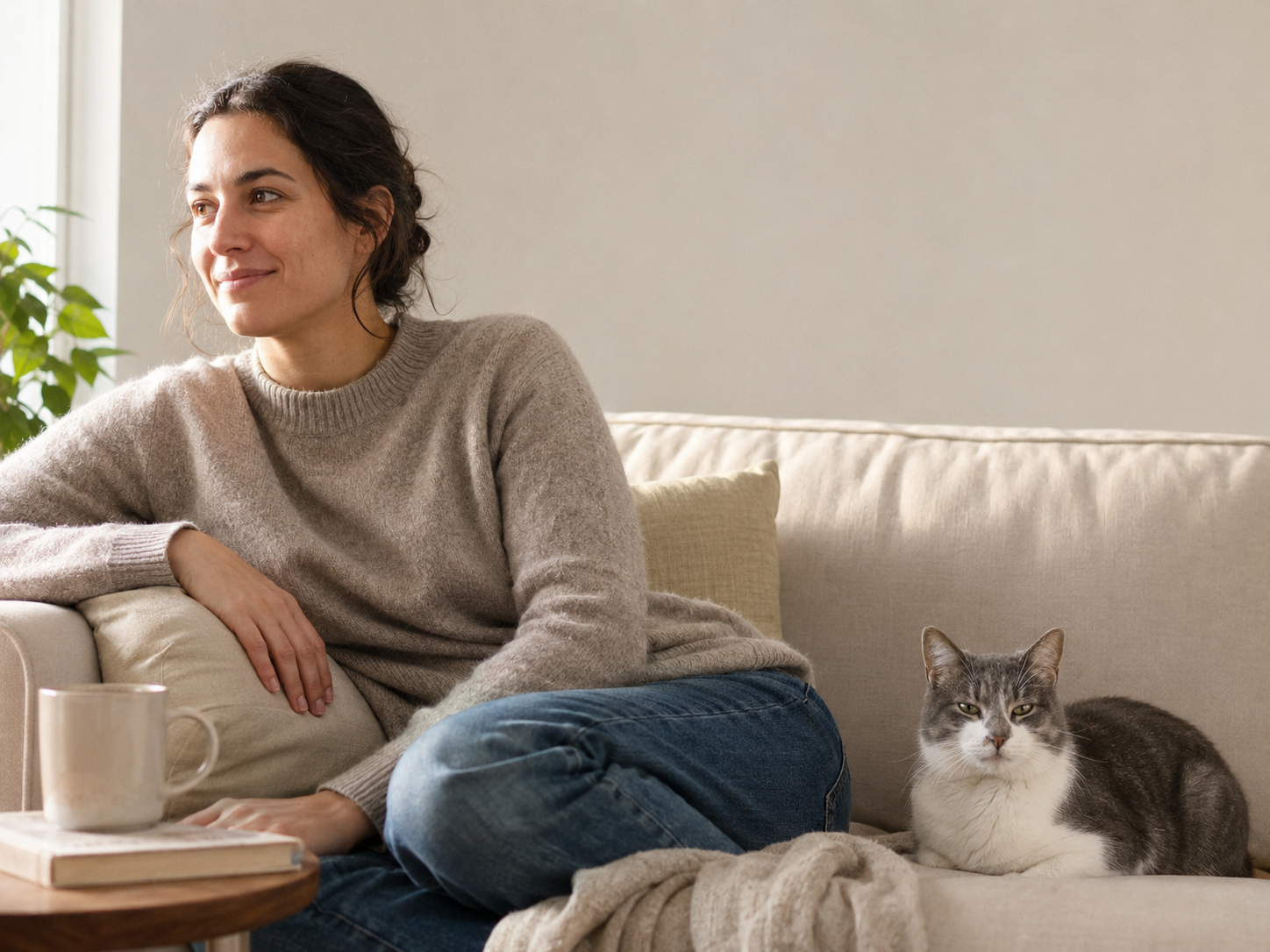

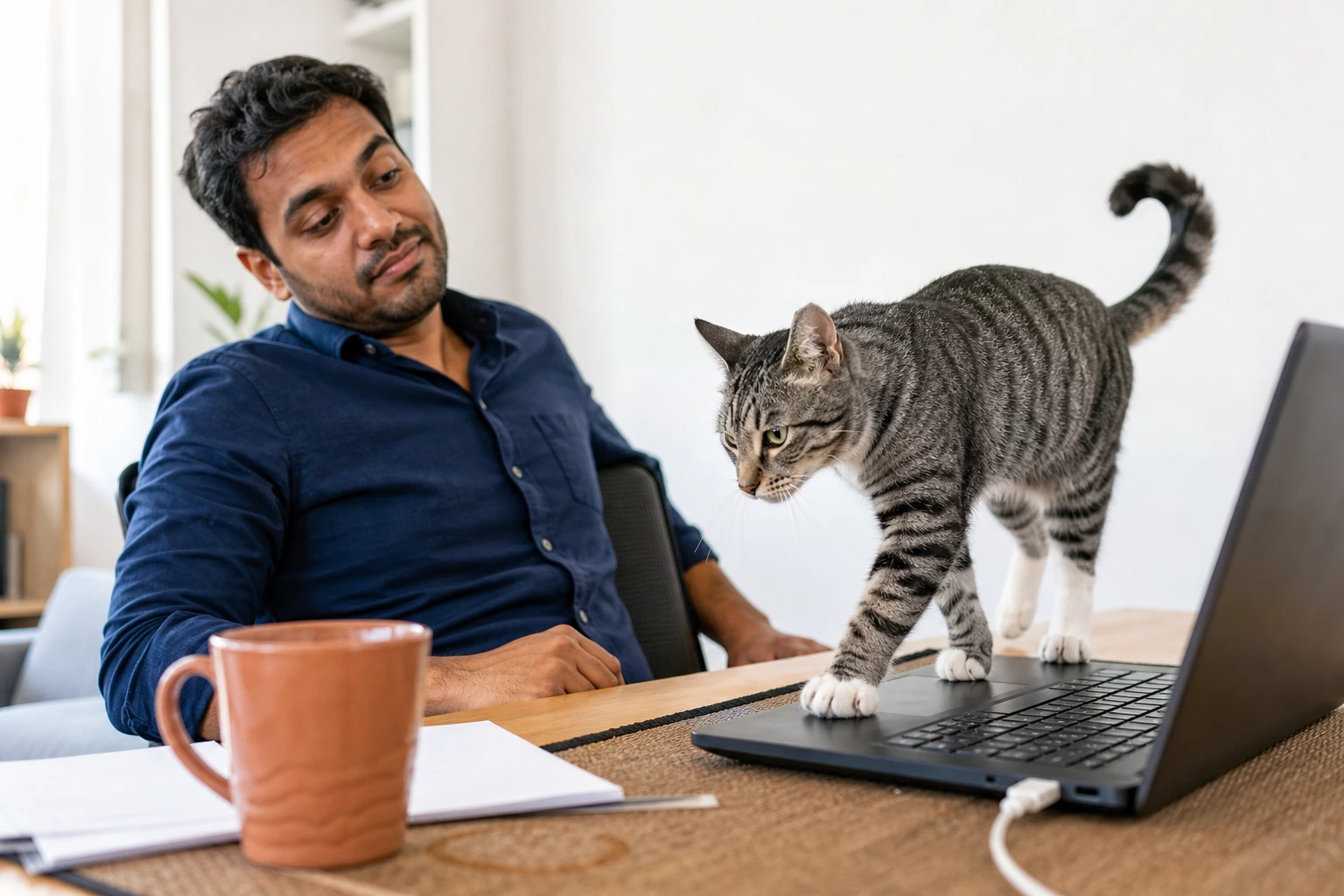
Somewhere in your call history there is a moment you do not remember, but your cat does. They jumped on the desk mid-meeting, you laughed, your coworkers cooed, you gave the obligatory scratch behind the ears, and a contract was signed. From that day on, the glowing rectangle hours stopped being boring and became the most reliable attention dispenser in the house.
That is the uncomfortable truth about meeting-crashing cats: it is trained behavior, and you are the trainer. Which is also the good news, because anything trained by accident can be untrained on purpose.
Why video calls are a cat’s perfect storm
Your cat has no theory of spreadsheets. What they see is simpler and, from a cat’s perspective, more inviting than almost anything else you do at home. You are stationary and cannot leave the chair. You are talking, animated, smiling, nodding, in exactly the warm register you use with them. And your full attention is pouring into one object in front of you, which tells a cat that attention is currently flowing and could be redirected.
“The cat lands on the desk, the meeting melts into aws, and somebody hands out a chin scratch. From the cat’s side of the keyboard, that is a paycheck,” says Dr. Mara Chen.
There is nothing new about the move itself. Long before laptops, cats were flattening themselves across open newspapers, homework, and paperback novels, anything a human stared at instead of them. The screen is just the current edition. Classic maneuvers include inserting themselves bodily between you and the display and the time-honored keyboard sit, which has the bonus feature of typing.
One more wrinkle: when you talk warmly at a screen, some cats conclude you are talking to them, and answer. The meow that lands in your one moment of silence is not sabotage. It may be your cat holding up their end of a conversation you started.
Pattern recognition seals it. If you sit down at the same desk at the same times and periodically reach down to pet whoever shows up, a cat connects those dots within days. Cats run on routine, and if remote or hybrid work changed yours, your cat is recalibrating what your presence at home means, using the only data available: what gets rewarded.
The accidental reward cycle
Animals repeat what pays. Attention pays, and to a motivated cat, nearly everything you do in response to an interruption counts as attention: laughing, narrating (“yes, everyone, this is Chairman Meow”), petting, cooing, even the scoop-and-squeeze as you deposit them on the floor. Brief counts. Annoyed counts. It all confirms that the desk is where the action is.
This is worth sitting with, because it explains why the interruptions survive your frustration. You are not failing to communicate displeasure. You are communicating engagement, and engagement was the goal.
The fix: pay attention before the meeting, not during
You cannot out-scold a reinforcement loop. You can out-schedule it.
Empty the tank first
The most effective single change is a deliberate attention deposit before you log on. Cats are wired around a natural sequence, hunt, eat, groom, sleep, and you can trigger the whole cascade on demand. Ten minutes of wand-toy play that ends with a “catch,” followed by a few treats or a small meal, sends most cats into wash-up-and-nap mode right as your call starts. This is not spoiling; it is strategy, and it doubles as the daily play your cat needed anyway.
“Run the day like a cat would: a hard play session, a small meal, then a warm bed at your elbow. A cat that has hunted and eaten right before your call has very little left to say about it,” Dr. Chen says.
Build a better seat than your keyboard
If your desk is the best real estate in the house, your cat will keep claiming it. Compete honestly: put something more desirable within arm’s reach. A cat tree or perch at desk height works, close enough that your cat can supervise you, positioned just out of camera frame. A heated mat is often the cheat code, since warmth outranks almost everything in feline economics. The location matters more than the furniture: near you, with a sightline to you, reachable for a quiet pet between agenda items.
Pay the new spot, not the old one
Reinforce the perch every time your cat chooses it, with treats, soft words, or slow blinks, when you are not mid-meeting. Clicker training accelerates this: click the instant they settle on the spot, then reward. Cats learn stationing this way readily, whatever their reputation. Consistency is the whole trick; the perch has to pay better than the keyboard, every time, for a few weeks.
What not to do
Do not punish. Not yelling, not clapping, not the spray bottle. It fails on every axis at once: it spikes stress and erodes trust, it can create brand-new behavior problems, and, worst of all, for an attention-seeking cat it works as a reward, because negative attention is still attention. Some cats will happily turn your outrage into a game where they always serve first.
If you must clear the desk mid-call, do it like a bored bouncer: no words, no eye contact, no petting. Lift, place on floor or perch, return to work. Repeated neutrally, it teaches that desk landings produce nothing at all, which is the one currency a cat will not work for.
Closing the office door is technically an option and usually a trap. Most cats treat a closed door as an emergency to be solved loudly, and paws hammering under the door reads worse on a call than a tail ever did. If you do need a closed-door meeting, balance it with genuine connection time after, so the door does not become the pattern.
And keep perspective. The interrupting is annoying, but it is also a compliment with fur on it. You are the central figure in your cat’s world, and the interruption is a bid for connection from an animal that has decided you are worth connecting with. Meet the need on your schedule, before the meeting, and the bids during it mostly dry up. Expect improvement in weeks, not days, and expect the occasional cameo forever. As remote-work perks go, there are worse ones.
What newer research adds
Researchers have actually studied the meeting-crashing cat. A study published in the journal Human-Computer Interaction examined how working from home changed the way people present themselves on video calls, and pet interruptions turned out to be a defining feature of the era, one that most participants managed around rather than eliminated, and that colleagues largely read as humanizing rather than unprofessional.
The attention-seeking explanation has research behind it too. Work from Oregon State University published in Current Biology found that most cats form secure attachments to their people, on par with dogs and human infants, and use their person as a base for security and reassurance. A cat bidding for your attention during the workday is that attachment system doing its job. The behavior is trainable; the motivation behind it is real, and worth honoring at some point in the day.