


Your Dog Watches TV Like a Critic, and Science Has Their Reviews
Surveys of well over a thousand dog owners show most dogs genuinely engage with screens, some search behind the TV, and a few bring a toy to join in. Here's what they're watching for, and how much screen time is too much.

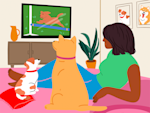
The debate over kids and screen time has been running for a generation. It turns out pet owners get their own version, because the research is now clear that dogs are not just passively parked in front of our televisions. They are watching, and they have preferences.
The evidence: dogs are engaged viewers
A study published in Applied Animal Behaviour Science surveyed more than 1,200 dog owners about how their dogs respond to screens, including their reactions to test footage of four things moving across a display: a panther, a bird, street traffic, and another dog.
The numbers describe an audience, not wallpaper. More than three-quarters of dogs did each of the classic engagement behaviors: tilting the head, pricking the ears, vocalizing at the screen, or walking toward it. More than a quarter went further, investigating behind or beside the TV or touching the screen with their nose, checking whether that on-screen dog was hiding somewhere physical. A small contingent, roughly one in twenty, either brought a toy over to join the fun or fled the room entirely. Anyone who has watched a terrier hunt for the doorbell dog that lives inside the soundbar knows both personalities.
What holds their attention is consistent: movement, and above all, other animals, with on-screen dogs the runaway favorite. Sound matters less than you would guess. Many owners reported their dogs watched just as intently with the volume off, which fits how dog perception is weighted toward motion.
The survey also measured us. Nearly half of the owners said they leave a TV or videos running for their dog when leaving the house, essentially tied with the 57 percent who set out interactive toys, and 17 percent queue up dog-specific programming such as DogTV. Screen time is now a mainstream tool of dog care, adopted mostly without anyone asking whether it works.
Who the superfans are
Screen interest is not evenly distributed. Younger dogs watch more than older ones. Herding and sporting breeds, the dogs bred to track and respond to movement all day, out-watch other groups, and dogs with sharper vision watch more than dogs whose eyesight has faded. If your Border Collie stalks the nature documentary while your senior Chihuahua naps through it, both are behaving exactly on-trend.
So is screen time bad for dogs?
Here is the honest answer: TV for dogs is an enrichment garnish, not a meal. There is no evidence-based daily limit, and no researcher has found harm in a dog enjoying the screen. The risk is substitution. A dog’s non-negotiable needs, exercise, sniffing the actual outdoors, play, social contact, and training, cannot be delivered by a panther in 4K, and a screen left on for a lonely dog will not treat separation anxiety, which is a panic disorder rather than a boredom problem.
A sensible house policy looks like this: use the TV as one rotating option among several for a dog home alone, alongside food puzzles and chew projects. Notice what your individual dog does with it, since the dog who relaxes to slow animal footage and the dog who ends up pacing and barking at every on-screen squirrel are having very different experiences, and only one of them is being enriched. And never let the glowing rectangle quietly eat the walk. Dogs, like kids, will not file the complaint themselves.
What newer research adds
In July 2025, an Auburn University team published a follow-up in Scientific Reports that built an actual measurement instrument for this, the Dog Television Viewing Scale. Analyzing 453 owner reports, they found dog TV behavior sorts into three components: reactions to animals, reactions to non-animal content like vehicles and doorbells, and “following” behavior, where a dog tracks an object off the edge of the screen or searches for where it went. Temperament predicted viewing style: excitable dogs did more following, apparently expecting the on-screen object to keep existing in the room, while more fearful or anxious dogs reacted more to non-animal triggers like doorbells and car sounds.
That last finding has a practical edge the earlier survey lacked: what you stream for your dog should match your dog. A confident, animal-obsessed watcher may love wildlife footage, while an anxious dog might do better with calm content free of doorbells, sirens, and knocking, the exact sounds that set them off in real life. The critics, it turns out, have genres.
References
Dr. Kohl is a board-certified veterinary dentist with a particular interest in preventive oral care. She reviews all dental health content at The Pet Times and contributes practical guides on home dental routines, professional cleaning, and oral disease prevention.
Meet our experts ↗Keep reading
 TrainingYour Dog Picked the Person Who Ignores It. Here's Why.Dr. Priya Nair · 7 min
 Health & WellnessPaw Chewing Is a Loop, Not a Habit. Breaking It Takes Two Moves.Dr. Amara Solis · 8 min
 LivingIs Your Dog Really Jealous, or Just Afraid of Missing Out? The Science Is Messier Than the Headlines.Dr. Nina Kohl · 5 min
 TrainingYour Dog Isn't Watching the Door. They're Smelling the Clock.Dr. Amara Solis · 5 min
 TrainingAn AI Box Can Drill Your Dog. It Can't Do the Part That Matters.Marcus Webb · 6 min
 First DaysStop Counting Your Puppy's Sleep Hours. Watch for the Change.Dr. Amara Solis · 8 min