


Paw Chewing Is a Loop, Not a Habit. Breaking It Takes Two Moves.
The itch starts the licking, the licking wets the skin, the wet skin grows the infection, and the infection makes it itch. Treat only one end of that and it comes straight back.
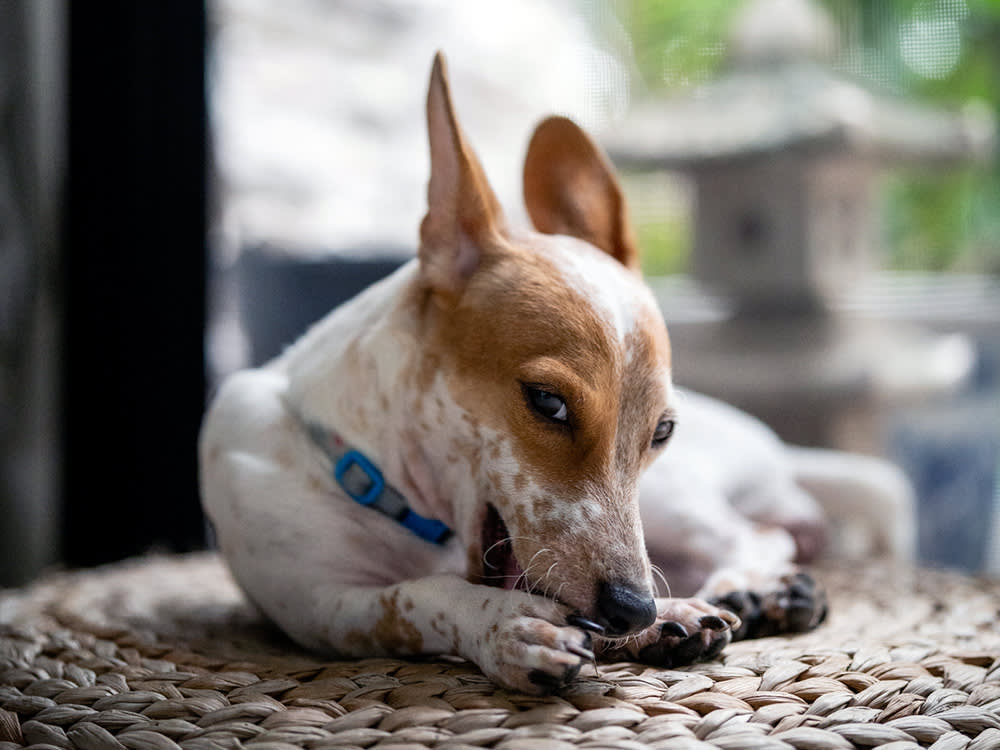
It starts as background noise. A wet, rhythmic slurping from the end of the sofa, mostly at night, mostly when you’re trying to sleep. Then one day you actually look at the foot and it’s a mess: red between the toes, the white fur stained rust-brown, and a smell like an old dishcloth.
Most owners at this point ask the wrong question. They ask why their dog is chewing, get an answer (“allergies”), treat that, and are baffled when the chewing carries on.
The reason is that paw chewing is not a single problem with a single cause. It’s a loop, and by the time you notice it, the loop is generating its own fuel. Something started it, but something else is now keeping it going, and if you only treat one of those, you get a dog who improves for two weeks and then relapses.
Understanding the loop is the whole thing.
The loop
Follow it round:
- Something makes the paw itch. Usually an allergy.
- The dog licks and chews the paw.
- The licking keeps the skin wet, and it damages the surface, opening tiny breaks in the skin.
- Warm, damp, damaged skin is an ideal environment for yeast and bacteria, both of which already live on your dog. They multiply.
- That infection is itchy. Very itchy. Often itchier than the original trigger.
- So the dog licks and chews the paw.
- Go to step 3.
The consequence is uncomfortable but important: within a few weeks, the thing making your dog itch is often no longer the thing that started it. You can remove the original allergen entirely and the loop will keep running on the infection alone.
Which is why the answer is always two moves, not one:
Move one: break the loop. Move two: find and treat what started it.
Do only the first and it relapses. Do only the second and it doesn’t resolve, because the infection is still there.
The word your vet will use, and what it doesn’t mean
Pododermatitis is the term for inflammation of the paw: the skin, the webbing between the toes, the pads, the nail beds.
It is not a diagnosis. It’s a description, roughly equivalent to a doctor telling you that you have “a rash.” It’s the finding, not the reason.
This matters practically, because “your dog has pododermatitis” is not an answer, and the follow-up question is always “caused by what?” A vet who says the word and hands you a cream without pursuing that question hasn’t finished the job.
What starts it
Allergies (the overwhelming majority)
If your dog chews all four feet, this is where the money is. Roughly 20 to 30 per cent of dogs have some form of allergic skin disease, and atopic dermatitis, the environmental sort, affects up to around 10 per cent of all dogs. Feet are the classic site, because they’re in permanent contact with grass, pollen, and dust, and because they’re easy to reach.
Three flavours, and telling them apart matters:
- Environmental (atopy). Pollen, mould, dust mites, grass. Often seasonal, at least at first, though many dogs progress to year-round. Usually starts in young adulthood, between one and three years old. Ears and feet are the giveaway pair.
- Flea allergy. The single most common allergic skin disease in dogs. One bite can trigger weeks of itching in a sensitised dog, which is why “I’ve never seen a flea on him” proves nothing at all. Every itchy dog should be on rigorous, year-round flea control, no exceptions, if only to take it off the list.
- Food allergy. Less common than the internet believes, and it does not produce a distinctive pattern you can spot by eye. It is non-seasonal, and it more often comes with gut signs alongside the skin ones.
Infection, which is both cause and consequence
Yeast (Malassezia) and bacteria (usually Staphylococcus) are the loop’s engine.
The tells for yeast: a distinctly musty, corn-chip, or cheesy smell, greasy or thickened skin, and brown-red staining. Bacterial infection tends to bring pustules, crusting, and more overt redness.
Both are treatable, and both need to be treated, whatever else you do.
The mechanical causes (often a single paw)
- Foreign body. A grass seed or foxtail driven up between the toes. These migrate, they abscess, and they frequently need to be surgically removed. This is the classic cause of a dog who suddenly, urgently attacks one specific foot, and the classic cause of a swollen, weeping lump between two toes.
- Injury. Cuts, burns from hot pavement, chemical irritation from de-icing salt or floor cleaner, a torn nail.
- Parasites. Demodex and Sarcoptes mites, and hookworm larvae, which literally penetrate the skin of the feet from contaminated ground.
Pain, which nobody thinks of
A dog with arthritis, or a soft-tissue injury, or a joint problem, will often lick at the limb over the sore area. Repeatedly, in the same place.
Chronic licking of the wrist or the front of the leg in a middle-aged or older dog is worth an orthopaedic look, not just a dermatological one.
Boredom and anxiety (last on the list, and it belongs there)
Genuine compulsive licking exists. But it is a diagnosis of exclusion, and it is arrived at after you’ve ruled out the physical causes, not instead of ruling them out.
The honest sequence is that most “anxiety licking” started as a physical itch and became a habit later, once the licking had acquired its own self-soothing value.
The mistake I see most often is treating one end of the loop. The dog gets an antifungal wash, the feet improve, the wash stops, and six weeks later the feet are worse than before, because nobody ever addressed the allergy underneath. Or the reverse: the allergy is managed beautifully and the dog is still chewing, because there’s a raging yeast infection nobody cleared. You have to do both, in the same month.
Breaking the loop
This is the part you do while the diagnostic work happens.
Dry the feet. Every time they come in from wet grass, rain, or a wash. Between the toes, properly, not a vague dab. Damp interdigital skin is the single best growth medium for yeast in your entire house.
Treat the infection. Medicated washes and wipes, chlorhexidine-based or antifungal, are the workhorse here, and they typically need to be used far longer than owners expect: weeks, not days. Systemic antifungals or antibiotics may be needed for a real infection. Get the specific product from your vet, because guessing here wastes months.
Stop the physical damage. A cone is not cruelty, it’s a tourniquet on the loop. It’s temporary, and it lets damaged skin close. A soft recovery collar or an inflatable one is often better tolerated than the classic plastic cone. Boots or a light sock can work for some dogs. None of these are treatments; they buy the skin time to heal while the actual treatment works.
Control the itch, properly. This is the piece that has genuinely changed. Modern targeted anti-itch drugs, a monoclonal antibody given by injection, and an oral JAK inhibitor, control itch far more precisely than steroids ever did, without the same side-effect burden. A recent retrospective study of the injectable reported success in around 88 per cent of allergic dermatitis cases. If your dog is chewing their feet raw, this is a legitimate conversation to have with your vet rather than something to endure.
Finding what started it
Flea control, non-negotiable. Year-round, on every animal in the house, with a proper veterinary product. This costs almost nothing and eliminates the most common allergic cause.
Track the season. Keep a diary. If it’s bad from April to September and fine in January, that’s environmental. If it’s identical all year, that’s a point for food or for something in the home.
The food trial, if indicated. And it must be done properly or not at all. A strict elimination diet, a hydrolysed or genuinely novel protein, for eight to twelve weeks, with absolutely nothing else: no treats, no chews, no table scraps, no flavoured medications, no toothpaste, nothing the neighbour gives him. A single lapse invalidates the whole trial. Most failed food trials are not failures of the diet; they’re failures of household compliance. Then you reintroduce the old food and see if the itch comes back, which is the step almost everyone skips and which is the only thing that actually proves it.
Diagnostics your vet may run: skin cytology (a tape impression under the microscope, which finds yeast and bacteria immediately and is cheap), skin scrapes for mites, culture, and X-rays if a foreign body or a joint problem is suspected. Allergy testing exists but is best used to guide immunotherapy, not to diagnose in the first place.
When to stop waiting
Book the vet if any of these is true:
- The paw is swollen, or there’s a lump or a draining hole between the toes. That’s a foreign body or an abscess and it won’t resolve on its own.
- There’s bleeding, an open wound, or pus.
- The dog is limping.
- There’s an odour, or the skin has thickened and darkened.
- The nails or nail beds are involved.
- It has been going on for more than a couple of weeks.
- The chewing is intense enough to keep the household awake.
What newer research adds
Two things are genuinely different from the standard advice you’ll find in older articles.
The itch drugs. The arrival of targeted anti-itch therapy has changed the ceiling of what’s achievable for an allergic dog. The old model was steroids, with the weight gain, the drinking, the panting, and the long-term risks that came with them. The current model is much more precise, and 2025 data on long-term use of the injectable antibody shows the majority of dogs maintaining substantially reduced itch scores over extended periods. “There’s nothing to be done, he’s just an itchy dog” is no longer a defensible position.
The skin barrier. Research increasingly frames atopic dermatitis not purely as an over-reactive immune system but as a defective skin barrier: the outer layer is leakier than it should be, letting allergens in and letting moisture out. That’s why barrier-supporting approaches, essential fatty acid supplementation, ceramide-containing topical products, and gentler washing, are now standard adjuncts rather than fringe advice. It’s not a cure, and it won’t replace the medication, but it is real, and it’s part of why the mundane advice, dry the feet, wash gently, don’t strip the skin, matters more than it sounds.
FAQ
Why does my dog chew their paws at night? Often because there’s nothing else going on. Itch is more noticeable in a quiet, still environment, exactly as it is for humans. It doesn’t mean the cause is boredom.
Is paw chewing always allergies? No, but allergies are the most common cause of chronic, all-four-feet chewing. A single paw is more likely to be a foreign body, an injury, or an infected nail bed.
Should I use a cone? Temporarily, yes. It isn’t a treatment, but it stops the physical damage while the actual treatment works. A soft or inflatable collar is often better tolerated.
How long does a food trial take? Eight to twelve weeks, with absolutely nothing else passing your dog’s lips. And the reintroduction at the end is the part that actually proves it, so don’t skip it.
My dog’s feet smell like corn chips. What is that? Usually yeast. It’s very common, it’s treatable, and it’s a strong sign that the loop is running. It’s worth a vet visit rather than a bath.
References
- “Canine Atopic Dermatitis: Prevalence, Impact, and Management Strategies.” Veterinary Medicine: Research and Reports, 2023. https://www.tandfonline.com/doi/full/10.2147/VMRR.S412570
- Olivry, T., et al. “Treatment of canine atopic dermatitis: 2015 updated guidelines from the International Committee on Allergic Diseases of Animals (ICADA).” BMC Veterinary Research, 2015. https://bmcvetres.biomedcentral.com/articles/10.1186/s12917-015-0514-6
- “Long term use of lokivetmab (Cytopoint) in atopic dogs.” PubMed Central, 2025. https://www.ncbi.nlm.nih.gov/pmc/articles/PMC11938560/
- “Use of Cytopoint in the Allergic Dog.” PubMed Central. https://www.ncbi.nlm.nih.gov/pmc/articles/PMC9343842/
- “Malassezia Dermatitis in Dogs.” VCA Animal Hospitals. https://vcahospitals.com/know-your-pet/malassezia-dermatitis-in-dogs
- “Pododermatitis in Dogs.” Merck Veterinary Manual. https://www.merckvetmanual.com/integumentary-system/pododermatitis-and-pyoderma/pododermatitis-in-dogs
Not a substitute for your vet. Our guidance is educational. For urgent symptoms, contact a vet or emergency clinic right away. Editorial standards
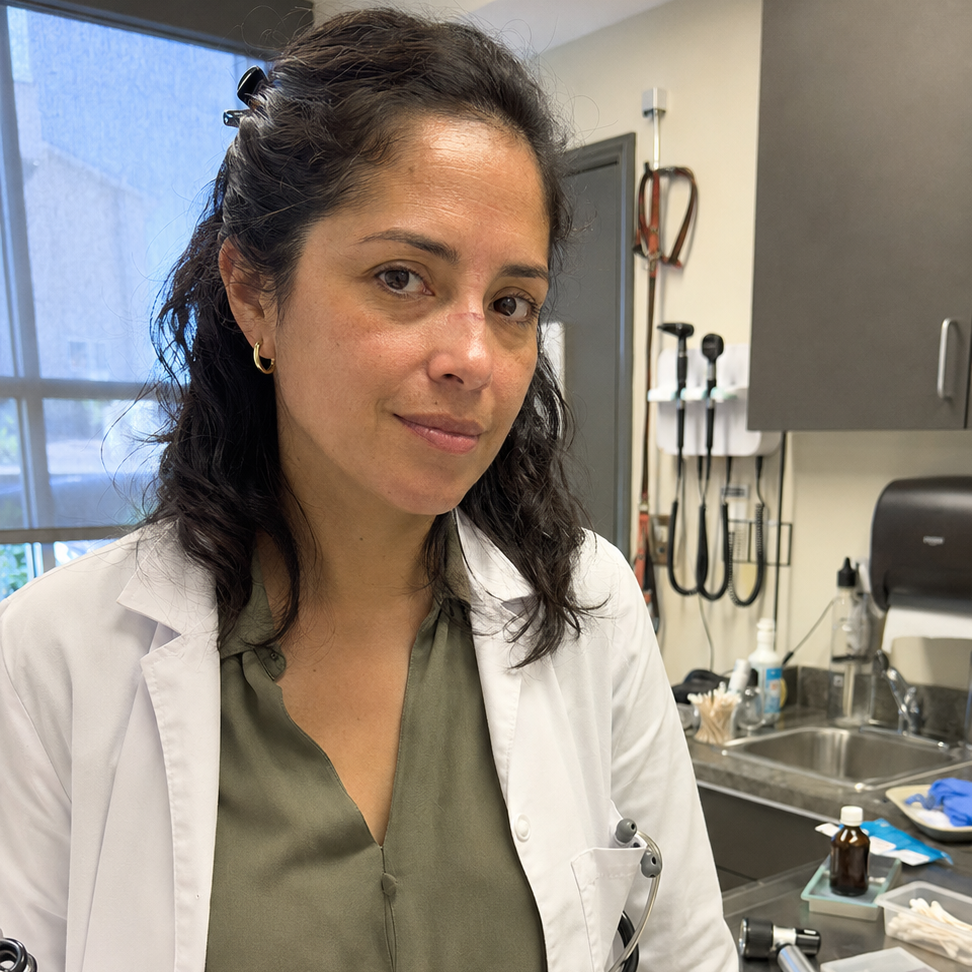
Dr. Solis is a board-certified veterinary dermatologist with over twelve years of clinical experience. She advises on skin conditions, allergies, and grooming practices that affect coat and skin health. All dermatology and allergy content at The Pet Times is reviewed by her team before publication.
Meet our experts ↗Keep reading
 Health & WellnessYour Dog's Yeast Infection Won't Surrender to Coconut OilDr. Priya Nair · 7 min
 Health & WellnessDog Losing Hair? One Question Splits It Into Two Different ProblemsDr. Mara Chen · 8 min
 Health & WellnessA Dog Who Keeps Shaking Their Head Is on a ClockDr. Priya Nair · 8 min
 Health & WellnessYou Found a Lump on Your Dog. Here's What It Might Be, and When to Worry.Dr. Priya Nair · 8 min
 Health & WellnessThe Vet Specialty Nobody Mentions, Until Your Dog Won't Stop ScratchingDr. Amara Solis · 6 min
 Health & WellnessYou Can't Cure Dog Allergies. Here's What Actually Stops the Itch.Dr. Amara Solis · 12 min