


A Dog Who Keeps Shaking Their Head Is on a Clock
Head shaking is almost always the ear. Left alone, it can burst a blood vessel in the ear flap. Here is what to check, and when to stop waiting.

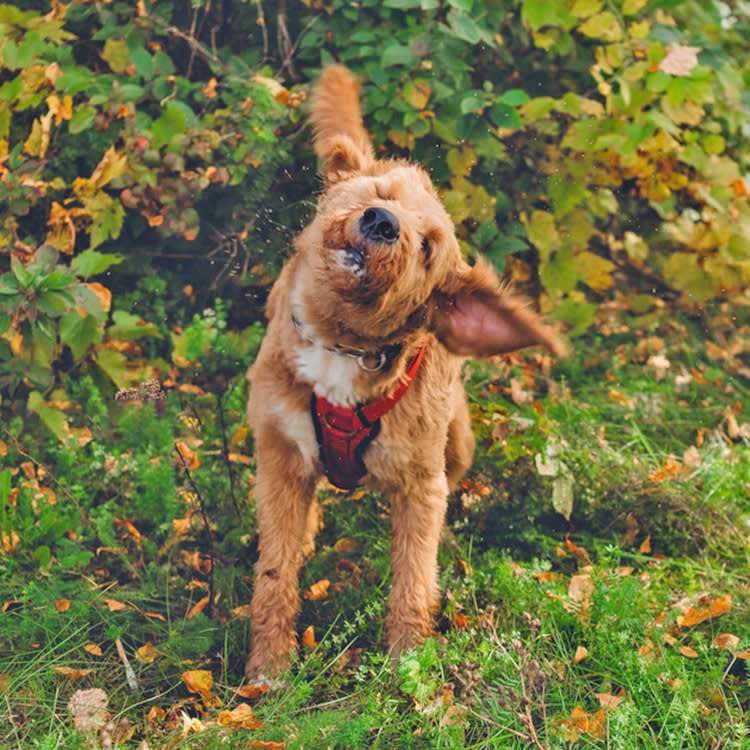
A dog shaking their head once or twice is nothing. A dog shaking their head over and over, all day, is a dog with a problem in their ear, and it is a problem that gets worse the longer it runs.
Here is the mechanism that makes this urgent rather than merely annoying. The violent flapping of a head shake whips the ear flap against the skull. Do that enough times and blood vessels inside the flap rupture, and it fills with blood. That is an aural hematoma: a swollen, heavy, painful ear that usually needs a vet to drain or surgically correct. Aural hematomas do not happen out of nowhere. They happen because something made the dog shake, and nobody stopped it.
So the frame for this is not “why is my dog shaking their head.” It is “the shaking is itself doing damage, and the clock started when it did.”
Start with the ear, because it is almost always the ear
Inflammation of the external ear canal, otitis externa, is the single most common cause of persistent head shaking in dogs. Some breeds are more prone, particularly long, floppy ears that hold in moisture and debris, but any dog can get it.
Ear infections. Bacterial and yeast infections are the leading cause. Beyond the shaking, look for discharge, an unmistakable odor, redness, swelling, and pain. It can affect one ear or both. Common bacterial culprits are Staphylococcus, Streptococcus, and Pseudomonas; yeast infections are usually Malassezia. Mixed bacterial and yeast infections in the same irritated ear are common, and worth knowing about because they need to be treated for both.
Allergies. This is the underlying driver behind a huge proportion of recurring ear disease. Dogs with food or environmental allergies get itchy, and the ears and paws are the two places it shows up most. If your dog gets ear infections over and over, the ear is the symptom, and the allergy is the disease.
Parasites. Ear mites (Otodectes cynotis) and ticks both take up residence in the ear canal. You can find a tick by lifting the ear flap and looking, though an engorged one is far easier to spot than a tiny seed tick. Ear mites are tick-shaped but microscopic, and diagnosing them means your vet looking at ear debris under a microscope. Both need prompt treatment: ticks carry disease, and ear mites spread to the other dogs and cats in the house.
Water. Water in the ear canal triggers a reflex to shake it out, and that is entirely normal. You can reduce it by not pouring water directly into the ears at bath time, and by drying the ears after a swim with cotton balls or a soft cloth. Cotton balls, not cotton swabs, which push debris deeper and can damage the canal.
The hematoma itself. Once it forms, it becomes its own irritant, because a heavy swollen flap is uncomfortable, and discomfort produces more shaking. It is a loop, and the only way out of it is treating what started it.
Normal shaking versus the kind that matters
Normal head shaking is occasional, brief, and purposeful. It looks intentional, a quick attempt to fling out whatever is bothering them or scratch an itch from the inside, and the dog is entirely normal between bursts. Head shaking may be the only sign, or it may come with a bit of scratching.
Abnormal head shaking is involuntary, persistent, or intense enough to interrupt what the dog is doing. It may look less like a shake and more like a tremor or a bob. And it tends to arrive with company: changes in behavior, difficulty walking, falling, involuntary eye movement, fever, or obvious pain.
That distinction, deliberate and brief versus involuntary and persistent, is the one to hold onto, because it decides whether you are looking at an ear or at a nervous system.
When the ears really are clean
Sometimes a dog shakes their head and the ears check out. Then the less common causes come into play, and they are worth knowing by name.
Vestibular disease. The vestibular system governs balance, eye movement, and head position. When it goes wrong you see loss of coordination, a head tilt, and nystagmus, rapid involuntary eye movement. It can be caused by an inner ear infection or a lesion in the brain. In older dogs there is a form that appears with no identifiable cause and usually resolves on its own over time, though it is alarming to watch. Severity varies, and some affected dogs produce head movements that are easy to mistake for ordinary shaking.
Idiopathic head tremors. In this syndrome, a dog has episodes of head movement they cannot control, nodding up and down or swinging side to side. The distinguishing feature is that you can usually interrupt an episode by distracting the dog. Nobody knows what causes it, and it is thought to be inherited: the breeds it turns up in most are Doberman Pinschers and English Bulldogs.
Cerebellar hypoplasia. Incomplete development of the cerebellum, the part of the brain that manages balance and coordinated movement. It is congenital, often the result of a viral infection during pregnancy. Affected puppies show intention tremors: head bobbles and body shakes that appear when the dog is concentrating on a specific movement. The more deliberate the action, the worse the tremor.
Neurologic disease. Trauma, infection, inflammatory disease, and brain tumors can all show up as excessive shaking or tremors, and they almost always bring company: seizures, or a dog who is simply not mentally themselves.
When to see a vet
If the shaking keeps going after you have dried and gently cleaned the ears, it needs to be looked at. Full stop. Not because every case is serious, but because the cheap ones are cheap to fix and the expensive ones get more expensive with time.
What your vet will do: look down the canal with an otoscope for infection or infestation, and take a sample of any debris to examine under a microscope for bacteria, yeast, or mites. If there is an infection and your dog also has balance problems, they will look deep into the canal to determine whether it has reached the inner ear, which needs more aggressive treatment.
Dogs with recurring infections or persistent itch should be worked up for allergies, which can mean a food trial or allergy testing. Dogs with tremors or head bobbing may need bloodwork and imaging, and a referral to a veterinary neurologist if there is concern about disease in the nervous system.
Go the same day if you see a head tilt, loss of balance, falling, flicking eye movements, fever, or a suddenly swollen, boggy ear flap.
Owners apologize to me for coming in about a head shake, as if it is too small a thing. It is not a small thing. A week of shaking can turn a treatable ear infection into a swollen ear flap and a surgical bill.
What newer research adds
The most useful development for anyone whose dog keeps getting ear infections is the growing evidence that the ear is not where the fight should happen.
A randomized, blinded, controlled trial published in Veterinary Dermatology in 2025 followed 34 dogs with atopic dermatitis and active ear inflammation. All were treated and brought into remission, then fed either a therapeutic diet targeting the skin barrier and allergy pathways, or a control diet, for up to six months. Only 25 percent of the dogs on the therapeutic diet relapsed with an ear infection, compared with 61 percent on the control diet. The diet more than halved the rate of new episodes, and reduced how much medication the dogs needed.
That is a striking result for a chronic problem that most owners are treating one flare at a time, with drops, forever. It reinforces what dermatologists have been saying: recurring otitis is usually an allergy problem wearing an ear costume, and the durable fix is upstream.
On the treatment side, there is also more evidence that long-acting products applied in the clinic, one or two doses given by your vet, work about as well as a two-week course of drops you administer at home, which matters enormously for dogs who fight ear medication. Recurrence rates in one trial were comparable, around 11 percent, in both groups. If the daily drops are the reason treatment is failing in your house, that is worth raising.
None of it changes the first rule. A dog shaking their head repeatedly is on a clock, and the clock is not in your favor.
References
- Watson, A., et al. “Incidence Rate of Otitis Externa Episodes in Atopic Dogs Is Reduced by a Therapeutic Diet in a 6-Month Randomised, Blinded, Controlled, Clinical Trial.” Veterinary Dermatology, 2025. https://doi.org/10.1111/vde.70017
- Merck Veterinary Manual. “Otitis Externa in Animals.” https://www.merckvetmanual.com/ear-disorders/otitis-externa/otitis-externa-in-animals
- “Idiopathic and Structural Episodic Nonintentional Head Tremor in Dogs: 100 Cases (2004–2022).” Journal of Veterinary Internal Medicine, 2023. https://www.ncbi.nlm.nih.gov/pmc/articles/PMC10658580/
- Merck Veterinary Manual. “Congenital and Inherited Cerebellar Disorders in Animals.” https://www.merckvetmanual.com/nervous-system/congenital-and-inherited-anomalies-of-the-nervous-system/congenital-and-inherited-cerebellar-disorders-in-animals
- “Comparison of Single or Two Dose Veterinarian-Administered Protocols and Daily At-Home Prescription Canine Otitis Externa Treatments.” 2025. https://pmc.ncbi.nlm.nih.gov/articles/PMC13082296/
Common questions
My dog is scratching their ear and shaking their head. What is it?
That combination points at the ear canal: an infection, allergies, ear mites or a tick, or trapped water. It should be examined rather than waited out, because the scratching and shaking themselves can cause further damage.
What does an inner ear infection look like in a dog?
Pain, fever, a head tilt, loss of balance, and rapid flicking eye movements. Inner ear infections are a step beyond the common outer-ear infection and need more aggressive treatment, so this warrants prompt veterinary care.
My dog keeps shaking their head but the ears look clean. Now what?
Clean-looking ears do not rule out disease deeper in the canal, which you cannot see without an otoscope. If the ears genuinely check out, the less common causes come into play: vestibular disease, idiopathic head tremors, or a neurologic problem. All of them need a vet.
Not a substitute for your vet. Our guidance is educational. For urgent symptoms, contact a vet or emergency clinic right away. Editorial standards
Dr. Nair is a veterinarian focused on diet and feeding. She covers everyday nutrition, treats, and the many "can they eat this?" questions owners ask, grounding each answer in what is actually safe and sensible for dogs and cats.
Meet our experts ↗Keep reading
 Health & WellnessThere's No 'Best' Food for Dog Allergies. Here's How to Actually Find YoursDr. Nina Kohl · 13 min
 Health & WellnessYou Cannot Tell a Lump Is Harmless by Touching ItDr. Mara Chen · 7 min
 Health & WellnessOne Flea Bite Can Wreck an Allergic Dog. The Count Never Mattered.Dr. Priya Nair · 9 min
 Health & WellnessScabies Looks Alarming. It's One of the Most Curable Things Your Dog Can Get.Dr. Amara Solis · 8 min
 Health & WellnessMost Hot-Spot 'Home Remedies' Are Useless. A Few Actually Work.Dr. Mara Chen · 6 min
 Health & WellnessDog Losing Hair? One Question Splits It Into Two Different ProblemsDr. Mara Chen · 8 min