


One Flea Bite Can Wreck an Allergic Dog. The Count Never Mattered.
Flea allergy dermatitis does not scale with the number of fleas, which is why 'but I only found one' is the most misleading sentence in the exam room. Here is what is actually happening under the skin, and how to end it.


Here is the sentence that sends people down the wrong path, and almost everyone says it: “But I only found one flea.”
For a dog with flea allergy dermatitis, that sentence contains no useful information. The severity of the itch has essentially nothing to do with how many fleas are on the dog. A handful of bites can produce weeks of misery. The problem is not the population. The problem is the immune system.
Once you understand that, everything about treating this condition rearranges itself, including why the thing that finally works is almost never the thing that stops the scratching.
What is actually happening
Flea allergy dermatitis, or FAD, is what happens when a dog’s immune system overreacts to proteins in flea saliva. The flea is not doing meaningful damage. The dog’s response to it is.
This is why the arithmetic breaks. A non-allergic dog can carry a real flea burden and barely notice. A sensitized dog can be wrecked by a few bites, and the number of bites does not scale neatly with the amount of scratching. Which is exactly why the household-comparison trap catches so many people: your other dog, or your cat, seems completely fine, and you conclude that fleas are not the issue.
Plenty of dogs are not allergic at all, which is exactly why the comparison misleads. For the sensitized ones, though, the misery runs deep enough that it is hard to convey. Anyone who has had lice, or a mosquito bite somewhere they could not reach, knows that itch is not a mild sensation. It is a maddening one, and it does not switch off.
Making it worse: many of these dogs are simultaneously running secondary bacterial and yeast infections in the damaged skin, and a good number of them also have environmental allergies underneath. Each one amplifies the itch. You are rarely treating one problem.
What it looks like
The classic distribution is the tell. Flea allergy tends to hit the back half of the dog: hair loss along the neck, the spine, and the thighs, rather than a scattershot pattern all over.
Look for:
- Relentless scratching driven by itchy skin
- Fur loss
- Thickened skin
- Redness
- Hot spots
- Restlessness
- Scabs or crusts
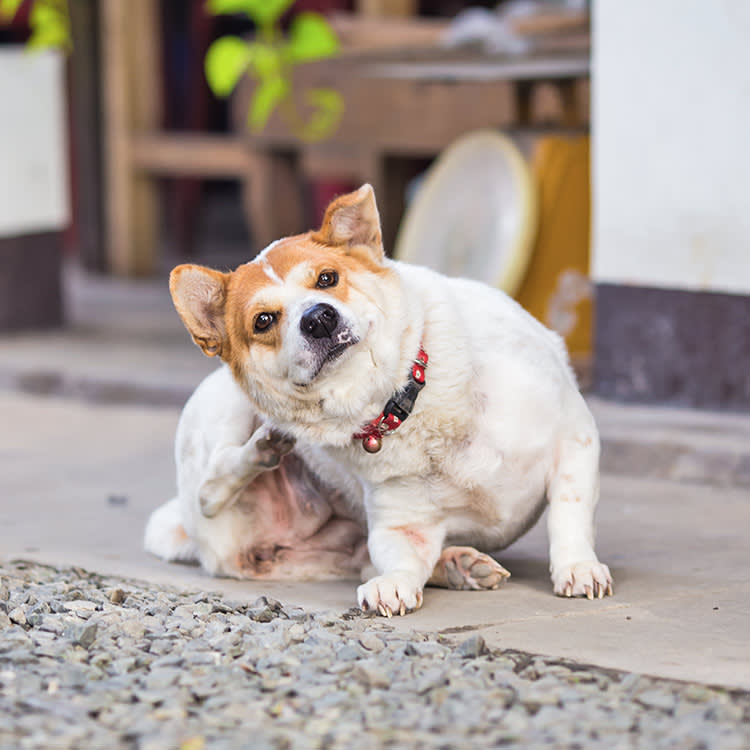
Run a hand over the affected area and it often feels hot, with a scatter of crusted scabs under the fur. The scratching has a signature quality too: automatic, back-foot-reaching, impossible to suppress, and it keeps going while the dog is trying to do something else entirely.
Live fleas may never turn up at all. What you are far more likely to find is flea dirt, the pepper-like specks of digested blood. Comb some onto a damp white paper towel. If the specks bleed rust-red, that is blood, and that is your answer.
The single most common mistake I see is a person who looked hard, found no fleas, and crossed fleas off the list. An allergic dog is an extremely efficient flea remover. They chew the evidence off themselves. If the itch pattern is back-end heavy, treat for fleas anyway and see what happens.
Prevention is the treatment, and it has to be year-round
Here is the counterintuitive core of the condition. There is no drug that cures a flea allergy. What ends it is stopping the bite from ever happening, which means prevention is the treatment, and everything else on this page is damage control.
Use a flea preventive, and use it all year. Not in the summer. Not when you see fleas. Always. And expect it to take time, because you are not fighting the fleas you can see; you are fighting a life cycle. That cycle runs roughly one to two months depending on conditions, and pupae can sit dormant for up to a year before emerging as adults. A house that looks flea-free in March can produce adults in June.
Veterinary dermatologists have moved heavily toward the oral isoxazoline preventives (products like Nexgard, Bravecto, and Simparica, which are dog-only), and the reason is not that they are more powerful in some abstract sense. It is that they are hard to screw up. The topical questions that quietly wreck a treatment plan simply do not arise: Did I get the full vial on? Did it land on skin or on fur? Did the bath two days later wash it off? An oral is swallowed or it is not.
Two practical caveats. These are prescription products and generally require an annual exam to renew. And the isoxazoline class carries a documented risk of neurologic reactions, including tremors, ataxia, and seizures, occasionally in dogs with no seizure history. That is not a reason to avoid them, and the FDA has been clear that they remain safe and effective for most dogs, but it is a reason to tell your vet if your dog has a seizure history rather than picking a preventive off a shelf.
Clean the house like you mean it
The dog is the minority of the problem. The environment is the majority of it.
Vacuum everything, and vacuum where the fleas actually are: along walls, in corners, and underneath furniture, not just the middle of the rug where it is easy. Clean the furniture too, and launder anything the dog sleeps on.
What you generally do not need is to have the house sprayed or professionally treated. For most households, the combination of a year-round preventive on every animal plus meticulous, boring cleaning is enough, and the chemical treatment is an expense that buys very little.
When the dog is already miserable
Once the skin is inflamed and the dog has not slept properly in a week, you need to break the itch cycle, and that is a separate job from killing fleas.
Itch relief. Some vets prescribe an antihistamine like Benadryl for a mild reaction. For more severe acute flare-ups, dermatologists more often reach for an oral anti-itch drug such as oclacitinib, or a short course of steroids.
Here is the warning that comes attached, and it is important enough to sit on its own line: a dog who has stopped scratching is not a dog without fleas. The itch medication works, the dog looks fine, everyone relaxes, and the flea infestation continues underneath. The preventive must keep going regardless.
Antibiotics or antifungals for the secondary bacterial and yeast infections that are almost always riding along in the broken skin.
Deworming. This one gets forgotten. Fleas carry the larvae of Dipylidium caninum, the flea tapeworm. A dog who swallows an infected flea while grooming, which is exactly what an itchy dog spends all day doing, ends up with adult tapeworms in the intestine. The treatment is simple and effective, usually an oral drug called praziquantel, but somebody has to think of it.
Allergy shots are worth understanding correctly, because people get hopeful about them for the wrong reason. Immunotherapy is built from your dog’s own tested allergens and can genuinely help with concurrent atopy, the likely genetic tendency toward allergic disease. It will not directly treat flea allergy dermatitis. It treats the neighbors, not the fire.
The home remedies, ranked honestly
“Natural” is not a synonym for “safe,” and it is definitely not a synonym for “works.”
Diatomaceous earth and boric acid. The usual move is to dust these along carpet and baseboards. Both are pesticides. Both will kill a fraction of the larvae and shave the population down a bit. Neither will hand you control of an actual infestation, and neither belongs directly on an animal. Diatomaceous earth is a silica, and it irritates eyes, skin, and airways. Boric acid is worse: corrosive to skin and eyes, and capable of causing vomiting, diarrhea, laboured breathing, and, at high enough doses, seizures and coma. You can apply them carefully and limit the exposure, but you would be spending real risk for a small return. A vacuum does more.
Essential-oil flea collars. These are marketed as repellents, not insecticides, and that classification matters: as unregistered products, their makers are not required by the EPA to hand over evidence that they work. Add a cat to the household and the calculus gets worse, because cats are unusually sensitive to essential oils.
Fish oil. This one is defensible, within limits. Once the fleas are handled, fish oil in the diet can take some of the edge off the inflammation driving the itch. What you should not do is rub oils into the skin. Topical coconut oil in particular has been linked to microbial overgrowth on already-damaged skin, which is precisely the wrong direction.
What newer research adds
Two useful updates since this advice was first written.
First, the isoxazoline preventives now have years of real-world safety data behind them. The FDA’s 2018 alert about neurologic events in the class stands, and it is a genuine signal worth discussing with your vet, especially for a dog with a seizure history. But large post-marketing reviews have continued to find these drugs safe and effective for the overwhelming majority of dogs, and control studies show flea kill beginning within hours and reaching essentially total elimination on the animal within a month or two of consistent use. In a 90-day U.S. field study of one of these products in households with existing infestations, effectiveness against fleas reached 99.5 percent at day 30 and 100 percent at days 60 and 90.
That number is the reason to be patient. The dogs in that study did not stop itching on day one. They got there on the schedule the flea life cycle allows, which is the schedule your dog is on too.
Second, and more useful in the exam room: manufacturers now explicitly list flea allergy dermatitis control as an indication for these products, and the mechanism is not mysterious. Eliminate the bite, and the erythema, papules, scaling, hair loss, and pruritus resolve on their own. Which is the whole thesis of this article, stated by a drug label: you are not treating an allergy. You are removing an exposure.
References
- U.S. Food and Drug Administration. “Fact Sheet for Pet Owners and Veterinarians about Potential Adverse Events Associated with Isoxazoline Flea and Tick Products.” https://www.fda.gov/animal-veterinary/animal-health-literacy/fact-sheet-pet-owners-and-veterinarians-about-potential-adverse-events-associated-isoxazoline-flea
- Elanco / DailyMed. “Credelio (lotilaner) chewable tablets: prescribing information, including 90-day field study efficacy and flea allergy dermatitis indication.” https://dailymed.nlm.nih.gov/dailymed/fda/fdaDrugXsl.cfm?setid=427f2ebc-ce24-452b-bbb3-43d4ef8b63b0
- Cavalleri, D. et al. “Assessment of the onset of lotilaner (Credelio) speed of kill of fleas on dogs.” Parasites & Vectors, 2017. https://pmc.ncbi.nlm.nih.gov/articles/PMC5664436/
- Companion Animal Parasite Council. “Fleas: diagnosis, treatment, and control guidelines.” https://capcvet.org/guidelines/fleas/
- U.S. Environmental Protection Agency. “Pesticide Registration: Minimum Risk Pesticides Exempted Under FIFRA Section 25(b).” https://www.epa.gov/minimum-risk-pesticides
- Centers for Disease Control and Prevention. “Dipylidium (tapeworm) infection.” https://www.cdc.gov/dpdx/dipylidium/index.html
Common questions
I never see any fleas on my dog. Can it still be flea allergy?
Yes, and this is the most common version of the story. An allergic dog grooms and chews aggressively, which removes the evidence. Often the only thing left to find is flea dirt, the dark specks of digested blood. Absence of visible fleas is not absence of fleas.
Will an antihistamine fix it?
Rarely, on its own. Antihistamines help some dogs with mild reactions, but flea allergy dermatitis is usually driven by pathways that antihistamines do not touch well. Vets more often reach for a targeted anti-itch drug like oclacitinib, or a short course of steroids for a severe flare, and the itch relief does nothing about the fleas themselves.
Do fleas become resistant to flea products?
In theory, resistance is more likely with products that have been on the market longer. In practice, most apparent 'resistance' turns out to be a treatment gap: an untreated pet in the house, an environment full of developing fleas, or contact with feral cats and urban wildlife. Investigate the gap before you blame the drug.
Not a substitute for your vet. Our guidance is educational. For urgent symptoms, contact a vet or emergency clinic right away. Editorial standards
Dr. Nair is a veterinarian focused on diet and feeding. She covers everyday nutrition, treats, and the many "can they eat this?" questions owners ask, grounding each answer in what is actually safe and sensible for dogs and cats.
Meet our experts ↗Keep reading
 Health & WellnessNo Fleas, Still Scratching? 7 Culprits, Ranked by How Likely They Are.Dr. Mara Chen · 14 min
 Health & WellnessYour Nose Can Diagnose Your Dog's Ears. Here's the Decoder.Dr. Priya Nair · 8 min
 Health & WellnessThe Fleas on Your Dog Are 5% of the Problem. The Rest Is in Your CarpetDr. Ravi Mehta · 10 min
 Health & WellnessYour Dog Has Fleas Long Before You Ever See OneDr. Amara Solis · 8 min
 Health & WellnessNothing in Your Pantry Will Cure Your Dog's Itch. 11 Things Will Make Tonight Bearable.Dr. Nina Kohl · 8 min
 Health & WellnessYour Tick Meds Won't Catch Them AllDr. Lena Park · 6 min