


Your Dog Isn't Watching the Door. They're Smelling the Clock.
How does your dog know you're almost home before the car turns in? They're not counting hours. They're reading the way your scent fades through the house, which turns out to be one of the strangest superpowers in the animal world.

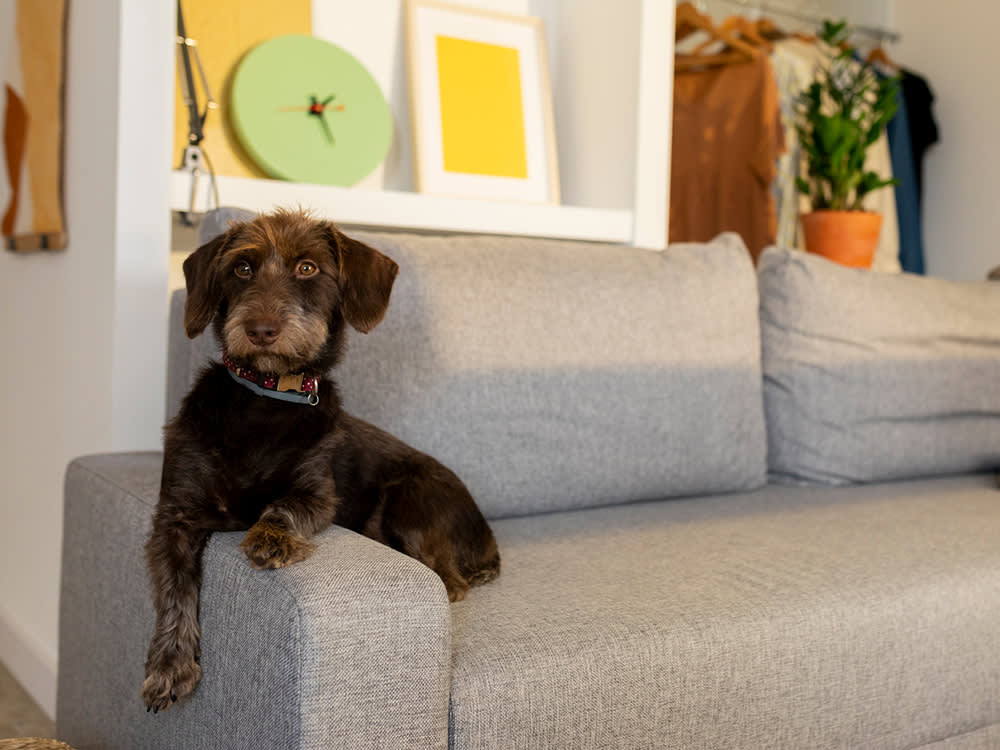
You have seen it and probably chalked it up to a sixth sense. A few minutes before you actually pull into the driveway, your dog is already up, already at the window, already vibrating with certainty. Or it is 5:58 and dinner is at 6:00, and somehow they know. It feels like your dog can tell time.
They can, more or less. They are just not doing it the way you do. While you glance at a clock or notice the light changing, your dog is doing something far stranger and more impressive: reading the passage of time through their nose.
What it means to “smell” time
Dogs live gloriously in the present, treating each treat and each thrown ball as the entire point of existence. But that in-the-moment quality hides a genuinely complex grasp of time. Plenty of dogs accurately anticipate predictable events, which is why yours hops onto the couch to watch the street right as the kids are due back, or starts campaigning for dinner with suspicious precision.
The mechanism is scent. Where we understand our surroundings mostly by sight, dogs decode who has been somewhere, and how long ago, through smell. That lets them make predictions about what is coming based on patterns they have quite literally sniffed out. The cognition researcher Alexandra Horowitz has spent years on this, and the idea sits at the center of her book Being a Dog: a nose that powerful does not just detect the world, it perceives time moving through it.
None of this is mystical. It comes down to a simple physical fact your dog exploits and you cannot. Smells fade, and they often fade on a schedule.
Your scent is the timer
Here is the everyday version. When you leave for work, you take your body with you but not your smell. The concentration of you hanging in the house drops steadily, hour by hour, as the morning wears on. Your dog can detect that decline with an accuracy that would embarrass any instrument in your kitchen.
So a dog who has lived the same routine long enough learns to read it. When the smell of you has thinned to a particular point, that is the cue that you are about to walk back through the door. The strength of your lingering scent, in other words, predicts the time of your return. It is less a countdown than a fuel gauge, and your dog reads the needle.
Owners tell me their dog is psychic, and I love ruining it for them a little. Your dog isn’t sensing your intentions from across the city. They’ve measured, very precisely, how far your scent has faded since you left, and matched that to every other day you came home. It’s not magic. It’s better than magic, because it’s real.
Reading the past off the ground
The same trick works in reverse, out on a walk. Many dogs can tell which direction a scent trail is heading, and they do it by comparing freshness, moving from where a smell is faintest and oldest toward where it is strongest and most recent, even when the difference between footsteps is almost nothing. When your dog buries their nose in a patch of grass, they are not just cataloguing who passed by. They are reading a timeline, sorting older traces from newer ones and reconstructing the order events happened in.
Time of day shapes it too. As the air warms across the day, currents shift and drift, carrying odor molecules with them. Dogs, with their oversized olfactory hardware, register that movement of scent through space in ways we barely notice, if at all. We might pick up on daily patterns in light or sound; the equivalent patterns in smell pass us by almost entirely.
The hardware behind it
There is a reason a dog can do this and you cannot. A dog’s nose holds scent receptor cells numbering in the hundreds of millions beyond what we have, and that alone accounts for much of their sheer acuity. But it is not only raw quantity. Dogs also sniff in stereo, pulling a slightly different odor picture into each nostril, which helps them locate where a smell is coming from. Research on how dogs work a scent trail suggests they often lead with the right nostril to investigate something new, then switch to the left once they recognize it, a two-step process that has no equivalent in the way we breathe.
Put it together and the “sixth sense” dissolves into something more interesting than a party trick. Your dog is running a continuous, high-resolution analysis of a dimension of the world that is almost invisible to you, and using it to keep time.
What newer research adds
Horowitz’s lab and others have kept pushing on exactly how far this goes, testing dogs’ olfactory experience in natural settings rather than sterile labs, and probing how dogs discriminate individual people and lingering traces by scent alone. The picture that keeps emerging is that smell is not a lesser sense doing a rough job. For a dog, it is the primary way of reading a scene, detailed enough to encode not just what and who but when.
The practical takeaway for the rest of us is small and kind. That intense, unhurried sniffing on a walk, the kind that makes you tug the leash because you have places to be, is your dog reading time and history off the pavement. Letting them do it is not a delay in the walk. For your dog, it is a large part of the point.
References
- Horowitz, Alexandra. Being a Dog: Following the Dog Into a World of Smell. Scribner, 2016.
- Horowitz, A., Hecht, J., and Dedrick, A. “Smelling Themselves: Dogs Investigate Their Own Odours Longer When Modified in an ‘Olfactory Mirror’ Test.” Behavioural Processes.
- Barnard College, Dog Cognition Lab. “Research on Canine Olfaction.” barnard.edu
Dr. Solis is a board-certified veterinary dermatologist with over twelve years of clinical experience. She advises on skin conditions, allergies, and grooming practices that affect coat and skin health. All dermatology and allergy content at The Pet Times is reviewed by her team before publication.
Meet our experts ↗Keep reading
 TrainingThat 'Calm' Flat-Faced Dog? The Science Says It's Mostly How You Raised Them.Dr. Mara Chen · 6 min
 TrainingYour Dog Has a Real Personality. Their Breed Barely Explains It.Dr. Nina Kohl · 8 min
 TrainingThe Frozen Stare Isn't the Fight. It's Your Last Few Seconds to Stop One.Dr. Amara Solis · 6 min
 TrainingEvery Dog Trainer Says They're 'Humane.' Here's How to Read Past ItDr. Amara Solis · 5 min
 TrainingDog Zoomies, Decoded: When the Crazy Laps Are Healthy and When They Aren'tDr. Priya Nair · 4 min
 TrainingYour Dog Doesn't Know What 'Family' Means. They Know Exactly Who's in Their Group.Dr. Nina Kohl · 5 min