


The Frozen Stare Isn't the Fight. It's Your Last Few Seconds to Stop One.
When your dog goes rigid and locks eyes with another dog, you have a short window before things escalate, and the instinct most owners reach for, yanking the leash, is the one that makes it worse. Here's how to read the freeze and use the window.

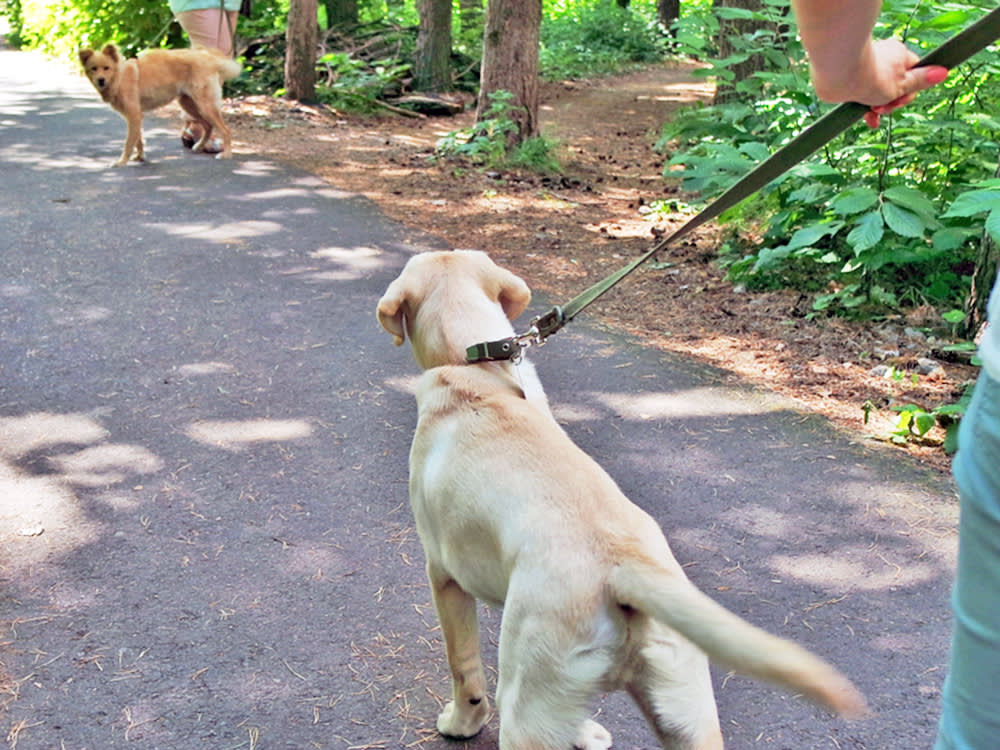
Every dog owner knows the moment. You are walking along, another dog appears up ahead, and your dog stops. The body goes stiff, the head drops slightly, and the eyes lock. Everything else in the world seems to vanish for them; there is only that other dog. Sometimes a word from you snaps them out of it. Sometimes, especially when the other dog is staring right back, breaking that focus is genuinely hard.
Here is the reframe that changes how you handle it. That frozen stare is not the fight. It is the moment right before the fight becomes possible, a short window, often just a few seconds, where your dog is committing to something but has not acted yet. Between two dogs, a hard, unblinking stare is a confrontation in its own language, and it can escalate fast: stare, to stiff, to bark, to lunge, to a full-blown scrap. Your job in those few seconds is to spend the window well. And the move most owners reach for by instinct spends it terribly.
Why dogs lock on
Fixation is not one thing, and the reason matters because it tells you how much danger you are in.
A lot of it is completely benign. Your dog might want to play, or be sitting on a pile of unspent energy, or be curious about this new dog, or be anticipating a greeting. Young dogs often fixate simply because they have not learned to read canine body language yet and are trying to work a stranger out. Breed plays a role too; herding and hunting dogs are built to “lock on” to movement and do it more readily.
But some fixation is the dangerous kind. A dog getting ready to defend themselves fixates. So does a possessive dog, or one guarding their person, or, most importantly, a fearful dog. Fear-based fixations are the ones most likely to end in a fight, because even a dog who is not aggressive can trip the wire on the other dog. And it only takes one of the two dogs to start something.
The stare is information, and it is early information, which is the good news. A dog who has locked on has not decided yet. They are gathering themselves. If you can interrupt the freeze before it hardens, you very often prevent the whole cascade. The instinct to haul the dog backward is the problem, because a sharp correction in that half-second reads to the dog as the situation getting worse, not better.
What to do in the window
First, do not yank the leash. This is the single most important don’t. A hard yank can jolt your dog into reacting faster, and worse, it can teach your dog to link that neck pain and alarm with the sight of another dog, which builds more reactivity for next time, not less. It can also hurt your dog’s neck, which defeats the entire point of protecting them.
Instead, work the window like this:
Block the view. Calmly step in front of your dog so your body interrupts the line of sight to the other dog, then lead them away. Breaking the visual lock is often enough on its own.
Get low if you have to. If a standing block does not work, crouch down to your dog’s level and fully screen the other dog from view. Cutting off the sightline usually loosens the fixation enough that you can redirect.
Redirect with something good. Keep a high-value treat, chicken slivers, or a favorite toy in your pocket. When your dog will not give you their attention, that is what buys it back. Use gentle, steady hand pressure to guide them along if needed; guide, never wrench.
Change your route. Sometimes the real fix is upstream. If your dog fixates constantly, walk them somewhere with fewer dogs to lock onto, at least while you build their skills.
Training the disengage
You cannot train the instinct out of a dog entirely. What you can train is the ability to break the fixation and turn their attention back to you, and that skill is gold.
Start with a “look at me” cue at home, with no other dogs around, until it is automatic. Then practice it near other dogs but at a big distance, far enough that your dog can still hear you and think. Reward every time your dog glances at another dog and then chooses to look back at you. You are building a reflex: notice the trigger, check in with the human, get paid. Over many sessions, you close the distance.
A “leave it” cue works the same way and generalizes to anything, another dog, a person, a car, a dropped sandwich. The catch that trips people up is that most owners under-train it. To be truly reliable, “leave it” should be practiced for months, against every kind of temptation your dog might realistically meet, not taught once and assumed.
When your dog is the one being stared at
You cannot control the other end of the leash. If another dog fixes on yours, your job narrows to two things: stop your own dog from staring back, using treats, a marker, or the cues above, and put distance between the two dogs. And stay calm while you do it, because your dog is reading you. A tight, panicked handler tells the dog there is something to panic about.
When to call a pro
Training reactive behavior is genuinely hard, and there is no medal for struggling alone. If your dog’s fixations are frequent and tipping into reactive or aggressive behavior, get a qualified trainer or behavior professional involved sooner rather than later. They can tell you whether fear, excitement, or something else is driving it, and hand you a plan and the tools to keep everyone safe. Early help is cheaper and faster than untangling a habit that has had a year to set.
What newer research adds
The strongest modern trend in this space is a hard turn away from leash corrections and toward teaching the dog a calmer response. A growing body of behavior research links aversive handling, including harsh leash pops, to more fear and reactivity over time, which is exactly why “don’t yank” has gone from one trainer’s opinion to mainstream guidance.
On the technique side, the disengagement work above has a well-known modern form worth seeking out: the “Look at That” game, popularized in Leslie McDevitt’s Control Unleashed program. Instead of asking your dog to ignore the trigger, it rewards them for calmly noticing it and then looking back at you, turning the other dog from a threat into a cue for a treat. Many force-free trainers use some version of it now, and it pairs perfectly with the distance-and-reward approach here. If you want a name to search or to ask a trainer about, that is the one.
References
- McDevitt, Leslie. Control Unleashed: Reactive to Relaxed. Clean Run Productions, 2019.
- Ziv, G. “The effects of using aversive training methods in dogs—A review.” Journal of Veterinary Behavior, vol. 19, 2017, pp. 50–60.
- American Veterinary Society of Animal Behavior. “Position Statement on Humane Dog Training.” https://avsab.org/resources/position-statements/
- Vieira de Castro, A. C., et al. “Does training method matter? Evidence for the negative impact of aversive-based methods on companion dog welfare.” PLOS ONE, vol. 15, no. 12, 2020.
Common questions
Why does my dog freeze and stare at other dogs on walks?
For lots of reasons, many harmless: excitement, curiosity, wanting to play, or a young dog trying to read a stranger. But a hard, rigid stare can also be defensive, possessive, or fear-based, and between dogs, a locked stare reads as a challenge. That is why it can tip into barking, lunging, or a fight quickly.
Should I pull my dog away when they fixate?
Not with a hard yank. Yanking can startle your dog into reacting faster and can teach them to associate the discomfort with the other dog, making them more reactive next time. Instead, block their view and calmly guide them away with gentle, steady pressure.
Can I train my dog to stop fixating?
You cannot delete the instinct, but you can teach a reliable 'look at me' or 'leave it' so your dog disengages and checks in with you instead. It takes consistent practice at a distance where your dog can still think, and for many dogs it is worth bringing in a professional trainer early.
Dr. Solis is a board-certified veterinary dermatologist with over twelve years of clinical experience. She advises on skin conditions, allergies, and grooming practices that affect coat and skin health. All dermatology and allergy content at The Pet Times is reviewed by her team before publication.
Meet our experts ↗Keep reading
 TrainingYou Can't Quiet a Bark You Haven't DecodedDr. Lena Park · 7 min
 TrainingThe Most Dangerous Dog Isn't a Breed. It's the One Nobody's Reading.Dr. Mara Chen · 7 min
 TrainingStop Refereeing the Dog Park by Folklore. Read the Dogs InsteadSasha Ford · 10 min
 TrainingYour Dog Isn't Being Bad. Leash-Biting Is Excitement With Nowhere to Go.Dr. Ravi Mehta · 5 min
 TrainingYour Dog's Toy Stash Is Adorable. The Growl Over It Isn't.Marcus Webb · 7 min
 TrainingThe Stuffed Kong Won't Save You: 7 Lies About Separation AnxietyDr. Amara Solis · 9 min