


Stop Refereeing the Dog Park by Folklore. Read the Dogs Instead
Most dog-park advice you overhear is a mix of half-truths and myths. Here's a simpler system: a handful of real skills for reading play as it happens, and the dangerous beliefs to unlearn.

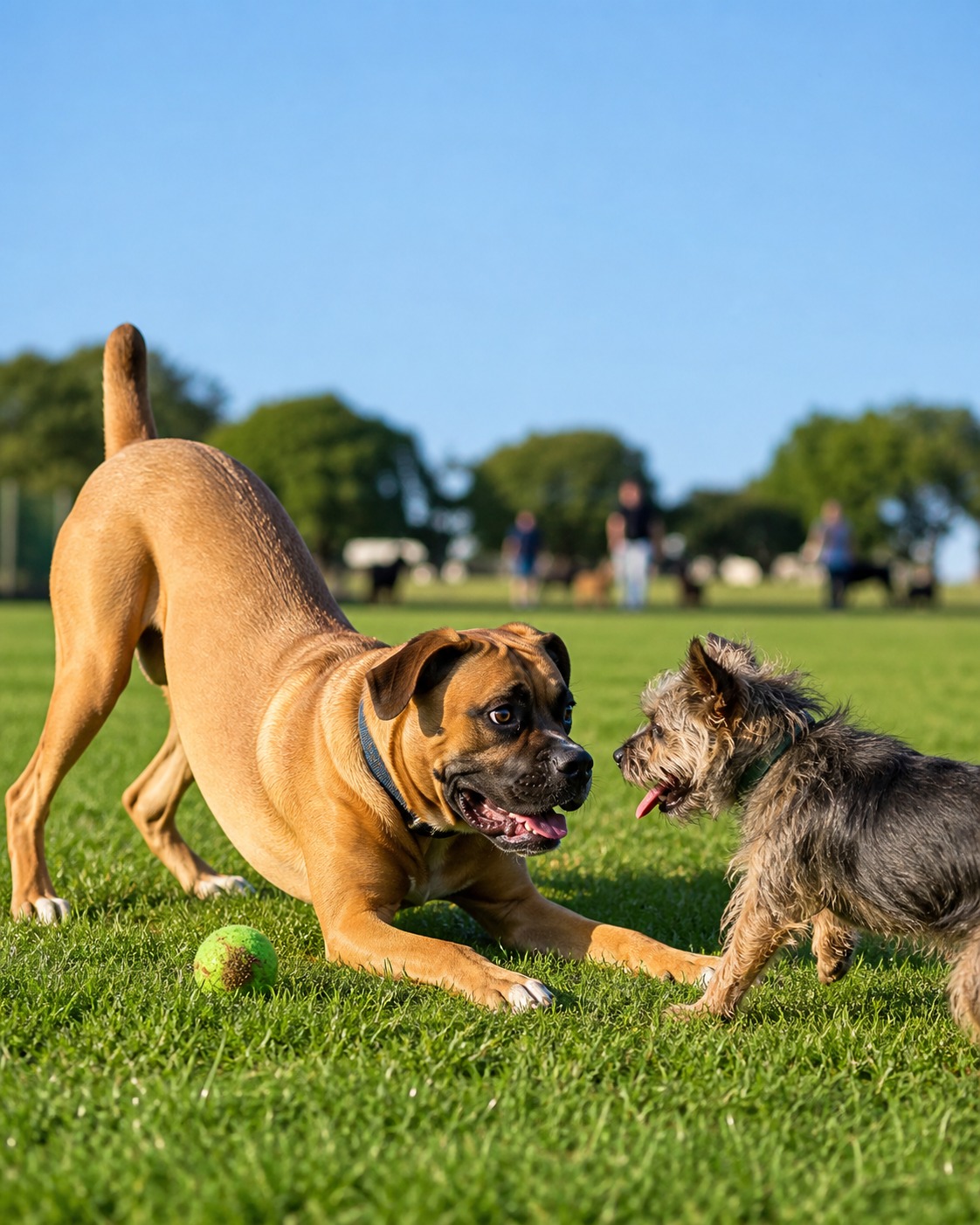
I will admit it: eavesdropping at the dog park is a small, guilty pleasure of mine. The trouble is what I overhear. The fence line is a rumor mill of confident, contradictory dog-behavior advice, some of it sound, a lot of it folklore left over from decades-old training myths. And here is the thing about trying to memorize a list of true and false statements: it does not help you in the moment, when two dogs are tangled up in front of you and you have about three seconds to decide whether to laugh or step in.
So instead of ranking a pile of dog-park sayings from true to nonsense, I want to give you something you can actually use standing at the gate. There are really only two things worth carrying in your head. First, a small set of skills for reading the dogs in front of you rather than reciting rules about dogs in general. Second, a shorter list of genuinely dangerous myths to unlearn, because a couple of them get dogs hurt. Get those two things right and you can let the rest of the fence-line chatter wash over you.
The one question underneath all of it: is everyone actually having fun?
Before any technique, the north star. Play is notoriously hard to pin down, even scientifically, because it borrows its moves from other behaviors entirely, predation, fighting, courtship, and repurposes them. A chase can look like hunting. A wrestle can look like a fight. That overlap is exactly why you cannot judge play by how rough it looks. You judge it by whether every dog involved is choosing to be there.
That reframe does a lot of work. “Is this okay?” is an unanswerable question about the abstract roughness of the play. “Does each dog seem to want this, and would they come back if separated?” is an answerable question about the dogs actually in front of you. Everything below is just a way of answering that second question faster.
The reading skills that actually work at the gate
Run a consent check
This is the most useful single tool in this article, and it is the current best-practice that modern behavior folks lean on hardest. When you are unsure whether play is mutual, gently interrupt it. Calmly hold back or call away the dog who seems to be doing most of the chasing, pinning, or pouncing, and watch what the other dog does with that pause. If they shake off and trot away, they were tolerating it, not enjoying it, and you have your answer. If they immediately re-engage, bounce back in, paw, offer a play bow, they were having a great time and you can relax. A consent check turns “I think that dog might be overwhelmed” from a guess into a quick, low-stakes test.
Watch for pauses, and be glad when you see them
Healthy play has a rhythm: bursts of wrestling or chasing broken up by frequent little pauses. The pause can be tiny, half a second of stopping, a glance away, a lie-down, a play bow, but it should keep happening. Those pauses are not the play breaking down; they are the play working. A dog who can pause is a dog exercising emotional control, and a dog with emotional control is far less likely to let the session boil over into a real fight. The warning sign is the opposite: relentless, non-stop intensity with no breaks. Play with no pauses is where trouble tends to start.
Look for role reversal
Good play is reciprocal, and the cleanest evidence of that is dogs swapping roles, the chaser becoming the chased, the one on top rolling to the bottom. When roles trade back and forth, both dogs are opting into both sides of the game. When they do not, pay attention. A dog who will chase but flatly refuses to be chased, who freezes or wheels around and charges when the other dog runs at them, is not really playing a mutual game. And a dog who is only ever the one being chased may be fleeing rather than frolicking, though the chaser can, and should, be able to choose to stop.
Take growling in context
A growl at the park panics a lot of owners, and it should not, on its own. Yes, some growls are serious and every growl deserves a look. But plenty of perfectly friendly dogs growl during play, the canine version of an “I’m gonna get you” tease, and some dogs even growl to defuse a tense situation, telling a pushy dog to back off. A growl is information, not a verdict. Read it alongside the body: loose and bouncy with pauses and role reversal is a playing dog who happens to be vocal. Stiff, still, and fixated is a different story.
Don’t let size or breed fool you
Two persistent bits of gate-lore deserve to be retired here. The first is that dogs must be the same size to play safely. Compatibility is real and worth watching, but it is about matched arousal and play style far more than matched size. Plenty of big dogs play beautifully with small ones by self-handicapping, rolling onto their backs, lying down, softening their movements. A large size gap is a reason to watch closely, not an automatic no. The second is that dogs of a given breed all play one way and can only pair with their own kind. There is no breed with a single, uniform play style every member follows; most dogs play in several styles, and a wrestler will find happy wrestling partners across every breed and mix at the park. Match dogs by how they play, not by what they are.
The myths that are actually dangerous to believe
Some fence-line sayings are merely wrong. These next few are wrong in ways that get dogs hurt, so they are the ones worth actively unlearning.
”They’ll work it out.”
Of everything I overhear, this one worries me most, because it is an argument for doing nothing at exactly the moment doing something matters. It assumes dogs will negotiate a truce, or that one will gracefully defer and the other will accept the deference. We cannot count on either. When dogs get tense, awkward, fixated, or potentially aggressive, the right move is to intervene early and gently, call them, walk away so they disengage and follow you, or shift the mood with a bright, happy voice, and physically separate them if it comes to that. If it turns out to be nothing, you have lost nothing. If it was heading somewhere bad, you just prevented it. Dogs cannot always work it out. They can, however, count on us to help them out.
”It’s just prey drive, don’t worry about it.”
Offered as reassurance, this is the opposite. If a dog is genuinely chasing another dog the way it would chase prey, that is precisely something to worry about, because prey-style chasing can hurt the dog on the receiving end. In real play, dogs treat each other as social partners, not as quarry. And the owner’s explanation may not even be right, the dog might simply be a bully or have poor social skills. Either way, a dog locked onto another with single-minded, no-pauses intensity, especially when the chased dog is trying to escape, is a reason to interrupt and redirect both dogs, never a reason to relax.
”Bring your puppy here young, for socialization.”
This sounds responsible and is often the opposite of it. Real socialization means giving a puppy many, varied, positive experiences, and a crowded dog park is a machine for producing the negative kind. A young puppy can get barked at, bowled over, pinned, or simply swarmed by a rush of adult dogs, and because puppies are so impressionable, a single bad scare can teach them that other dogs are frightening, the exact opposite of the goal. Puppies absolutely need to meet other dogs of different ages, sizes, and breeds, but you want to curate those encounters so they go well. The dog park hands you no control over who greets your puppy, which makes it the wrong classroom for this particular lesson.
”That behavior is about dominance / being alpha.”
This one is less acutely dangerous but poisons everything downstream, so it earns a place here. For decades nearly every unwanted behavior got blamed on a dog wanting to dominate people or other dogs. The field has moved firmly past that, and for good reason: the framing was never accurate, and worse, it pushed owners toward confrontational, “show them who’s boss” handling that made behavior problems worse and damaged the relationship. When you catch yourself explaining a dog’s behavior through dominance, swap in a better question, what is this dog feeling, and what has been reinforced? Which brings us to the one principle that actually does drive behavior.
The principle worth trusting: reinforcement drives behavior
If you keep only one piece of training theory, keep this one, because most trainers consider it the bedrock of the work. Any behavior that gets reinforced is strengthened and becomes more likely to happen again. There are real complexities, some behaviors are driven by internal rewards you do not control, but the working rule is simple and reliable: reinforce what you want to see more of, and do not reinforce what you do not. How you respond to your dog today is quietly shaping the dog you will have tomorrow. It is a far more useful lens than dominance ever was, and it happens to be true.
And one honest caveat about the park itself
Worth saying plainly, because the chatter rarely does: the dog park is not for every dog. For many dogs it is a joy, off-leash running, open space, good sniffing, good company. For others it is not a playground but a gladiator pit, overwhelming, frightening, or a place where an under-socialized or reactive dog is set up to fail. If your dog dreads it, you are allowed to skip it. There are quieter walks, smaller playdates with known dogs, and sniffy solo adventures that give a dog everything the park promises without the crowd. Reading the dogs includes reading your own.
References
- Bradshaw, John W.S., et al. “Dominance in Domestic Dogs: Useful Construct or Bad Habit?” Journal of Veterinary Behavior, vol. 4, no. 3, 2009, pp. 135–144. doi.org/10.1016/j.jveb.2008.08.004
- Bekoff, Marc. “Play Signals as Punctuation: The Structure of Social Play in Canids.” Behaviour, vol. 132, no. 5–6, 1995. doi.org/10.1163/156853995X00595
- Byosiere, Sarah-Elizabeth, et al. “Investigating the Function of Play Bows in Dog and Wolf Puppies.” Behavioural Processes, 2016. doi.org/10.1016/j.beproc.2016.02.006
Sasha Ford is a certified cat behaviour consultant who has worked with shelters, catteries, and private clients across the country. They review all feline behaviour content at The Pet Times, with expertise in multi-cat households, indoor enrichment, and stress-related disorders.
Meet our experts ↗Keep reading
 TrainingYour Dog Isn't Wrecking the Yard. They're Doing a Job. Name It.Dr. Mara Chen · 8 min
 TrainingThe Stuffed Kong Won't Save You: 7 Lies About Separation AnxietyDr. Amara Solis · 9 min
 TrainingYour Dog's Behavior Problem Probably Isn't Your FaultDr. Nina Kohl · 6 min
 TrainingYour Dog Isn't Rude. Your Dog Is Overstimulated.Dr. Mara Chen · 6 min
 TrainingYour Dog's Nibble Is a Dial, Not a Switch. You're Turning It the Wrong Way.Dr. Nina Kohl · 9 min
 Training8 Things 'Everyone Knows' About Dogs That Are Flat WrongDr. Amara Solis · 8 min