


Your Dog Isn't Wrecking the Yard. They're Doing a Job. Name It.
Digging isn't one behavior, it's five different jobs wearing the same costume. Read the hole, name the job, and you can move the behavior instead of fighting it.

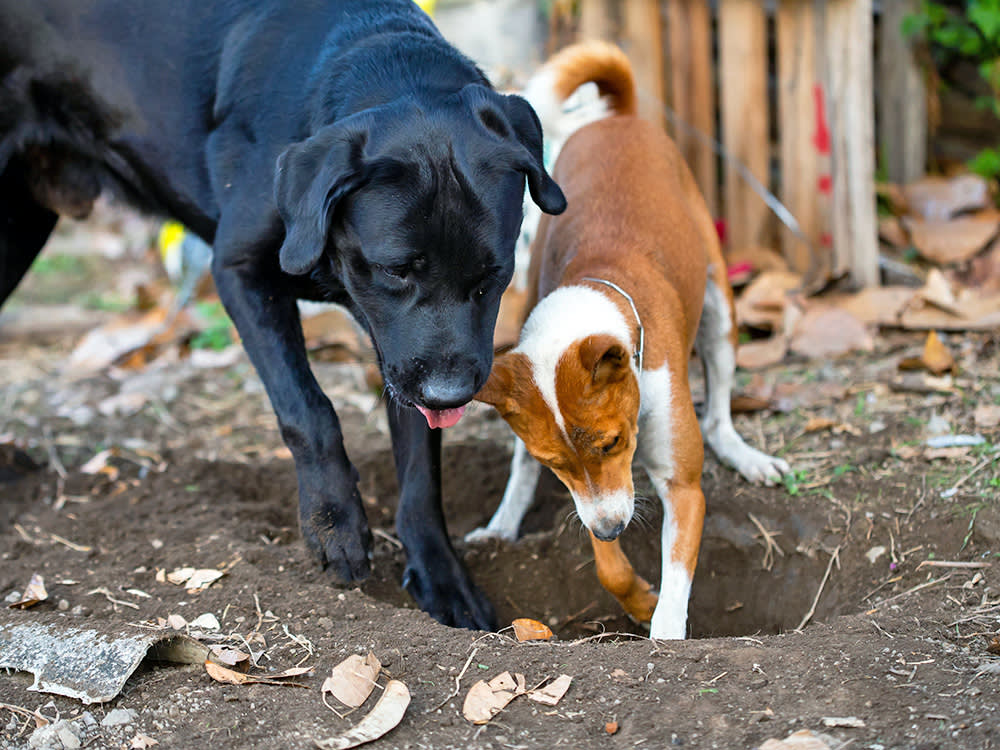
Standing over a fresh crater in the lawn, most people ask the wrong question. They ask how do I make this stop. The dog, meanwhile, has answered a different question entirely, and answered it well: they had a need, and the ground was the tool.
Digging is not one behavior. It is at least five, and they only look identical because they use the same equipment. A dog caching a bone, a dog hunting a vole, a dog excavating a cool patch of soil on a 90-degree afternoon, a dog tunneling under the fence to get to a friend, and a dog with nothing to do are five different animals with five different problems. Treating them all the same way is why so many anti-digging plans fail.
So read the hole first. Where it is, when it happened, and what your dog did next will usually tell you the job. Once you can name the job, you stop trying to delete a behavior that is thousands of years old, and start moving it somewhere that works for both of you.
The five jobs
1. The vault
Dogs cache. They dig a hole, deposit something valuable, cover it, and come back for it later, and the behavior is old enough to predate the couch by a long way. Ancestral canids dug dens to whelp and raise pups in, and dug to store what they could not eat immediately.
How to spot it: the hole is modest, purposeful, and something is in it, or was. The prized toy has gone missing. Your dog returns to the same spot repeatedly.
What it means: almost nothing is wrong. This is a dog with a resource and an instinct. It is only a problem if it is happening in the vegetable bed.
2. The hunt
A dog’s nose is their primary sense, and the soil is thick with information. Something down there smells good, and the smell has a location.
Hearing does more work here than people realize. Dogs pick up ultrasonic frequencies well beyond our range, which means a dog standing on your lawn can hear voles, moles, and other burrowing animals moving beneath them that you have no idea are there. To that dog, your yard is not empty. It is occupied, and they know exactly where.
How to spot it: intense, focused, nose-down digging in one specific location, often with the head disappearing into the hole. Frequently the same few spots, which is a hint that the tenants are real.
What it means: your dog is not being destructive, they are being correct. If you have a rodent problem, addressing that will do more than any training plan.
3. The cooling system
Soil a few inches down is meaningfully cooler than the air above it. A dog with no shade and no way to shed heat will make their own cold spot.
How to spot it: shallow, wide, pit-shaped digging, often against a wall, under a deck, or beneath the only bush in the yard, and the dog is lying in it. Happens in the heat of the day. Big, heavy-coated, or dark-coated dogs do this the most, and it is common in Dobermans, which is not a breed anyone expects to see on a digging list.
What it means: this is a welfare signal, not a behavior problem, and it is the one to take seriously. A dog excavating a cool pit is telling you the yard does not have what they need. Get shade over them, get water to them, and reconsider how long they are out there.
4. The escape
Some dogs dig with a destination in mind. Being shut outside alone does not suit them, or a squirrel is running the fence line, or they simply know which neighbor keeps the good biscuits.
How to spot it: the hole is at the fence line. Always at the fence line.
What it means: the digging is a symptom, and the disease is either separation distress or barrier frustration. Filling that hole just moves it two feet down the fence. Fix the reason they are alone and unhappy in the yard.
5. The unemployment
The catch-all, and the most common. Digging is enormously satisfying: it engages the nose, the eyes, the ears, the shoulders, and the problem-solving brain all at once. A dog with an empty schedule and a lawn will discover this within a week.
How to spot it: the digging is scattered, enthusiastic, and increases the longer the dog is left with nothing to do.
What it means: the yard is not the problem. The day is. Before you build a single deterrent, audit what your dog’s brain and body actually got today. An under-worked dog will invent a job, and the invented job usually looks like vandalism.
Breed makes some dogs specialists
If you have a Terrier, a Fox Hound, or a Dachshund, you have a dog whose ancestors were selected, over generations, specifically for the willingness to go into the ground after something. That drive was not a side effect. It was the job description, and generations of selection for a function raise the pressure to express it.
You are not going to persuade a Dachshund that dirt is uninteresting. You are going to give them somewhere legal to be a Dachshund.
Do not yell at your dog in the hole
This is the mistake that quietly makes everything worse.
Come charging across the yard shouting, and the dog learns something you did not intend to teach: digging summons you. For a dog who is under-stimulated and starved of interaction, negative attention is still attention, and your dramatic arrival is the most interesting thing that has happened all afternoon. You have just paid for the behavior you are trying to stop.
Say nothing. Walk over. Redirect.
Nobody ever tells me their dog learned to dig because they yelled at them for digging, but I see it constantly. The dog is alone all day, they dig, a human comes running out and makes a lot of noise, and now digging is the button that produces a human. The behavior is not the problem. The reinforcement schedule is.
Give the dig a legal address
The single most effective intervention is also the least intuitive: instead of stopping the digging, sanction it.
Build a dig box. A wooden sandbox frame, or a hard plastic kiddie pool, filled with sand or loose soil. No yard? An indoor version works better than it has any right to: a big cardboard box, a few worn-out shirts, some toys buried in the folds, a scatter of treats.
Load it. Bury bones, toys, and treats in it, deep enough that your dog has to work. The first few times, make it easy and obvious.
Redirect to it, calmly. When you find your dog digging where you would rather they did not, walk them over to the box without a scene, and let them go to town when they get there. You have not punished the instinct. You have relocated it.
For a dog who genuinely loves to dig, the box is not a consolation prize. It is the best thing in the yard.
Protecting what you care about
If you have landscaping worth defending, a few humane options work.
Scent deterrents. Citrus peels (orange, lime, grapefruit) discourage a lot of dogs, and vinegar or pepper can work on the soil around plants. Two hard rules: make sure your dog does not eat the peels, and never spray a deterrent directly on your dog, not even a natural one.
No chemicals. Not on soil your dog uses, not on plants they can reach.
Rocks over the existing holes. An open hole is an invitation, and dogs return to the excavation they have already started. Large stones over it remove the temptation.
Fencing, carefully. Strategically placed non-electric fencing around a garden bed can work. What does not work, and what actively injures dogs, is burying chain-link or chicken wire in the soil to stop them. The dog digs anyway, hits wire, and cuts their paws.
The real answer is a tired dog
Every trainer eventually says the same unglamorous thing: the best deterrent is a dog whose needs are already met.
That means walks, yes, but walking on its own is rarely enough. It means scent games, puzzle toys, a ball or frisbee, social time with other dogs, and short, focused training sessions. Ten minutes of real work, two or three times a day, moves the needle more than an extra loop around the block, because mental work exhausts dogs in a way that mileage does not.
You cannot walk most dogs into satisfaction. You can, however, give them a job. And if you do not give them one, they will pick one, and it will involve your lawn.
What’s new since this was written
The most useful reframe to come out of applied behavior work recently is treating digging, chewing, shredding, and sniffing as behavioral needs rather than behavioral problems, on the same footing as food and rest. On that view, a dog who never gets to dig is not a well-behaved dog. They are a dog with an unmet need, and unmet needs leak.
There is a second thing worth carrying with you, from the heat research on dogs. Dogs overheat far more often on ordinary warm days than most owners believe, and flat-faced, heavy, and older dogs have the least margin. So if your dog is digging pits and lying in them, do not file it under mischief. File it under a dog who is trying, with the only tool they have, to cool down.
References
- Uccheddu, S., et al. (2024). Do you need to chew? A case report on dogs’ behavioural needs. Veterinary Record Case Reports, 12(2).
- Heffner, H. E., & Heffner, R. S. (2007). Hearing ranges of laboratory animals. Journal of the American Association for Laboratory Animal Science, 46(1), 20–22.
- Hall, E. J., Carter, A. J., & O’Neill, D. G. (2020). Incidence and risk factors for heat-related illness (heatstroke) in UK dogs under primary veterinary care in 2016. Scientific Reports, 10, 9128.
- Cornell University College of Veterinary Medicine, Riney Canine Health Center. Destructive Behavior in Dogs.
- American Veterinary Society of Animal Behavior. Position Statement on Humane Dog Training.
- Duranton, C., & Horowitz, A. (2019). Let me sniff! Nosework induces positive judgment bias in pet dogs. Applied Animal Behaviour Science, 211, 61–66.
Dr. Chen is a small-animal veterinarian who leads health and safety coverage at The Pet Times. She writes and reviews the bulk of our illness, condition, and safety content, translating clinical guidance into clear, practical advice owners can act on at home.
Meet our experts ↗Keep reading
 TrainingYour Dog Doesn't Fail at Restaurants. They Fail in the First 90 Seconds.Dr. Nina Kohl · 7 min
 TrainingSix Weeks of Crate Rest Will Break You Both. Give the Dog a Job Instead.Dr. Nina Kohl · 8 min
 LivingMost Dog Fights Happen at Home. Pick the Second Dog Accordingly.Dr. Mara Chen · 7 min
 TrainingMost Dog-Park Advice Is Half True. These Are the Signals That Actually MatterDr. Nina Kohl · 10 min
 LivingYour Dog Has Two Beds Because They Have Two Kinds of SleepDr. Ravi Mehta · 7 min
 TrainingYour Dog Doesn't Know It's 5 O'Clock. It Knows You.Dr. Mara Chen · 6 min