


Your Dog Has Two Beds Because They Have Two Kinds of Sleep
The dog who ignores their expensive bed all evening and then climbs into yours at midnight isn't being difficult. Daytime sleep and night sleep are different jobs, and they need different beds.

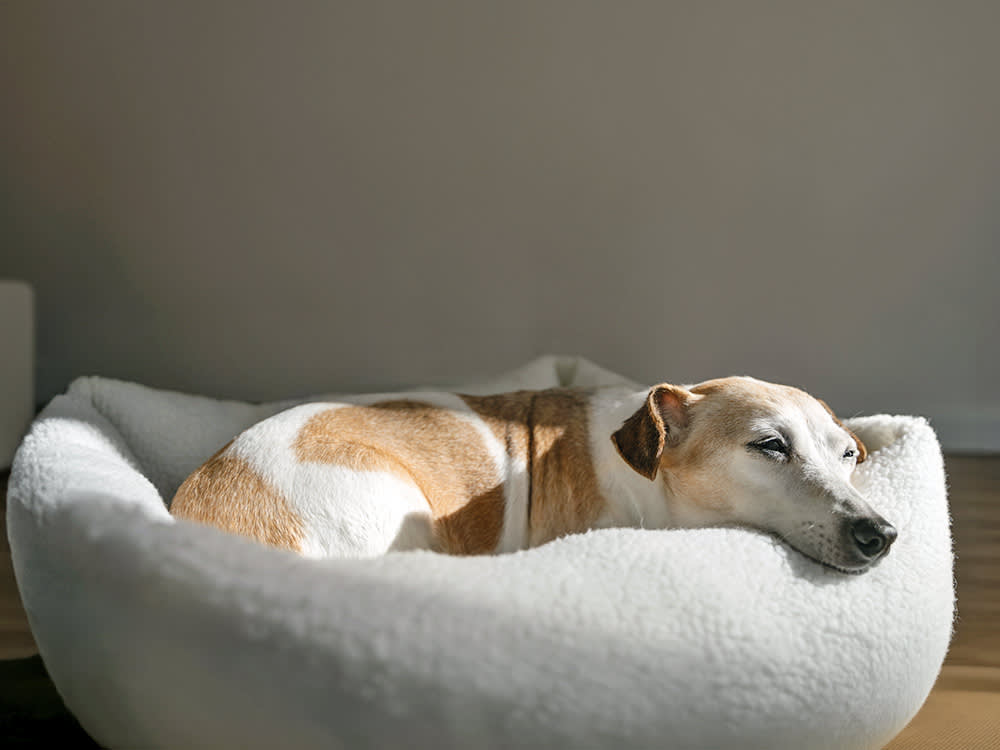
Your dog has a bed. A good one. It cost more than your last pair of shoes and they love it, in the daytime.
Then night falls, and the bed sits empty while forty pounds of dog crawls up the duvet and takes the warm patch you were about to lie in.
This is not stubbornness, and it isn’t a training failure. It’s the most sensible thing they do all day. Because dogs don’t have one kind of sleep, they have two, and the two kinds want completely different things from a bed.
Daytime sleep is surveillance sleep
Daytime dog sleep is light and fragmented. They’re not down for the count. They’re dozing, in and out, on a hair trigger, with an ear on the house. Any door, any bag, any change in your voice, and they’re up.
That kind of sleep has a shortlist of requirements, and if you read them as a dog they explain everything:
- Don’t get stepped on. Light sleep in a busy corridor is not rest.
- Manage your temperature. A dog who runs hot will pick tile or a cooling mat over a plush bed every time. A dog who runs cold will burrow.
- Keep a view of the room. They want a line of sight on the door, the stairs, or you.
- Keep it predictable. Same spot, same feel, low stakes.
Their own bed is basically purpose-built for that list. Predictable, undisturbed, low-traffic, and saturated in their own smell. And that last part is doing more work than we give it credit for. A dog’s own bed is the place that smells most reliably of them, and for a lot of dogs, that scent is the whole point.
Meanwhile the sofa and your bed, in the daytime, are missing the one ingredient that makes them worth the trouble.
Night sleep is deep sleep, and deep sleep is exposure
At night, the job changes. Now they’re going down properly, for hours, in the state where they are least able to react to anything.
And deep sleep is a vulnerable thing to do. So the requirement flips: instead of a defensible spot with sightlines, they want a body they trust.
That’s why the same dog who ignored their bed all evening ends up wedged against your knees. Your bed offers warmth, contact, a familiar heartbeat, and the smell of the person whose presence means nothing bad is going to happen. Their own bed can’t offer any of that. It’s a good place to doze. It’s a lonely place to be unconscious.
Which is also why some dogs go straight back to their own bed the moment you leave the room. The sofa wasn’t the draw. You were.
“Owners tell me the dog ‘won’t use’ the bed, and then they describe a dog who uses it for eight hours a day and skips it for the other eight,” says Dr. Nina Kohl. “Nothing is broken. A dog is choosing a quiet, defensible spot for light sleep and a warm, safe body for deep sleep. If you want the bed to win at night, it has to start doing the job you’re actually asking it to do.”
When the night-time clinging is worth a second look
There’s a version of this that isn’t cosy, and it’s worth naming.
Some dogs are not seeking closeness at night, they’re seeking it constantly, and cannot cope without it. A dog who follows you room to room all day, who cannot settle unless they’re touching you, who panics when you close a door, isn’t showing you affection. That’s insecurity, and it’s the raw material of separation anxiety.
A dog’s preferences and a dog’s interests are not automatically the same thing, and this is one of the places they come apart. A dog who can rest alone, in their own space, without falling apart is a dog with a skill worth having. If yours can’t, that’s worth addressing well before it becomes a problem that shows up when you go back to the office.
The tell is easy: can your dog settle in their own bed while you’re in the same room, without contact? If yes, you have a preference. If no, you have a project.
Choose the bed for the sleep, not the sofa
Most unused dog beds are unused because they were bought to match a rug.
Watch how your dog actually sleeps and buy the shape that matches:
- Curled tight like a doughnut: they want walls. A bolstered or donut bed gives them something to press their spine against.
- Stretched out flat: they want a mattress. A big, open, flat pad, and it must be long enough to actually sprawl on.
- Head propped up: they want a raised edge or a headrest.
- Belly-up, legs everywhere: they want space, and they want to be cool. A big, unbolstered, breathable bed.
Then think about temperature, because a lot of “bed rejection” is a hot dog on a hot bed. If your dog keeps abandoning a plush bed for the kitchen floor in summer, they’re not rejecting the bed. They’re rejecting the insulation.
What’s new since this was written
We now have a much better sense of how normal this whole arrangement is, and it turns out most of us are lying about the dog bed.
A 2024 study in Scientific Reports, using a nationally representative sample of more than 1,500 American adults, found roughly half of pet owners co-sleep with their animals. Other surveys put the dog-in-the-bed figure even higher. Whatever you’re doing, you’re not unusual.
The more interesting finding is that the arrangement is not free. That same 2024 work found co-sleepers reported poorer sleep quality and more insomnia symptoms than non-co-sleepers, while 93 percent of them believed their pet had a positive or neutral effect on their sleep. In other words: people love it, and it may be quietly costing them sleep they don’t notice losing. An Australian study of over 1,300 dog owners found no overall hit to self-reported sleep quality, so this isn’t settled, and it certainly isn’t a reason to evict a dog who makes you feel safe.
Just know that if you’re the one lying awake at 3 a.m. pinned under a hind leg, the fix isn’t willpower. It’s a bed of their own that’s genuinely worth choosing.
References
- “Co-sleeping with pets, stress, and sleep in a nationally-representative sample of United States adults.” Scientific Reports, 2024. PMC
- Smith, B.P., et al. “Human-Animal Co-Sleeping Practices Among Australian Dog Owners.” Anthrozoös. tandfonline.com
- Bunford, N., et al. “Sleep in the dog: comparative, behavioral and translational relevance.” Current Opinion in Behavioral Sciences, 2020. sciencedirect.com
- “Could sharing a bedroom with your pets be keeping you from getting a good night’s sleep?” The Conversation, 2024. theconversation.com
Dr. Mehta is a board-certified veterinary nutritionist who evaluates pet food formulations, ingredient quality, and the science behind dietary trends. He writes and reviews all nutrition content at The Pet Times, including our food rankings and feeding guides.
Meet our experts ↗Keep reading
 TrainingYour Dog Is Bored, Not Heartbroken. Build These 7 Activity Stations.Dr. Nina Kohl · 7 min
 Product PicksNo Single Product Fixes Separation Anxiety. These 7 Stack Up to Something That Works.Dr. Lena Park · 7 min
 Product PicksMost Faux Fur Is Just New Plastic in a Nicer Shape. This Dog Bed Isn't.Sara Lim · 6 min
 Product PicksShe Left 12 Years in Finance to Make Dog Beds That Don't Look Like Dog BedsLeila Torres · 5 min
 Product PicksThese Dog Beds Are Handwoven by Indian Artisans, Not Stamped Out in a FactorySasha Ford · 4 min
 Product PicksYour Dog's Next Bed Might Be 12 Recycled Soda Bottles. On Purpose.Leila Torres · 6 min