


Your Dog Doesn't Fail at Restaurants. They Fail in the First 90 Seconds.
Nobody's dog is bad at brunch. They're bad at arriving. Fix the entrance, the spot, and the direction they're facing, and the meal takes care of itself.

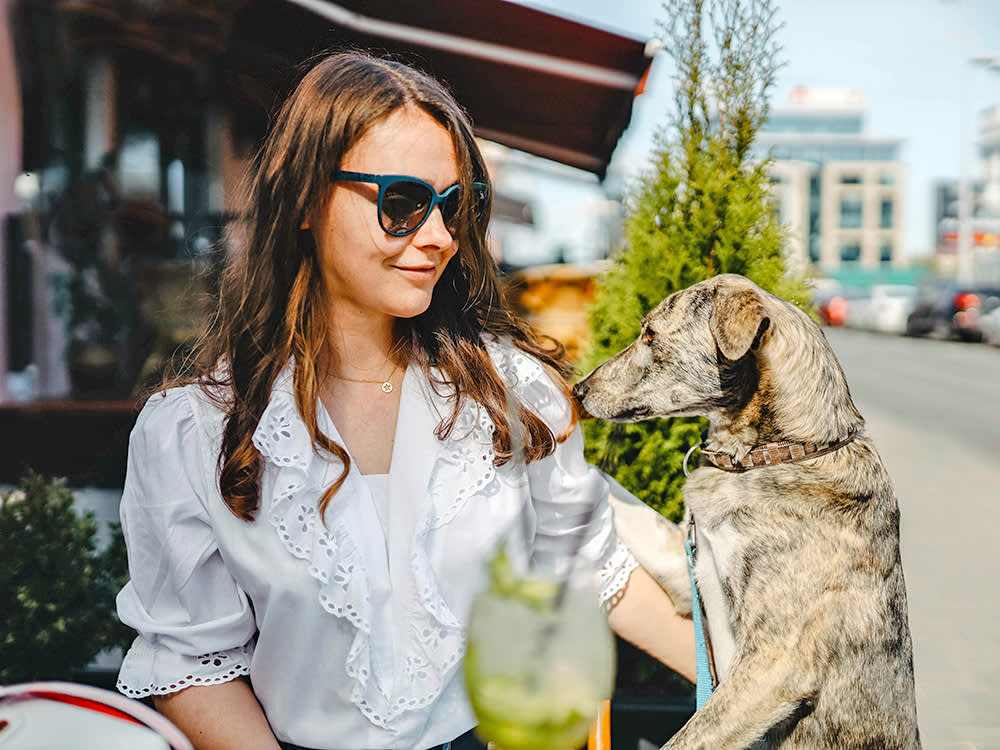
Watch a dog have a bad time at a restaurant and you’ll notice something. It almost never falls apart at minute forty.
It falls apart at minute one. The walk through the patio past three tables of strangers. The chair scraping. The waiter appearing overhead. The dog standing, vibrating, scanning, with nowhere to be and no idea what’s expected. By the time you’ve been handed a menu, your dog is already over threshold, and the next hour is you managing a dog who has never been given a job.
Which means the entire problem is a ninety-second problem, and you can solve it before you ever leave the house.
The one skill that matters more than all the others
If your dog can do only one thing, make it this: settle on a mat.
Not “sit.” Not “stay.” A portable, generalised, lie-down-and-switch-off on a specific blanket, anywhere you put it.
Here’s why it beats everything else. A stay is a held position, and holding a position is effortful. Your dog is doing work the entire time, and eventually the work runs out, usually somewhere around the entrée. A settle is a place, and a place is restful. The mat tells your dog: this is your spot, nothing is going to happen, you are off duty.
It also travels. Under the table, behind your chair, wedged against a wall. Same mat, same meaning, wherever it lands.
Build it at home over a couple of weeks. Mat comes out, dog lies on mat, dog gets paid. Extend the duration. Move the mat to a different room. Move it while your dog is on it. Then add distraction: you standing up, you walking away, the doorbell.
The dog who has that mat has a restaurant. The dog who doesn’t is going to spend the meal freelancing.
The other three skills, briefly
They matter, they’re just downstream of the settle.
Loose-leash walking, because the fifteen feet from the pavement to the table is where most of the damage gets done.
“Leave it,” because something will hit the floor, and it may well be a chicken bone or a grape or a chocolate crumb. This one is a genuine safety cue, not a manners cue.
Polite greeting, because someone will stop to say hello, and a dog who jumps or plants their nose in a stranger’s lap is a dog who is about to cost you the patio.
The pre-game: what you do in the ten minutes before you leave
This is the highest-leverage thing in this article and almost nobody does it.
Run a short training session immediately before you walk out the door. Sixty seconds of nice leash-walking. Three or four reps of “leave it.” Put the mat down in a couple of different spots and have your dog settle on each one.
This does two jobs at once. It reminds your dog of the behaviours you’re about to need, so you’re not asking cold. And it tires their brain, which is a different and more useful kind of tired than a physical walk. A dog who has just done cognitive work settles far more readily than a dog who has just done cardio.
Then bring the things:
- The mat. Obviously.
- High-value treats, and more than you think. You’ll be paying continuously for the first ten minutes.
- A long-lasting chew or a stuffed food toy. This is the workhorse. A dog with a job that takes forty minutes is a dog you can eat a meal next to.
- Water, unless you’re certain the venue provides it.
Set them up to succeed, don’t test them
You are not trying to find out whether your dog can do this. You’re trying to make sure they can.
Go after real exercise. A long walk, a hike, a hard play session with a dog they like. Not thirty minutes before; ideally an hour or two, so they’ve cooled down and settled.
Go at their good hour. Every dog has a time of day when they’re naturally low-energy and a time when the zoomies arrive on schedule. Pick the first one. Do not book brunch for the hour your dog usually loses their mind.
Pick an easy venue. Quiet, spacious, genuinely dog-friendly rather than dog-tolerating. Avoid a packed patio for the first several outings. You want your dog under threshold, and a crowded, loud room takes them over it before you’ve sat down.
Keep the first trips short. A coffee. A single drink. Twenty minutes. Then leave while it’s still going well. Build up to a full meal over weeks, not on day one.
Now the ninety seconds
This is where the article earns its title. Three decisions, all made on arrival, all of which determine the next hour.
1. Pick the quietest spot in the space. Away from the kitchen door, away from the till, away from the through-route that staff use. Every person who walks within a metre of your dog is a decision your dog has to make, and you want to reduce the number of decisions.
2. Put the mat down before you sit down. Not after. Before you look at a menu, before you take your coat off. The mat goes down, the dog goes on it, the dog gets paid heavily. That’s the transaction that defines the meal.
3. Face them away from the entrance. This is the trick that changes everything and it costs nothing.
A dog facing the door is on sentry duty. Every arrival is an event they have to process, and they cannot switch off because their job is to monitor the threshold. Turn them ninety degrees so the door is behind them, and you have quietly relieved them of a shift they never asked for.
People spend six months on a stay and then seat their dog facing the front door of a busy café. The dog isn’t failing the training. The training was fine. You put them on watch.
During the meal: pay, and keep paying
The mistake here is treating good behaviour as the baseline and only intervening when things go wrong. That’s backwards, and it means the only attention your dog gets is for the things you don’t want.
Feed the calm. Drop a treat onto the mat when your dog is lying there doing nothing. Especially when they’re doing nothing. That’s the behaviour you’re buying, so buy it.
Pay for the check-in. When your dog looks up at you rather than at the person walking past, that’s exactly the choice you want and it should be enormously worth their while.
Stay ahead of it. Scan the room. A dog approaching, a toddler heading over, a tray of food going past at nose height. Get in front of these things rather than reacting to them. A treat scattered on the mat at the right moment is far cheaper than a recovery from a lunge.
Give them the chew when the food arrives. That’s the moment your attention leaves them entirely, and it’s the moment they most need something to do.
Sit in the same spot when you can. Familiarity does a lot of work here. A table your dog has settled at successfully three times is a table they’ll settle at again.
Know when to leave
Not every dog is going to be a patio dog, and that is completely fine.
If your dog is stressed, panting hard, unable to settle, whining, or fixating on the room, cut it short and go. No shame, no failure. Get the food to go.
Give it a few tries before you decide, because a first outing is not diagnostic and dogs improve fast once the pattern is familiar. But if the answer after several attempts is that your dog hates this, believe them. They’re not being difficult. A busy restaurant is a hard place for a lot of dogs, and there is nothing wrong with a dog who would rather be at home.
And even the best-adjusted dog will have an off day. They might be a bit unwell. There might be a storm coming that they can feel and you can’t. Something might smell wrong. It’s not a referendum on your training.
Bottom line
Nobody has a dog who is bad at restaurants. People have dogs who are bad at arriving at restaurants, which is a much smaller and much more fixable problem.
Teach the settle. Train for sixty seconds before you leave. Pick the quiet corner, put the mat down before you sit, and face your dog away from the door.
Then order something. They’ll be asleep by the time it arrives.
References
- American Veterinary Society of Animal Behavior. “Position Statement on Humane Dog Training,” 2021. https://avsab.org/wp-content/uploads/2021/08/AVSAB-Humane-Dog-Training-Position-Statement-2021.pdf
- “Behavioral Problems of Dogs.” MSD Veterinary Manual. https://www.msdvetmanual.com/behavior/normal-social-behavior-and-behavioral-problems-of-domestic-animals/behavioral-problems-of-dogs
- Riemer, Stefanie, et al. “Reinforcer Effectiveness in Dogs: The Influence of Quantity and Quality.” Applied Animal Behaviour Science, vol. 206, 2018, pp. 87–93. https://doi.org/10.1016/j.applanim.2018.05.016
- “People Foods to Avoid Feeding Your Pets.” ASPCA Animal Poison Control Center. https://www.aspca.org/pet-care/animal-poison-control/people-foods-avoid-feeding-your-pets
Dr. Kohl is a board-certified veterinary dentist with a particular interest in preventive oral care. She reviews all dental health content at The Pet Times and contributes practical guides on home dental routines, professional cleaning, and oral disease prevention.
Meet our experts ↗Keep reading
 LivingDon't Teach Your Dog to Swim. Teach Them to Get Out.Dr. Priya Nair · 8 min
 TrainingPlaytime Is Secretly Training. 6 Dog Games That Teach While You Both Have FunSasha Ford · 8 min
 TrainingStop Steering. The Walk Is the One Thing Your Dog Should Get to Decide.Dr. Lena Park · 7 min
 TrainingNo, You Don't Need a Show Dog to Compete in ObedienceTom Hadley · 7 min
 TrainingYes, Your Dog Can Learn to Skateboard. It's Just Shaping in Disguise.Claire Sutton · 5 min
 Training'Spin' Looks Impressive. It's the Easiest Trick You'll Ever Teach.Sasha Ford · 5 min