


Stop Steering. The Walk Is the One Thing Your Dog Should Get to Decide.
Giving a dog choices sounds like permissiveness. It isn't. Agency is a specific, bounded practice with measurable effects on stress and confidence, and the leash is where most of us quietly take it away.

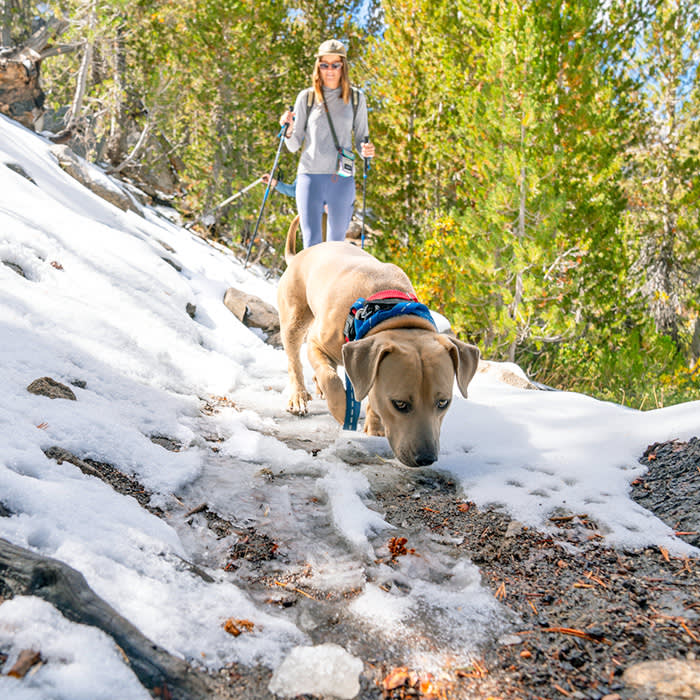
Here is a thing you did today without noticing. Your dog stopped to sniff something, and you kept walking, and the leash tightened, and the dog gave up and followed.
That is a small moment and it is also the whole subject. We talk about giving dogs “choices” as though it means letting them run the household, and the objection writes itself: I am not letting a Labrador pick the dinner menu. But agency, in the animal-welfare sense, is much narrower and much more specific than that, and the effect it has on a dog is measurable. The place most people accidentally strip it out is not the couch or the dinner bowl. It is the eight-minute walk where the dog has a nose and no vote.
Agency is not permissiveness. It is control over the small stuff.
The definition worth using: an animal has agency when their own behavior reliably changes what happens to them. Not everything. Just enough that acting on the world is worth doing.
In practice that means offering options and then honoring the answer:
- Hold up two toys, take the one they reach for.
- Close a treat inside each fist, offer both, and open whichever one they nose first.
- On a walk, let them pick the direction, and when they stop to sniff, stop with them until they are finished rather than tugging them onward.
- At home, make several options available, beds, the couch, different rooms, different people, and then simply leave them alone about where they choose to spend their time.
Every one of those is bounded. You chose the two toys. You chose the block. You chose which rooms exist. The dog chooses within the frame, and the frame is yours. Nothing about this requires you to lose an argument with your dog.
What the choice actually does to them
They engage with the world instead of bracing against it. An animal with agency approaches a new place as a set of possibilities and behaves in an exploratory, flexible way. An animal without it becomes preoccupied with what is about to be done to them, which shows up as reactivity, withdrawal, and rigidity. The same dog, in the same park, is a different dog depending on whether their behavior has ever changed the outcome there.
They are less stressed, because uncertainty is the stressor. Lack of control is one of the most reliable ways to make an animal anxious. A dog who can choose their route can steer away from the thing that bothers them, the running lawnmower, the dog barking behind the fence on the corner. That is the obvious version. The subtle version is that they are also free to investigate smells you cannot perceive and to check out something new, which converts an unpredictable environment into one they are actively sampling. Uncertainty drives stress. Control relieves it, and that is a health outcome, not a mood.
They get better at things. A dog interacting with the environment on their own terms is gathering information and building skills they will use later. Confidence is not something you can give a dog by telling them they are good. It is the residue of having made choices that worked out.
They stop being frustrated with you. A huge share of whining, barking, and pestering is a dog who wants a thing and cannot get it because a human keeps intercepting. Offer the stuffed Kong or the puzzle toy and let them pick, and the exasperated noise stops, because they got the one they wanted. (Though, realistically, they may want both.)
The leash is where it goes wrong
If you only change one thing, change the walk, because the walk is the highest-frequency place where a dog’s preferences get overruled, dozens of times per outing, mostly on autopilot.
The evidence here is unusually clean. In a controlled study, dogs who spent two weeks doing nosework, where they were allowed to search and use their noses freely, became measurably more optimistic on a cognitive bias test, approaching an ambiguous stimulus faster than before. The control group, who did heelwork for the same two weeks and were not allowed to search, did not change. Same dogs, same duration, same handlers. The only difference was whether the dog got to use their nose on their own terms.
Read that again, because it is the whole argument in one experiment: the freedom to sniff changed how the dogs interpreted an ambiguous situation. Not their obedience. Their outlook.
When a client tells me their dog is anxious and pulls constantly, one of the first things I ask is who is deciding where the walk goes. If the answer is always the human, we have found something we can change this week, for free.
What you get out of it, which is the part people skip
A dog who can express a preference gives you something you cannot otherwise get: data.
If your dog consistently picks one training treat over another, use the one they pick, and your training gets more effective immediately. If you learn which way they want to walk, you have found their preferred route, and you can just take it. If you notice which bed they actually sleep in, out of the three you own, you know which one to buy next time.
This is what makes the whole thing collaborative rather than indulgent. You are not surrendering. You are getting feedback, and using it to be a better read on what your dog actually wants, which is a great deal easier than guessing and being wrong for eleven years.
How to run it this week
- Do one “dog’s choice” walk. No destination. They pick every turn, they sniff as long as they want, you follow. Fifteen minutes is plenty.
- Offer two, honor one. Two toys, two treats, two beds. Whatever they pick is the answer, every time, without negotiation.
- Do not interrupt a settled dog. If they chose a spot and are lying in it, that was the choice. Leave them there.
- Bound it explicitly. Choice does not extend to traffic, to the road, to the stranger’s picnic, or to whether they get their medication. You still hold the frame.
What newer research adds
The sniffing finding is holding up and getting broader. More recent work comparing scentwork classes with traditional obedience classes has continued to find welfare benefits on the scentwork side, which fits the underlying explanation: the dog is not just tired afterward, they have spent the hour doing something they got to direct.
The takeaway for a normal week is not that you need to enroll in a nosework class. It is that the sniffing your dog is already trying to do, on the walk you are already taking, is the activity in question. You do not have to add anything. You have to stop cutting it short.
References
- Duranton, C., and Horowitz, A. “Let me sniff! Nosework induces positive judgment bias in pet dogs.” Applied Animal Behaviour Science, 2019. https://www.sciencedirect.com/science/article/abs/pii/S0168159118304325
- “Effects of scentwork and traditional training classes on dog welfare, behavior, and human-dog bond.” Applied Animal Behaviour Science, 2026. https://www.sciencedirect.com/science/article/pii/S0168159126000158
- Špinka, M. “Animal agency, animal awareness and animal welfare.” Animal Welfare, 2019. https://www.cambridge.org/core/journals/animal-welfare
- American Veterinary Society of Animal Behavior. “Position Statement on Humane Dog Training.” https://avsab.org/resources/position-statements/
Dr. Park is a board-certified emergency and critical care specialist. She reviews our health and safety content for clinical accuracy and contributes guides on recognising urgent conditions. Her focus is helping owners act quickly and correctly when it matters most.
Meet our experts ↗Keep reading
 TrainingYour Herding Dog Has No Sheep. Give It Eight Exercise Balls Instead.Marcus Webb · 6 min
 TrainingPlaytime Is Secretly Training. 6 Dog Games That Teach While You Both Have FunSasha Ford · 8 min
 TrainingYour Dog Doesn't Fail at Restaurants. They Fail in the First 90 Seconds.Dr. Nina Kohl · 7 min
 TrainingNo, You Don't Need a Show Dog to Compete in ObedienceTom Hadley · 7 min
 Training'Spin' Looks Impressive. It's the Easiest Trick You'll Ever Teach.Sasha Ford · 5 min
 LivingADHD Doesn't Make You a Bad Dog Parent. Your Reminder App Does.Leila Torres · 8 min