


ADHD Doesn't Make You a Bad Dog Parent. Your Reminder App Does.
The guilt is the wrong target. If your brain drops tasks, the fix isn't trying harder at a routine that depends on remembering, it's removing the memory step entirely. Including for the one care task where forgetting is genuinely dangerous.

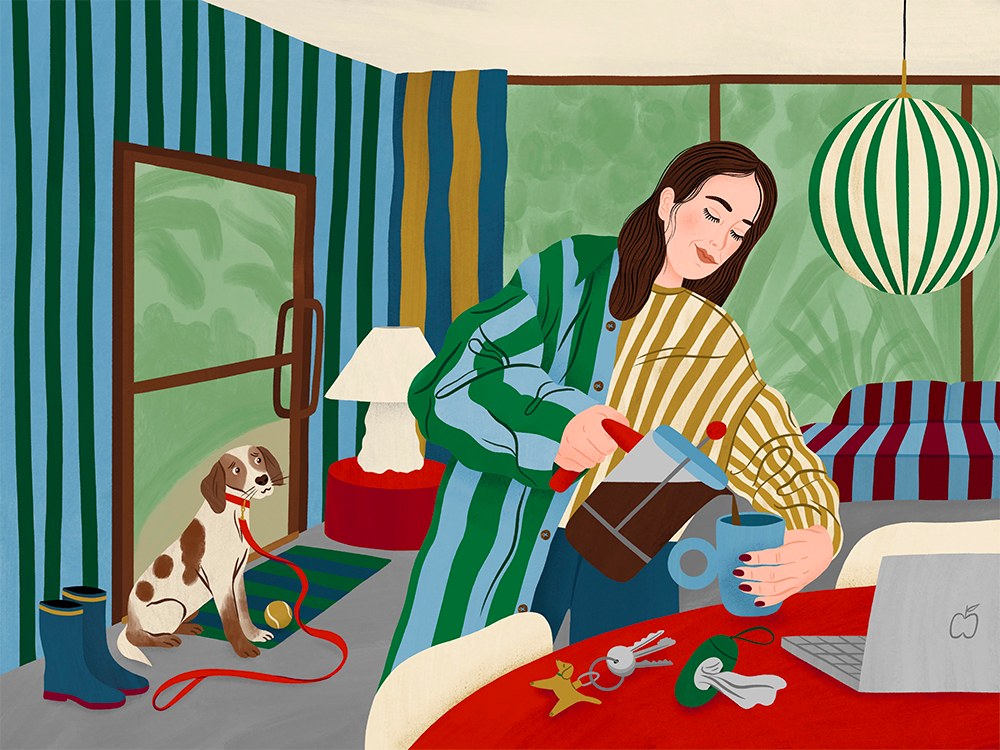
Here’s the moment, and if you have ADHD you already know it.
The harness is on. The leash is clipped. The treat pouch is on the hook. The dog is at the door, vibrating. And then you notice the laundry, or the dishwasher, or a tab you left open, and thirty minutes later the dog is still standing at the door and you are still in the kitchen, and you have no memory of deciding not to go.
The dog eventually comes to find you. And that is the moment the guilt lands.
Most writing about ADHD and pet care wants to console you about that guilt. This isn’t that. The guilt is real and it is also a distraction, because it points you at the wrong problem. You do not have a character defect that a dog is quietly forgiving you for. You have an executive function difference that makes any routine dependent on remembering structurally unreliable. The answer is not to remember harder. It is to build a system in which remembering is not a required step.
That reframing matters, because it moves this from a moral failure you apologize for to an engineering problem you solve. And it is solvable.
The one that actually matters, before anything else
Let’s start where the stakes are, because most ADHD-and-pets advice starts with feelings and never gets to the thing that can actually hurt your dog.
The care task most vulnerable to a brain that loses track of time is the monthly preventative. Heartworm, flea, and tick prevention are dosed on a schedule that assumes you will notice that a month has gone by, and time blindness is precisely the inability to notice that a month has gone by. Miss enough of them and you are not looking at a tidiness problem. You are looking at heartworm disease, which is expensive, dangerous, and grueling to treat.
If that’s your failure mode, do not solve it with a better reminder. Solve it by removing the monthly decision from your life.
Ask your veterinarian about an injectable extended-release heartworm preventative. ProHeart 12, a moxidectin injection given at the clinic, is FDA-approved to prevent heartworm disease for a full 12 months in dogs 12 months and older, and in trials it was 100 percent effective across that year. It also treats existing larval and adult hookworm infections. There’s a six-month version as well. It is not right for every dog, and your vet will want to talk through your dog’s health history first, but for a person whose brain does not do monthly, it converts twelve chances to fail into one appointment a year.
That single swap does more for your dog than any amount of self-improvement.
For flea and tick, look at longer-interval chews and collars rather than monthly ones, and put everything else on autoship so the box arriving is the reminder.
Why the guilt is worth putting down
The shame that comes with this is not incidental, and it has a name.
What most people describe as “I’m the worst dog parent” is closer to internalized ableism: chastising yourself for failing at a task your brain is not built to do the way you were told it should be done. And the guilt is not neutral. It doesn’t motivate. The spiral of dropping the ball, then punishing yourself for dropping the ball, tends to add anxiety and low mood on top of the original difficulty, which makes the next task harder rather than easier. The shame is not a corrective. It’s a tax.
This lands hardest on women and on people raised as girls, who are diagnosed later and less often, are pushed harder toward masking, and arrive at adulthood with a perfectionism problem stacked on top of an attention one. The result is an impossible standard applied to a brain that was never going to meet it, and then rejection sensitive dysphoria turning every ordinary miss into evidence of total failure.
Two things are true at once. Your systems need work. You are not a bad person, and you are almost certainly a better dog parent than you think, because people who hold themselves to an impossible standard are, as a rule, the ones already doing the most.
“Dogs are far more adaptable to an imperfect routine than their people believe,” says Dr. Nina Kohl. “What they struggle with is unpredictability that comes with tension. A walk that happens at a slightly different time every day is fine. A household where the human is visibly distressed about the walk is the part the dog notices.”
Build the scaffolding: what actually works
Everything below is designed on one principle. Do not build a system that requires you to remember. Build one where the environment remembers for you.
Attach dog tasks to things that already happen
Willpower-based routines fail. Attached ones survive. The technique is to bolt the new task to an existing anchor that already happens without effort: the coffee maker, brushing your teeth, the shower, locking the front door.
The training version of this is the highest-yield trick in the whole list. Do not schedule a daily training session, because a scheduled session is a thing you will fail to do and then feel bad about. Instead, bring the dog into a routine you already reliably complete. Practicing a stay? Take the dog into the bathroom while you brush your teeth and hold the stay for the two minutes you’re already standing there. That is a real, repeated, daily rep, and it costs you nothing, because you were going to brush your teeth anyway.
Do the hard dog work when your brain is actually online
Everyone with ADHD has a window when the machinery works. For a lot of people it’s the morning. For some it is emphatically not.
Find yours, then put anything requiring focus, patience, or consistency inside it: training, nail trims, medication, grooming, vet calls. And stop scheduling those things for the end of the day, when you have two functioning brain cells left and both of them are assigned to feeding yourself and getting to bed. You are not failing at 8pm training. You are scheduling training at a time your brain has closed.
Make time visible, because you cannot feel it
Time blindness is not carelessness. It is the genuine inability to perceive elapsed time, and it is why a dog can stand at a door for thirty minutes without you registering it.
The fix is external and physical. A tracking system you mark, not one you consult. A whiteboard on the fridge with a box you check at each feeding tells you, instantly and without any recall effort, whether the dog has eaten. A wall calendar where you cross off the walk. Analog timers you can see counting down. The rule is that the information has to live outside your head, where it can be looked at rather than remembered.
Use a body double
Body doubling, doing a task in the presence of another person, is one of the most reliably effective ADHD tools there is, and it maps onto dog care almost perfectly.
Find a walking buddy and the walk stops being a task you must initiate. It becomes a plan you’d be breaking. If nobody’s available in person, call or text a friend, tell them you’re taking the dog out, and ask them to stay on the phone while you do it. It sounds absurd until you try it, and then it works.
Run the two-coach argument on purpose
When the critical voice starts up, the useful move is not to fight it. It’s to give it an opponent.
Coach A is the one saying you’re the worst dog parent alive because you promised the dog a snuffle mat session and then went out. Coach B’s job is to say the true thing: that you’re doing your best today, that the dog is fine, that the missed enrichment session is a small thing in a life full of care. Let them argue. Coach A eventually runs out of material.
This is not positive thinking, and it isn’t about believing Coach B. It’s about not letting Coach A hold the floor uncontested, because the uncontested version is what turns a small miss into a lost afternoon.
Automate the stuff that doesn’t need you
Take a hard, unsentimental look at your dog’s care and separate the tasks that genuinely require your attention from the ones that only require someone’s.
Feeding: an automatic feeder on a timer removes the task entirely, and removes the dog’s uncertainty with it. If your dog is used to waiting at the top of the stairs for the sound of the food bin, that’s a dog managing your executive function for you, and they should not have to.
Water: a fountain with a large reservoir buys you days instead of hours.
Medication and preventatives: autoship, plus a pill organizer, plus the injectable option above where it applies.
Vet appointments: book the next one before you leave the building, while the receptionist is standing there. Not later. Later is not a real time.
Enrichment: a rotating bin of stuffed frozen toys prepared in one hyperfocus session on a Sunday will carry you through a month of days when you cannot possibly assemble one. Your hyperfocus is not a bug here. It’s a manufacturing capability. Use it in batches.
The thing to actually take from this
Good enough is not a consolation prize. In parenting research, and in the experience of most people who’ve had to learn it the hard way, “good enough” is the target. The perfect version was never available to anybody.
Your dog does not have a comparison group. They are not measuring you against an imaginary owner with a color-coded feeding chart. They are living the life they have, which, if they are fed, walked, protected from heartworm, and loved, is a good one. Dogs are extraordinarily forgiving of an imperfect schedule. They are much less forgiving of a missing preventative, and that is exactly the thing you can hand to a syringe and a calendar and never think about again.
Fix the systems. Put the guilt down. It was never load-bearing.
What’s new since this was written
Two developments are worth knowing about if you’re building this scaffolding now.
The first is that long-interval parasite prevention has expanded significantly. Beyond the annual heartworm injection, there are now flea and tick products dosed every three months rather than monthly, which means the whole parasite-prevention category, historically the most memory-dependent part of dog care, can be reduced to a handful of events a year instead of dozens.
The second is that adult ADHD diagnosis has risen sharply, which means a lot of people are arriving at this problem in their thirties and forties, having spent decades assuming they were simply disorganized. If that’s you, and you are only now connecting the dropped dog tasks to a diagnosis, the useful thing to know is that none of the strategies above require you to become a different person. They require you to stop designing your dog’s care as though you already were one.
References
- U.S. Food and Drug Administration. “FDA approves ProHeart 12 (moxidectin) for prevention of heartworm disease in dogs.” Link
- McTier, T.L., et al. “ProHeart 12, a moxidectin extended-release injectable formulation for prevention of heartworm disease in dogs in the USA for 12 months.” Parasites & Vectors, 2019;12:369. Link
- American Heartworm Society. “Heartworm basics.” Link
- Centers for Disease Control and Prevention. “ADHD in adults.” Link
- Attention Deficit Disorder Association. “Rejection sensitive dysphoria and ADHD.” Link
- CHADD (Children and Adults with Attention-Deficit/Hyperactivity Disorder). “Women and girls with ADHD.” Link
Leila Torres leads our Living coverage, from home life and travel to the products and rescue stories that come with sharing a life with animals. She edits and writes across the section, with a soft spot for pieces about the bond between people and their pets.
Meet our experts ↗Keep reading
 Training'Spin' Looks Impressive. It's the Easiest Trick You'll Ever Teach.Sasha Ford · 5 min
 TrainingPlaytime Is Secretly Training. 6 Dog Games That Teach While You Both Have FunSasha Ford · 8 min
 TrainingYour Herding Dog Has No Sheep. Give It Eight Exercise Balls Instead.Marcus Webb · 6 min
 TrainingNo, You Don't Need a Show Dog to Compete in ObedienceTom Hadley · 7 min
 TrainingYour Dog Doesn't Fail at Restaurants. They Fail in the First 90 Seconds.Dr. Nina Kohl · 7 min
 LivingDon't Teach Your Dog to Swim. Teach Them to Get Out.Dr. Priya Nair · 8 min