


Your Herding Dog Has No Sheep. Give It Eight Exercise Balls Instead.
Treibball is urban herding: you direct your dog to push giant balls into a goal from a distance. It was invented by accident, it demands almost nothing of you physically, and it's the rare sport built for the dog who's destroying your house from boredom.

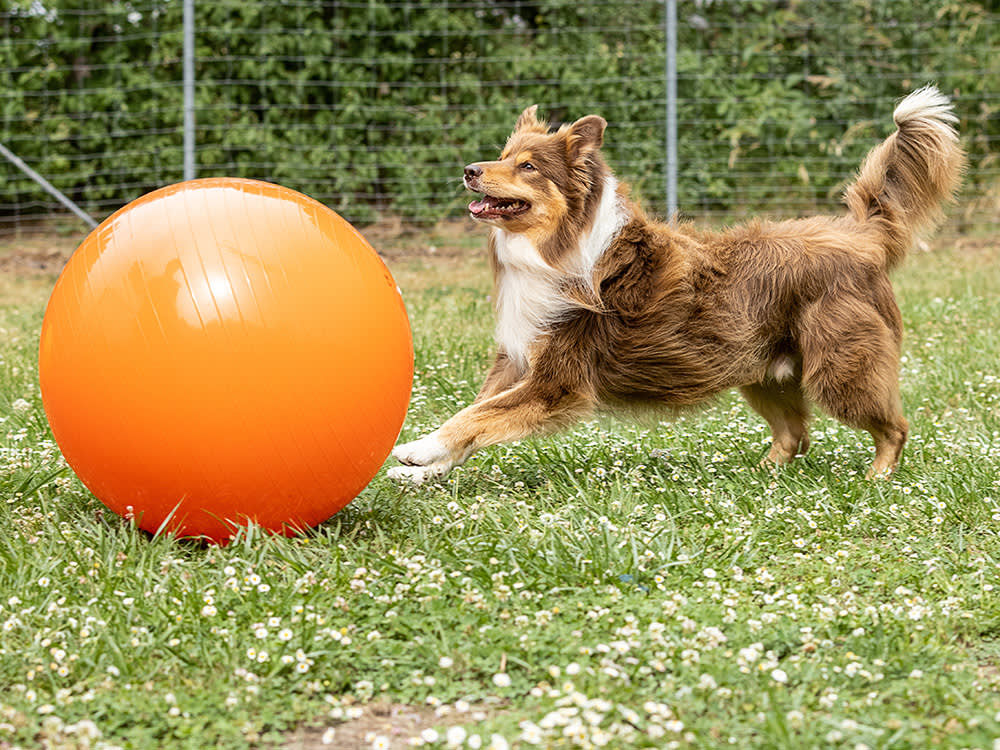
Most of us do not have sheep. This is the great unspoken tragedy of the modern herding dog, who was engineered over centuries for a job that your apartment does not contain, and who will therefore attempt to herd whatever is available: the children, the other dog, the cat, you.
There is a sport designed for exactly this problem, and almost nobody has heard of it.
It is called Treibball (pronounced “try ball”), and it is best described as urban herding. From a distance, you direct your dog to push large exercise balls into a goal, the way a shepherd directs a dog to move sheep into a pen. The balls are the sheep. The dog does not appear to care about the distinction.
It was invented by dogs, essentially
The origin story is my favorite thing about it.
In 2005, the Dutch dog trainer Jan Nijboer was watching his Australian Cattle Dogs after a herding lesson. The dogs, who had finished the actual work and still had energy to burn, had started pushing their rubber water dishes around the field. They had, unprompted, invented a game.
Nijboer wondered whether they would push something bigger. He tried large exercise balls. The dogs took to the new “sheep” immediately.
He introduced it to his herding students, and it spread across Europe and then to the United States. Sweden hosted the first international Treibball competition in 2007. The American Treibball Association was founded after its founder, Dianna Stearns, came across drive-ball videos in 2009, and the National Association of Treibball Enthusiasts launched in 2010, both of them explicitly built around dog-friendly, positive-reinforcement training.
That is not incidental to the sport. It is a defining feature of it, and it is worth understanding why.
The sport that does not need you to be athletic
Here is what makes Treibball genuinely unusual, and it is the reason it deserves more attention than it gets.
All dogs are welcome, regardless of breed or age. You do not need a Border Collie. You do not need a young dog.
And, crucially: Treibball makes almost no physical demands on the handler. The distance skills and verbal cues are similar to agility, but you are not running. You stand in one place and direct. Which means people of any age and any athletic ability can play, including people for whom agility or flyball is simply not on the table.
Sit with the significance of that. The dogs who most need a job are frequently owned by people who cannot physically match their energy. Treibball is one of the very few sports that resolves that mismatch directly: the dog runs, the handler thinks.
Why it works on the dog who is wrecking your house
The behavioral case here is strong, and it is not really about exercise.
A large share of the behavior problems trainers get called about trace back to the same root: bored dogs, expected to lie quietly while their people watch television. Most dogs are problem-solvers. They have intelligence and drive, and if there is no legitimate outlet for either, it gets funneled somewhere: destructive chewing, digging, barking, fence-running.
Treibball attacks that at the source, because it is a thinking game, not a running one.
The dog has to be directed to a specific ball, depending on where that ball has rolled. Both dog and handler are continually correcting their positioning. It is a genuine, continuous problem-solving exercise for both of you, and it is the mental work that tires a dog out in the way physical exercise alone never quite does.
It also builds something specific and valuable: off-leash reliability at a distance. You spend the entire sport asking a dog to take direction from twenty, thirty, forty feet away. That skill does not stay in the ring.
The dogs I see with the worst behaviour problems are almost never under-exercised. They are under-employed. There is a difference. You can walk a Border Collie into the ground and it will come home and reorganise your furniture, because you tired out the legs and left the brain running. Treibball is one of the few things that makes a dog think hard from a standing start, and it does it in a garden.
What the training actually looks like
You do not start with a ball, and everyone is disappointed by this.
Like every canine sport, it is built on foundation skills first. Expect to spend the early sessions on things like:
- Sends to a mat from a distance, starting at around fifteen feet and building.
- Downs on cue at varying distances, which is the brake pedal for the whole sport.
- Targeting objects on direction, so the dog learns to go to the thing you indicate rather than the thing they fancy.
Only once those are solid does the ball appear.
And one rule that catches a lot of dogs out: the dog drives the ball with the nose only. A dog that bites the ball is eliminated in competition. If your dog has a retrieving background and habitually grabs targets with its mouth, that is a habit you will have to work through, and it is worth knowing before you start.
If your dog already has a sport background, in agility or disc, you will find your existing cues do not map cleanly onto the Treibball maneuvers. Most handlers end up doing some translation work, matching up cues the dog already knows to the new positions. That is normal, and it is part of the fun.
Who this is really for
High-energy dogs whose people cannot match their activity level. That is the honest core of the audience, and it is a large one. Our sedentary lives are frequently at odds with the level of activity a working-bred dog needs to be well.
Herding breeds without livestock, obviously. But the sport is genuinely open, and a mixed-breed dog with an opinion and some drive will do fine.
Suburban and city dogs, who have the least access to space and the most need for something to do.
And handlers who cannot run. This is the group most poorly served by dog sports generally, and Treibball is one of the few real answers.
What newer thinking adds
The broader shift in dog training over the last decade has been away from “tire the dog out” and toward giving the dog a job, and Treibball sits neatly inside it.
The evidence has been accumulating that mental work and problem-solving are more effective at satisfying a dog than physical exercise alone, and that a dog with agency, one that is solving something rather than merely being moved through a routine, is a measurably better-off dog. Scent work has become the flagship example of this, and it is now widely recommended for reactive and anxious dogs precisely because it engages the brain without demanding a high-arousal state.
Treibball belongs in that same category, and it has one thing scent work does not: it is a herding job, for a dog built to herd. For the right animal, that is not a substitute for the real thing. It is close enough that they cannot tell.
Whether you compete or just do it in the garden, the proposition is the same. Your dog has a set of skills, honed over centuries, that your life has no use for.
Give them eight inflatable sheep and stand back.
References
- American Treibball Association. https://americantreibballassociation.org/
- National Association of Treibball Enthusiasts. https://www.natedogs.com/
- Duranton, C., and Horowitz, A. “Let me sniff! Nosework induces positive judgment bias in pet dogs.” Applied Animal Behaviour Science, vol. 211, 2019. https://www.sciencedirect.com/science/article/abs/pii/S0168159118303411
- Rooney, N. J., and Cowan, S. “Training methods and owner–dog interactions: Links with dog behaviour and learning ability.” Applied Animal Behaviour Science, vol. 132, 2011. https://www.sciencedirect.com/science/article/abs/pii/S0168159111000797
- American Veterinary Society of Animal Behavior. “Position Statement on Humane Dog Training.” https://avsab.org/resources/position-statements/
Marcus Webb writes about the gear, gadgets, and everyday choices that make life with a pet easier. His coverage runs from product picks to training and the causes worth paying attention to, always with an eye on what actually earns a place in your home.
Meet our experts ↗Keep reading
 Training8 Ways to Be the Dog Owner Your Building Doesn't Complain AboutMarcus Webb · 8 min
 TrainingBefore You Cut a Hole in Your House, Answer This: What Else Can Fit Through It?Marcus Webb · 8 min
 LivingThe Only People Who Should Own a Husky Walk 11 Miles a DayMarcus Webb · 7 min
 TrainingStop Steering. The Walk Is the One Thing Your Dog Should Get to Decide.Dr. Lena Park · 7 min
 TrainingStop Chasing Your Dog. That's Why Fetch Isn't Working.Jordan Ellis · 9 min
 LivingDon't Teach Your Dog to Swim. Teach Them to Get Out.Dr. Priya Nair · 8 min