


8 Ways to Be the Dog Owner Your Building Doesn't Complain About
Shared walls, shared elevators, shared patience. A trainer's playbook for keeping the peace with neighbors, from the leash rules to the one that actually prevents the barking complaint before it starts.

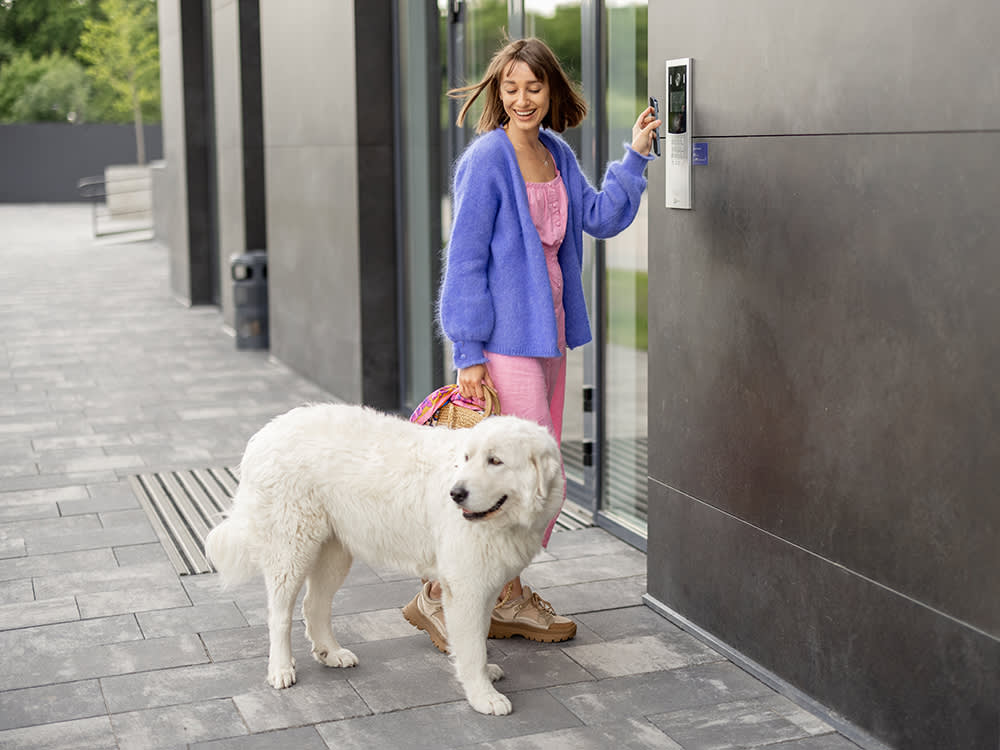
Living well with a dog in an apartment building is mostly an exercise in managing other people’s experience of your dog, not your dog’s experience of the building. Your neighbors do not see the goofy, lovable animal you see. They see a strange dog in a shared elevator, hear paws thundering overhead at 7 a.m., and field the barking that starts the moment you leave for work. Almost every neighbor complaint traces back to one of a handful of avoidable situations, and the good news is that all of them are things you can get ahead of. Here is the playbook, ordered roughly from the easiest wins to the one that prevents the complaint you’re most likely to actually receive.
1. Treat the leash as non-negotiable in every shared space
Lobby, elevator, stairwell, hallway, the ten feet between your door and the trash room: leash on, every time. This is not about whether your dog is friendly. It is about the fact that the people sharing those spaces did not sign up to interact with your dog, and some of them actively don’t want to.
“The mistake well-socialized dog owners make is assuming everyone shares their enthusiasm,” says Tom Hadley, a trainer who works with city dogs. “Your dog being a happy, social animal is great. It is also completely irrelevant to the neighbor who is allergic, or afraid, or simply doesn’t want fur on their work clothes. Their comfort sets the rule, not your dog’s friendliness.”
Plenty of people would rather not be greeted by a dog, for reasons that are entirely theirs to have. A leash makes the interaction opt-in instead of opt-out, which is the whole point.
2. Ask before any dog meets any dog
Spotting another dog in the building is not an invitation. The other animal may be reactive, recovering from surgery, in training, or simply having a bad day, and you have no way of knowing from across the lobby.
“Permission comes before everything when two dogs are about to share space,” Hadley says. “Even dogs who know each other can get territorial in and around home turf. The hallway outside someone’s door is their dog’s doorstep, and dogs guard doorsteps.” A careless nose-to-nose introduction in a tight corridor can frighten a dog, trigger a scuffle, and, just as costly, chip away at your own sociable dog’s confidence after one bad encounter. If two owners genuinely want their dogs to meet, do it on a neutral walk outside together, where neither dog is defending home ground.
3. Give yourself room at the elevator and the door
For a reactive or over-excitable dog, the elevator is a trap: a small metal box that may open onto anything. Build in a buffer. Call the car, then take a few steps back so you can read who steps out before you commit.
“Press the button, then create distance,” Hadley says. “You want the option to let a car go and wait for the next one. A few feet of space is the difference between managing the situation and reacting to it.” If you’re working with a jumpy dog, keep treats on you and use a well-fitted harness for control, and at high-traffic hours, take the stairs if your dog can handle them. The stairwell is almost always emptier, and it counts as exercise for both of you.
4. Lay down a rug, for the floor below you
Sound travels straight down. The zoomies that look adorable in your living room land as a thunderstorm in the apartment beneath you. A large, thick rug is the single cheapest piece of acoustic diplomacy you can buy, and many buildings now require renters to cover a percentage of hard flooring precisely for this reason.
A rug muffles the symptom. If the zoomies are constant, treat the cause too: a dog tearing laps around the apartment at night is usually a dog with unspent energy, and an extra walk or a real session at the park does more for your downstairs neighbor than any amount of carpet.
5. Solve barking by figuring out why, not by saying “no”
This is the complaint you are most likely to hear, and it is the one that punishment makes worse. Dogs bark for distinct reasons, demand, alarm, boredom, anxiety, and the fix depends entirely on which one you’re dealing with.
“Scolding a barking dog often backfires, because to the dog, your attention is the reward,” says Dr. Priya Nair, a veterinary behaviorist. “If the bark is a demand for attention, even negative attention pays it off. The behavior gets stronger, not weaker.” For demand barking, the move is to remove the payoff entirely: leave the room or calmly take the dog out of the situation, so the bark earns nothing. Structured time-outs can help, but Dr. Nair adds an important caveat, “a time-out is only fair, and only effective, once the dog’s exercise, mental stimulation, and enrichment needs are genuinely met. A bored, under-walked dog isn’t being naughty, it’s telling you something.” And never accidentally pay the bark off: hand over food the instant a dog barks for it, and you have just taught a very reliable lesson.
6. Build a dog who is okay being alone
Separation distress is the engine behind most chronic apartment barking, and it is more common than owners assume. Studies put the prevalence of separation-related behavior in dogs somewhere in the range of 13 to 29 percent worldwide, and the problem is especially visible in apartments, where thin walls turn one dog’s anxiety into the whole floor’s problem. Rates climbed further in the years after pandemic lockdowns reset many dogs’ expectations about how often their humans should be home.
The fix is to make your departure predict something good rather than something scary. “Pair leaving with a payoff the dog only gets when you go,” Dr. Nair says. “A reserved special chew or a stuffed puzzle that appears the moment you pick up your keys reframes your absence as the best part of the day.” The most effective options are the ones that occupy the mind: a lick mat, a frozen stuffed Kong, a slow-release puzzle feeder. For dogs with genuine separation anxiety rather than mild boredom, build alone-time gradually and loop in a behaviorist, because true separation anxiety rarely resolves on willpower alone.
7. Desensitize the building’s own noises
Here is the step the standard etiquette list skips, and it prevents a whole category of barking before it starts. Apartment dogs don’t just bark from boredom; they bark at the building, the hallway footsteps, the elevator chime, the neighbor’s door, the buzzer, the package delivery. Every one of those is a trainable trigger.
“Apartment living hands your dog a hundred mystery sounds a day, and a dog who finds them alarming will announce each one,” Dr. Nair says. “You can take the charge out of them.” Play recordings of knocks, buzzers, and hallway noise at a low volume while feeding your dog something excellent, then slowly raise the volume over days. The goal is for the buzzer to predict a treat instead of an intruder. Pair it with a “place” cue, sending the dog to a specific mat when the buzzer sounds, and you convert your noisiest trigger into a calm routine. This one takes a couple of weeks of five-minute sessions, and it pays off every single day after.
8. When the dog wins, apologize like a neighbor
Even with everything above dialed in, your dog is still an animal, and animals have thunderstorms, bad nights, and meltdowns you can’t fully prevent. When it happens, get ahead of the resentment with a small human gesture.
“A bottle of wine and a short, good-humored note does more for neighbor relations than any training plan,” Tom Hadley says. “Something like, ‘Sorry about the racket, the storm got the better of us, we’re working on it.’ It signals you know, you care, and you’re trying.” A neighbor who believes you are a considerate person extending genuine effort will forgive an occasional bad night. A neighbor who thinks you don’t notice or don’t care will file a complaint. The difference is often one friendly note.
References
- Salonen, Milla, et al. “Prevalence, Comorbidity, and Breed Differences in Canine Anxiety in 13,700 Finnish Pet Dogs.” Scientific Reports, vol. 10, 2020, article 2962. https://doi.org/10.1038/s41598-020-59837-z
- de Assis, Luciana Santos, et al. “Developing Diagnostic Frameworks in Canine Separation-Related Problems.” Frontiers in Veterinary Science, vol. 7, 2020. https://doi.org/10.3389/fvets.2020.00499
- American Veterinary Society of Animal Behavior. “Position Statement on the Use of Punishment for Behavior Modification in Animals.” https://avsab.org/resources/position-statements/
Marcus Webb writes about the gear, gadgets, and everyday choices that make life with a pet easier. His coverage runs from product picks to training and the causes worth paying attention to, always with an eye on what actually earns a place in your home.
Meet our experts ↗Keep reading
 LivingADHD Doesn't Make You a Bad Dog Parent. Your Reminder App Does.Leila Torres · 8 min
 TrainingYour Herding Dog Has No Sheep. Give It Eight Exercise Balls Instead.Marcus Webb · 6 min
 TrainingPlaytime Is Secretly Training. 6 Dog Games That Teach While You Both Have FunSasha Ford · 8 min
 LivingDon't Teach Your Dog to Swim. Teach Them to Get Out.Dr. Priya Nair · 8 min
 TrainingStop Chasing Your Dog. That's Why Fetch Isn't Working.Jordan Ellis · 9 min
 TrainingStop Steering. The Walk Is the One Thing Your Dog Should Get to Decide.Dr. Lena Park · 7 min