


No, You Don't Need a Show Dog to Compete in Obedience
The obedience ring looks like a members-only club for purebreds and pros. It isn't. Here is how mixed-breed shelter dogs and nervous first-timers actually get started, with Rally-O as the on-ramp.

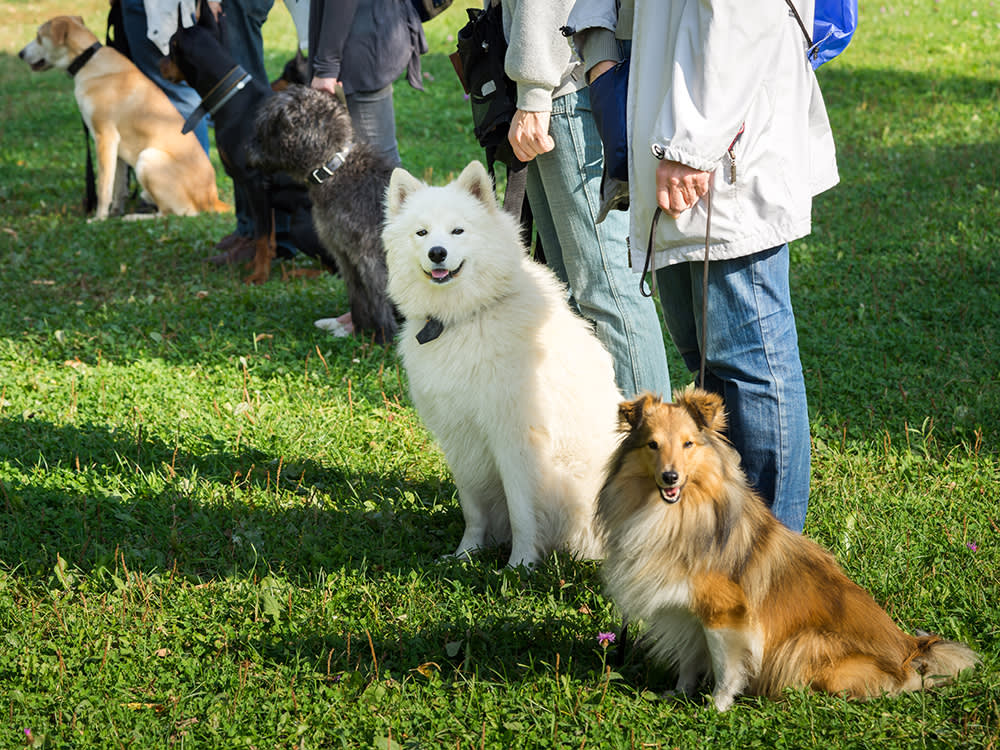
Watch a good obedience team work and it looks like sorcery. A nod of the head, a sweep of the arm, and the dog snaps into a heel, a halt, a down, the two of them gliding through the judge’s calls in perfect sync while a small crowd murmurs its approval. Then you look down at your own dog, who is currently ignoring “sit” in favor of a fascinating smell, and the whole enterprise feels like a different species of pet ownership entirely.
Here is the reframe this piece is built on: that polished team is not the price of admission. It is the far end of a road that starts with an ordinary dog and an owner who decided to try. You do not need a purebred, a trophy shelf, or a background in dog sports. Plenty of the dogs earning titles are shelter mutts, and plenty of their handlers started exactly where you are, unable to get a reliable “stay.” The magic is not breeding. It is the relationship, and that is something you can build.
The scoreboard is not really the point, and the best handlers know it. What obedience training actually builds is a dog that trusts your signals and an owner who has learned to give clear ones. Do that with a rescue mutt and a folding chair in your backyard, and you have already got the thing the ribbons are just a receipt for.
What obedience really is
Strip away the pageantry and obedience is a set of exercises that show off controlled communication between a handler and a dog. Depending on the level, the skills can include sit, down, stand for exam, recall, heel, retrieve, jump, and scent work, and the difficulty climbs as you move up through the classes, commonly named Novice, Open, and Utility.
Three threads run through every level. Control shows up everywhere, especially in heeling and in a dog’s response to spoken commands or, as a team advances, silent hand signals. Agility of a basic kind appears at the Open level, where the dog clears jumps. And scent work waits at the top, in Utility, where a dog has to find the one article carrying the handler’s scent in a pile and bring back the right one.
Crucially, the door is open to mixed breeds. The American Kennel Club is the biggest and best-known venue and welcomes both purebreds and mixed breeds into its programs. Beyond it, mixed-breed dogs can compete through the American Mixed Breed Obedience Registry, the Australian Shepherd Club of America, St. Hubert’s Companion Dog Sports Program, and the United Kennel Club. If someone tells you your rescue is not eligible, they are wrong.
The methods got a lot kinder
It helps to know how much the sport has changed, because the old version earned its scary reputation. Into the 1970s, dogs were often trained with punishment-avoidance, the so-called “jerk and pull” approach, on the theory that a negative consequence would produce the behavior. It worked for some dogs and failed plenty of others.
The shift came from trainers willing to question it. One influential pioneer, working with a Shetland Sheepdog in that era, realized that choke collars and withheld praise were getting her nowhere, and that food was a superb motivator, only to be told she could not bring treats to class. Her dog performed beautifully with food at home and miserably without it in the room. The lesson she drew, that there had to be a better way, helped push the whole sport toward motivation over intimidation.
Over the last couple of decades, operant conditioning and clicker training have taken that further, breaking a complex exercise into small pieces a dog learns step by step, rather than expecting the finished behavior all at once. Trainers have written entire books on shaping obedience this way. The upshot for a beginner is simple: the modern version of this sport is something a dog can genuinely enjoy.
Rally-O: the low-stress way in
If formal obedience still sounds intimidating, this is your entry point. The AKC and the Association of Pet Dog Trainers offer Rally-O, a faster, looser take on the classic exercises, run in a low-key atmosphere that still keeps the scorekeeping. The judge designs a course of numbered signs, and you and your dog move station to station performing whatever each sign asks. The best part for anxious newcomers: instead of standing stiff and silent, you are allowed to use your body and talk to your dog, cheer them on, keep them loose. It is designed to give a dog and handler ring experience without the pressure of the formal Novice ring, and the exercises map directly onto what a Novice title requires.
Why bother, even if you never compete
The honest answer is that the ribbons are a side effect. The real return is the bond. Handlers who have put in thousands of hours describe a way of growing together with their dogs that is hard to get any other way, and dogs who train get to travel, focus, and share experiences most pets never have.
But you do not have to enter a single trial to collect the benefit. An obedient dog simply gets a bigger life. A dog whose recall is rock solid can be trusted off leash in the right places, can run in a field or the woods and come back, can be a dog more fully because it can be trusted. Training is not about control for its own sake. It is what lets you safely give a dog more freedom, which is arguably the most loving thing you can do for one.
So if you have ever watched an obedience team and felt that mix of awe and “not for me,” reconsider. Find an instructor you click with, start with Rally-O and a few basics, and let your ordinary dog surprise you. The gap between your living room and that ring is smaller than it looks, and every step across it makes your dog’s everyday life better.
Tom Hadley writes about training and behavior, helping owners understand what their pets are trying to tell them. His work covers everyday manners, decoding common behaviors, and the small changes at home that make dogs and cats easier to live with.
Meet our experts ↗Keep reading
 Training'Spin' Looks Impressive. It's the Easiest Trick You'll Ever Teach.Sasha Ford · 5 min
 TrainingStop Steering. The Walk Is the One Thing Your Dog Should Get to Decide.Dr. Lena Park · 7 min
 TrainingPlaytime Is Secretly Training. 6 Dog Games That Teach While You Both Have FunSasha Ford · 8 min
 TrainingYour Dog Doesn't Fail at Restaurants. They Fail in the First 90 Seconds.Dr. Nina Kohl · 7 min
 Training8 Ways to Be the Dog Owner Your Building Doesn't Complain AboutMarcus Webb · 8 min
 LivingADHD Doesn't Make You a Bad Dog Parent. Your Reminder App Does.Leila Torres · 8 min