


Your Dog Doesn't Know It's 5 O'Clock. It Knows You.
Dogs seem to read the clock, waiting at the bowl or the door right on cue. The science says they're not tracking time so much as tracking a mix of biology, senses, and, mostly, you.

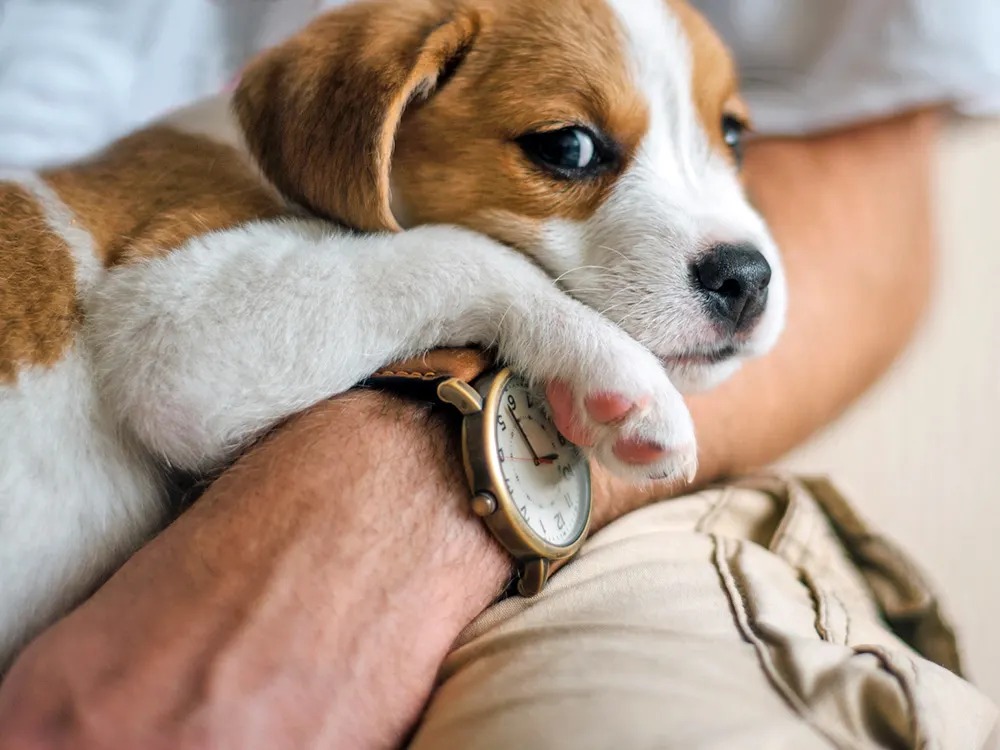
It’s 4:59, and your dog is already parked by the bowl, ears up, watching you. At 5:01 it paws the bowl with the impatience of a diner whose reservation is running late. It happens with walks, with bedtime, with your arrival home. For an animal that doesn’t own a watch, your dog keeps an unnerving schedule.
The tempting explanation is that dogs have some internal clock ticking off the hours. The more interesting, and better-supported, answer flips the frame: your dog isn’t really reading time at all. It’s reading its body, its environment, and above all, it’s reading you. The 5 o’clock alarm going off next to the food bowl is mostly a very good read on the human in the kitchen.
First, the honest caveat
Studying an animal’s sense of time is genuinely hard. A dog can’t tell you what it feels, so researchers are stuck watching behavior and inferring what’s behind it, and it’s easy to ask a question the dog is answering differently than you think. Comparative-cognition scientists are careful about this precisely because the risk of reading in too much is high.
So the picture below is built from a modest body of research plus a lot of careful inference. What comes through clearly is that “can dogs tell time” doesn’t have one answer. It has at least three overlapping ones.
One: the body keeps rough time on its own
The most basic layer is biology. Circadian rhythms drive hunger, sleep, and energy in dogs just as they do in people, so it’s easy to imagine hormones and other internal signals nudging a dog toward “it’s about time to eat” as its stomach empties on a familiar cycle.
There’s also good evidence dogs handle a second kind of timing, called interval timing, the sense of how long a duration lasts. In lab work, dogs trained to earn a treat by pressing a button learned to hold off when the machine was rigged to withhold the reward until a full minute had passed. As the minute wound down, they’d ramp their pressing back up, timing their effort to the payoff. Some got visibly baffled when the rules changed, glancing between the machine and their person as if to say the thing was broken. That’s not clock-reading, but it is a real, trackable sense of elapsed time.
Dogs clearly register durations, that part is well supported. What people mistake for clock-reading is usually something richer: a dog stitching together its own hunger, the light in the room, and a hundred little signals from us into a prediction. They’re not counting minutes. They’re reading the whole scene.
Two: the senses catch cues we miss
Then there are the moments biology can’t explain, like a dog waiting at the door as you pull up even when you get home at wildly different times. That’s not an internal clock. That’s a sensory system far sharper than ours picking up on the world.
Dogs’ hearing and smell operate at a level that sometimes exceeds our understanding of how they even use them. A dog may clock the specific engine note of your car blocks away, notice the uptick in street traffic as a neighborhood full of commuters heads home, track the angle of the sun, or read the way scents in the house fade over the day. One researcher described a childhood dog that would emerge from hiding about thirty seconds before she got home each day, most likely tuned to the distinctive rattle of her old car. To us it looks like the dog knew the time. Really, the dog caught a cue we couldn’t.
Three: mostly, dogs are reading us
The biggest factor may be the one that’s easiest to overlook: our own routines. Dogs are exceptional pattern learners, and much of the pattern they’re learning is you. They track which event tends to follow which, and a startling amount of their day is organized around our habits, not their own internal schedule.
Your dog may “know” it’s breakfast time because it smells coffee and hears you moving in the kitchen. It may know a walk is coming when you ask a smart speaker for the weather and reach for your shoes. Each little action is a domino, and your dog has memorized the chain. That’s also why routines are so calming for dogs: a predictable day tells a dog its needs will be met on schedule, so it can settle instead of staying vigilant. Interestingly, attentiveness seems to matter more than breed here, a dog that’s deeply tuned to its person likely has a sharper sense of “time” than one that pays less attention, simply because it’s reading more cues.
So, can dogs tell time?
The satisfying answer is that it’s all of the above at once. Dogs almost certainly perceive time through biology, senses, and social routine woven together, and there’s still a great deal we don’t understand about how they experience the world. But the next time your dog materializes at the bowl on the dot, you can retire the idea of a little clock in its head. Maybe it’s hungry. Maybe it clocked the sun dropping. Most likely, it noticed you close the laptop, and it knows exactly what you do next.
What this means for you
There’s a practical upshot. If your dog gets anxious around a certain time of day, or seems to start fretting well before you leave, the fix usually isn’t about the clock, it’s about the cues. Because dogs read our patterns so closely, the small pre-departure rituals we do without thinking, grabbing keys, putting on shoes, a particular sigh, can become anxiety triggers all on their own. Shuffling or softening those cues, and keeping the genuinely important routines, food, walks, rest, steady and predictable, does more for a dog’s sense of security than any attempt to explain the time to them ever could.
References
- Silver, Z. A., et al. Occidental College Canine Cognition Lab. https://www.oxy.edu/academics/areas-study/cognitive-science
- Macpherson, K., and Roberts, W. A. “Do dogs (Canis familiaris) understand physical time?” Comparative cognition research, Western University. https://www.uwo.ca/psychology/
- Roberts, W. A. “Are animals stuck in time?” Psychological Bulletin, 2002, 128(3), 473–489. https://doi.org/10.1037/0033-2909.128.3.473
Common questions
Can dogs actually tell time?
In a loose sense, yes. Dogs don't read clocks, but research shows they track durations and anticipate regular events using a blend of body signals, environmental cues, and learned routines. They perceive the passage of time, just not in numbers.
How does my dog know when I'm about to come home?
Usually through cues you don't notice: the sound of a familiar car, a shift in neighborhood activity as commuters return, changing light, or fading scent. Dogs are extraordinary at picking up patterns in their environment and in you.
Why do dogs do so well with a routine?
Routines give a dog predictability, and predictability is comforting. When a dog knows food, walks, and rest arrive at reliable points in the day, it can relax instead of staying on alert for the next thing.
Dr. Chen is a small-animal veterinarian who leads health and safety coverage at The Pet Times. She writes and reviews the bulk of our illness, condition, and safety content, translating clinical guidance into clear, practical advice owners can act on at home.
Meet our experts ↗Keep reading
 TrainingYour Dog Isn't Being Dominant. You Trained It to Steal the Bed.Dr. Mara Chen · 7 min
 LivingYour Dog Is a TV Critic, and Their Reviews Depend on Their PersonalityDr. Lena Park · 4 min
 LivingYour Dog Has Two Beds Because They Have Two Kinds of SleepDr. Ravi Mehta · 7 min
 TrainingYour Dog's Toy Stash Is Adorable. The Growl Over It Isn't.Marcus Webb · 7 min
 TrainingYour Dog Isn't Ignoring the TV. They're Seeing a Different Show.Dr. Ravi Mehta · 8 min
 TrainingStop Rushing the Sniffs. Your Dog's Nose Is Doing Real Work.Jordan Ellis · 6 min