


Your Dog's Toy Stash Is Adorable. The Growl Over It Isn't.
Hoarding is a harmless, funny quirk right up until it turns into resource guarding, and most owners never notice the line being crossed. Here's where it is, and the one rule that keeps you on the right side of it.

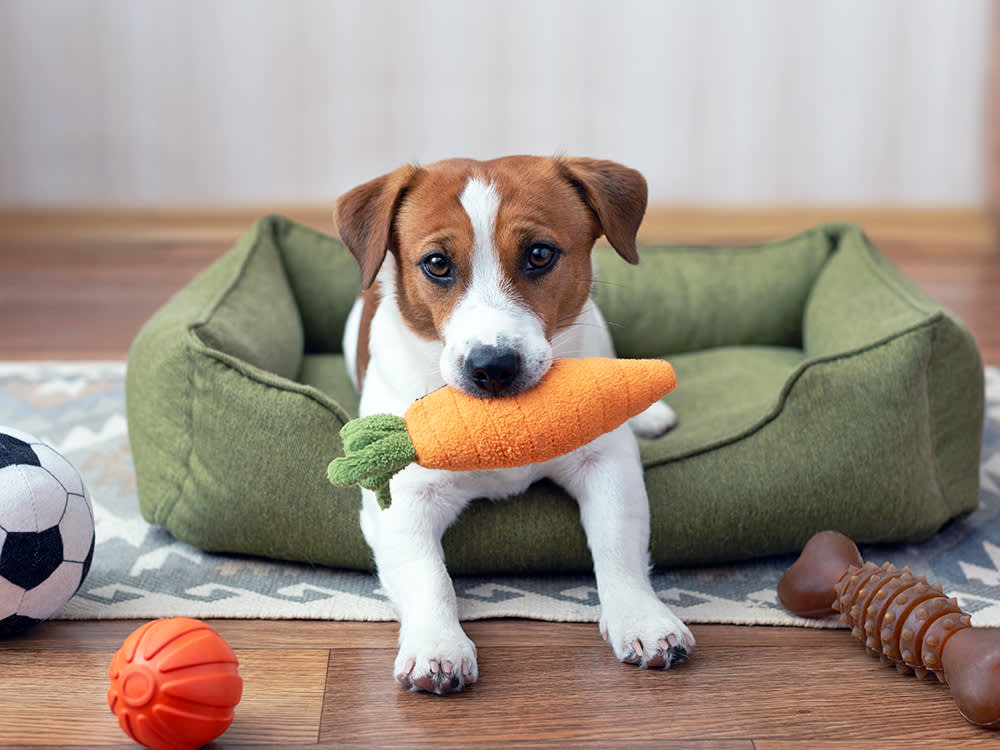
There is a genre of internet video where a Golden Retriever fits seven toys in his mouth at once, or a Frenchie assembles his entire collection on the bed and glares at anyone who approaches. It is, correctly, one of the great pleasures of being online.
Toy hoarding is a real behavior, it’s mostly harmless, and it’s genuinely charming.
But there is a line running through the middle of it that almost nobody talks about, and it’s the only part of this subject that actually matters. On one side is a dog who has a pile of stuff. On the other is a dog who will hurt you over the pile of stuff.
The behaviors look nearly identical from a distance. The difference is not in the collecting. It’s in what happens when you walk toward it. And the reason this deserves an article rather than a caption is that the second thing usually develops out of the first, quietly, while everyone is laughing.
First, why they do it
There’s no research literature on canine toy hoarding specifically, which is worth saying up front. It isn’t a common enough behavior to have attracted a study, and everything below is a well-founded theory rather than a finding. Four explanations cover almost every case.
1. Caching, inherited
Wild canids bury and stash surplus food. It’s an ancient, efficient behavior: secure the resource, come back for it later. Domestic dogs still carry the wiring, which is why a dog will bury a chew in the couch cushions with elaborate, imaginary nose-shovelling, and why the “den” they choose is nearly always a bed or a crate.
If your dog carries objects one at a time to a specific spot and then checks on them, that’s caching. It’s the same software running on very different hardware.
2. Scarcity, learned
This is the one that tells you something about your dog’s history.
A dog who once had to compete for resources, in a litter that was too big, in a shelter, on the street, sometimes learns that anything good is temporary. The response is to secure it. Rescue dogs and dogs with unknown early histories are over-represented here, and it can show up months after adoption, once the dog has enough good things to be worth protecting.
This is also the category most likely to slide into guarding, for obvious reasons. A dog who stashes because they once went without is a dog for whom the stash means something.
3. Hormones
Less known, and genuinely useful.
An unspayed female dog experiencing a pseudopregnancy, a hormonally normal false pregnancy following a heat cycle, will often gather soft objects and treat them as puppies. She’ll carry them carefully, arrange them in a nest, mother them, and become upset when they’re taken away.
The tell is the specificity: it’s soft, puppy-sized, puppy-shaped things, treated with a particular tenderness rather than possessiveness. If your unspayed female dog has suddenly begun collecting plush toys and nesting with them, this is very probably what’s happening, and it’s worth a vet visit rather than a training plan.
4. Smell, and the smell is you
The reason your dog’s stash contains your socks.
Dogs collect things that smell like the people they’re bonded to. Socks, laundry, shoes, a slipper, the sleeve of a jumper. This is why the hoard so often looks less like a toy box and more like an archive of you. Newly adopted dogs do it particularly hard, and it’s one of the more touching things they do.
(The breed question, which everyone asks: yes, retrievers seem to over-represent. Goldens, Labs, and doodles were bred to carry objects gently in their mouths and deliver them somewhere. It would be strange if that didn’t show up in the living room. But the behaviorists who see this clinically don’t strongly associate it with any breed, and the internet’s sample is not a random one.)
Now the line
Here’s the part that matters.
Hoarding is about acquisition. Guarding is about defence. They can look the same for months and then diverge sharply, and the moment of divergence is usually missed because everyone is charmed.
Watch what your dog does when you approach the stash.
Still fine:
- Collects, arranges, checks on the pile, sleeps near it.
- Watches you approach with interest, or gets up and follows you.
- Lets you pick something up, maybe reclaims it afterwards.
- Brings you things from the pile.
The early warning signs, in escalating order:
- Freezing. The dog goes still. Chewing stops. This is the first one and the most commonly missed, because a still dog looks calm.
- Hard eye. A fixed stare, often with the whites showing at the corners.
- Stiffening over the object. The body lowers and tightens; the dog places themselves between you and the stash.
- Eating faster, or lip-curling. Speeding up is a guarding behavior. So is a lip lifted just enough to show a tooth.
- A growl.
- A snap, then a bite.
The critical thing about that ladder is that it is a communication system, and it works from the top down. A dog freezes because they hope it will be enough. If freezing doesn’t make you stop, they escalate.
Never punish a growl
This is the single most important sentence in this article, and it’s the mistake that turns a manageable problem into a hospital visit.
A growl is information. It is your dog telling you, clearly and without violence, that they are uncomfortable and would like you to stop. It is the last warning before the bite.
If you punish the growl, shout, loom, grab, “assert dominance,” you do not remove the discomfort. You remove the growl. You teach your dog that warning you is dangerous, and the next dog you meet is one who goes from stillness straight to teeth with nothing in between.
Vets and trainers call this the silent biter, and it is made, not born. Every “he bit with no warning” story is, very often, a story about a dog whose warnings were punished out of them.
So: if your dog growls over their stash, do not correct it. Back away. Then go and fix the underlying problem, which is that your dog does not believe good things are safe around you.
The dogs that scare me are not the growlers, they’re the freezers. A growl is a dog still willing to negotiate. A dog who has learned that growling gets them shouted at has stopped negotiating, and the next thing they offer you is a bite. When an owner tells me proudly that they trained the growl out of their dog, my heart sinks, because what they’ve actually done is disable the smoke alarm.
The trade rule, which fixes almost everything
Here is the practical policy, and if you take one behavior away from this piece, take this:
Never take something from your dog for free.
Every single time you remove an object from your dog, trade it. Approach with something better, cheese, chicken, a piece of hot dog, offer it, let them drop the item to take it, then pick the item up.
What this does, repeated over weeks, is rewrite what your approach means. Right now, in a guarding-prone dog, you walking toward their stuff predicts loss. After a few hundred trades, you walking toward their stuff predicts the arrival of something better. A dog who believes that has no reason to guard, because your hand is now the best thing that happens to their toys.
The corollaries:
- Don’t take things just to prove you can. The old advice about taking your dog’s food bowl away mid-meal to establish dominance is not just outdated, it actively creates guarders. You are demonstrating precisely the thing the dog is afraid of.
- Give them enough stuff. Scarcity drives guarding. A dog with plenty of toys, plenty of chews, and a reliable food supply has less to defend. If your dog stashes because they were once deprived, the answer really is more toys, not fewer.
- Give the stash a home. A bed or a crate the dog can retreat to with their things, that nobody, including children, is allowed to reach into. A dog with a genuinely safe place needs to defend it less, not more.
- Teach “drop” and “leave it” properly, on a low-value object, paid generously, long before you ever need them on a high-value one.
When to get help
Call in a qualified behavior professional, a certified behavior consultant or a veterinary behaviorist, if:
- Your dog has growled, snapped, or bitten over an object, ever.
- The stash is being defended from other pets in the house.
- There are children in the home. This is not a wait-and-see situation.
- The collecting has become frantic or compulsive: the dog can’t settle, can’t be redirected, is distressed when an item is missing, and isn’t doing anything else with their day.
That last one is worth flagging separately. A dog who is obsessively carrying and rearranging, to the exclusion of eating, playing, and interacting, may be showing a compulsive behavior driven by stress, anxiety, or boredom rather than a happy quirk. Compulsive disorders in dogs are real, they respond to treatment, and they’re worth a conversation with your vet.
What newer research adds
The most relevant recent work isn’t about hoarding, it’s about toy attachment, and it reframes the question usefully.
Researchers studying dogs’ relationships with individual toys have found that dogs can develop something that looks a great deal like a genuine preference for and attachment to specific objects, recognising them, seeking them out, and choosing them over identical alternatives. That is not the same as an addiction, and it doesn’t mean a dog with a favourite toy has a problem. But it does support the idea that the objects in the pile have real meaning to the dog, rather than being interchangeable stuff.
Which is the whole argument for the trade rule. If the toy genuinely matters to your dog, then taking it for free genuinely costs them something, and a dog who is repeatedly made to lose things they value is a dog learning to defend them.
Pay for it. Every time.
FAQ
Is toy hoarding bad for my dog? On its own, no. It’s a normal, harmless quirk for most dogs. It only becomes a problem if the dog starts defending the stash, or if the collecting becomes compulsive and crowds out everything else.
My dog growls when I go near his toys. What should I do? Back away calmly, do not punish the growl, and start working on trades: never remove an object without offering something better. If there has been any growling, snapping, or biting, get a qualified behavior professional involved rather than working through it alone.
Should I take toys away to stop the hoarding? No. Scarcity is one of the things that drives guarding. A dog with plenty of toys has less to defend than a dog with three.
My unspayed female dog has started collecting plush toys and nesting. Is that normal? It may well be a pseudopregnancy, a hormonally driven false pregnancy after a heat cycle. It’s common, and it’s worth a vet visit rather than a training plan.
References
- “Resource Guarding in Dogs.” American Veterinary Society of Animal Behavior. https://avsab.org/resources/position-statements/
- “AVSAB Position Statement on Humane Dog Training.” American Veterinary Society of Animal Behavior. https://avsab.org/wp-content/uploads/2021/08/AVSAB-Humane-Dog-Training-Position-Statement-2021.pdf
- “False Pregnancy in Dogs.” VCA Animal Hospitals. https://vcahospitals.com/know-your-pet/false-pregnancy-in-dogs
- “Compulsive Disorders in Dogs.” VCA Animal Hospitals. https://vcahospitals.com/know-your-pet/compulsive-disorders-in-dogs
- “Spaying and Neutering.” American Veterinary Medical Association. https://www.avma.org/resources/pet-owners/petcare/spaying-and-neutering
Marcus Webb writes about the gear, gadgets, and everyday choices that make life with a pet easier. His coverage runs from product picks to training and the causes worth paying attention to, always with an eye on what actually earns a place in your home.
Meet our experts ↗Keep reading
 TrainingSix Weeks of Crate Rest Will Break You Both. Give the Dog a Job Instead.Dr. Nina Kohl · 8 min
 TrainingYour Dog Doesn't Fail at Restaurants. They Fail in the First 90 Seconds.Dr. Nina Kohl · 7 min
 TrainingYour Dog Doesn't Know It's 5 O'Clock. It Knows You.Dr. Mara Chen · 6 min
 LivingYour Dog Has Two Beds Because They Have Two Kinds of SleepDr. Ravi Mehta · 7 min
 TrainingYour Dog Isn't Ignoring the TV. They're Seeing a Different Show.Dr. Ravi Mehta · 8 min
 Living'All-Day Play' Is a Red Flag, Not a Selling PointJordan Ellis · 9 min